Shinji Kagawa. Hiroshi Kiyotake. Takashi Inui. Takumi Minamino. Yoichiro Kakitani. There’s no shortage of talents produced and nurtured by Cerezo Osaka – who are the fun side of J.League for neutral fans. Cerezo have always been available to be a joy for the eyes, less when it comes down to winning trophies (the first two came in 2017, but the number of lost finals for Cerezo is unbelievable).
Nevertheless, in the last years, the board has become pretty good in attracting good players, not only producing them. Take these last seasons: Tatsuhiro Sakamoto made the leap to J1 with Cerezo Osaka. Same happened with Satoki Uejo, who was torching defences in J2. And last Winter other fantasy players came along: Jordi Croux is a good example, Masaya Shibayama is another solid add from last Summer.
But if you add to that mix also Hirotaka Tameda, Hiroaki Okuno (a Swiss knife for every position), and other prospects on loan (Motohiko Nakajima and Jun Nishikawa)… it becomes impossible to find space on the pitch. And when your pitch time doesn’t give you a proper chance to show your talent, you need to leave. That’s why it must have been easy to assign the award for J2 League in the “Best Wish” category.
After exciting times in Kumamoto and Yamagata, Hikaru Nakahara couldn’t stay in Osaka. He needed to leave Cerezo, although on loan – and Tokyo Verdy represented a perfect match for him. With J1 League coming next year back at the National Stadium (this time in green), Nakahara might be the right card to play for a survival.
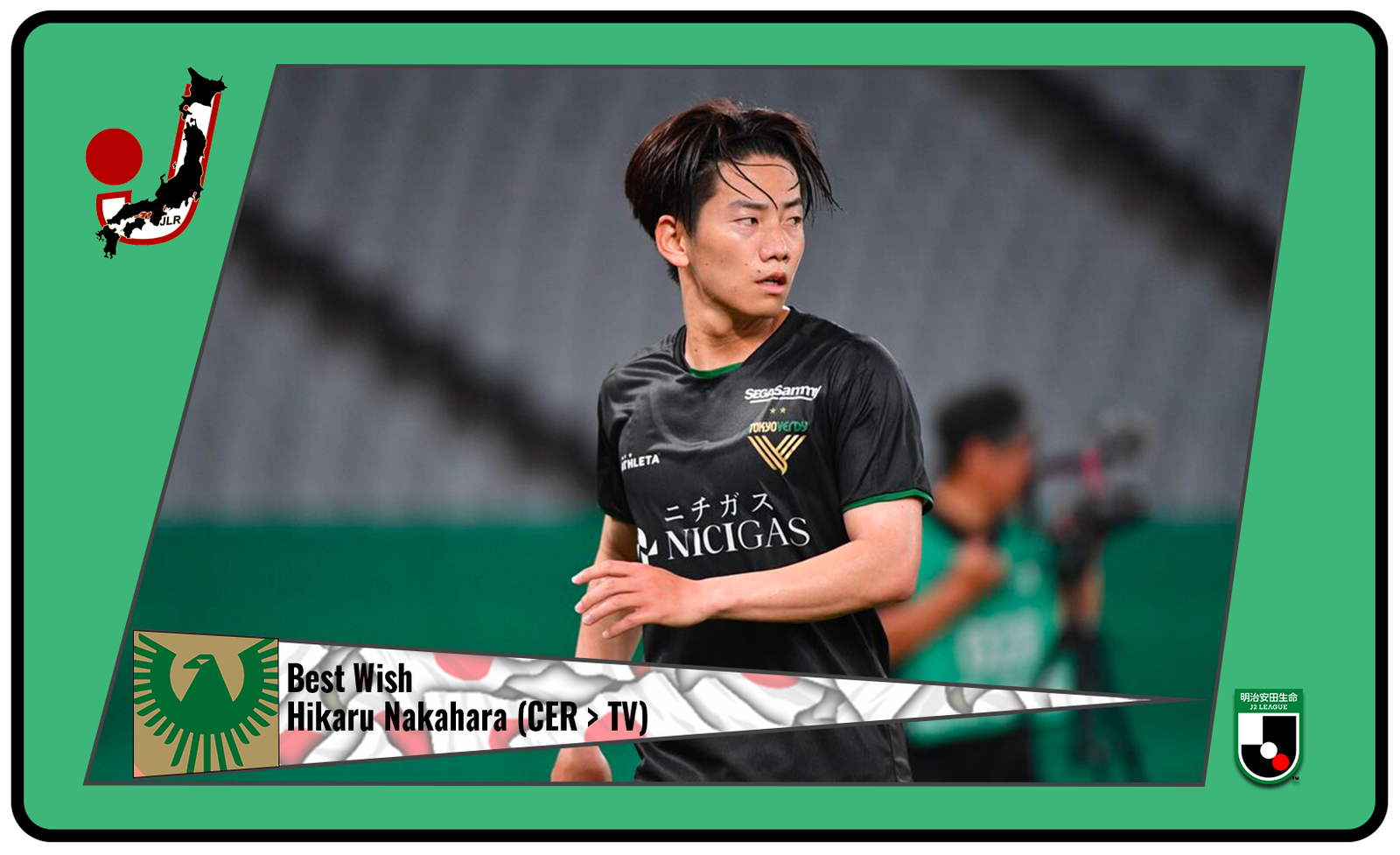
Climbing the ladder
Born in Yamaga, Kumamoto Prefecture, in the end Nakahara began as a pro in his home court. Takeshi Oki was looking a creative wing to place on the right flank and he nurtured Nakahara since the beginnings. He didn’t feature in Roasso Kumamoto’s youth ranks, but the winger had a nice stint with the Komazawa University.
A first year to learn, a second to definitely emerge as one of the most interesting talents in J3 League. Six goals and six assists to cement his profile, although Oki didn’t shy away from forming talents in all his stints on the bench throughout the J.League-sphere. Once Roasso failed to come back to J2 another time, second tier-clubs took note and made an offer for the winger.
That’s how Nakahara moved up North, signing for Montedio Yamagata. It took a bit as well for the winger to emerge, simply because Montedio faced a managerial chance. Kiyotaka Ishimaru gave Nakahara some minutes, but his successor Peter Cklamovski actually put the former Roasso player in the starting eleven. Nakahara immediately repaid the Australian head coach with decent performances.
In an offensive architecture and 4-4-2 by Cklamovski, Nakahara could be finally useful. He ended the campaign with six goals and six assists. And although Montedio couldn’t reach J1 – they ended seventh in the table –, someone took note. Nakahara took his chance to make another leap. This time to J1, joining Cerezo Osaka in the process.
Blossoming in Osaka – and then stop
On paper, the plan should have worked perfectly. Agio Kogiku needed to replace Tatsuhiro Sakamoto, who left that Winter for Belgium, joining KV Oostende. Nakahara seemed the perfect fit – a lefty playing on the right side of a 4-4-2. And he indeed gathered a lot of minutes, playing 27 J1 matches and even scoring in one of his first games in the Osaka derby in the J.League Cup.
But something didn’t work properly with Kogiku. Takashi Inui left mid-season in 2022 because of some disagreements with the head coach and Jean Patric decided to join Vissel Kobe in the process after a solid rookie season in Japan. Furthermore, Hiroshi Kiyotake ended massively sidelined because of injuries – so 2023 should have been a good year for Nakahara to solidify his position in the team.
Instead, from the last Winter, it was clear Kogiku wanted something else. Cerezo brought in Jordy Croux from Avispa Fukuoka to challenge Nakahara, plus Capixaba ended up being the replacement of Jean Patric. Then Shinji Kagawa decided to come back mid-2023, although he featured more as a central midfielder. If you take that into account and the few starting chances Nakahara got, a separation was needed for both parts.
When Nakahara didn’t have enough trust in rotations (never started in J1, always put in as a joker in the second halves), it’s clear he had to leave. And that’s where the perfect match came under the form of Hiroshi Jofuku – looking for reinforcements for his campaign run towards a return to J1 with Tokyo Verdy.
The grass is always greener
Despite the broad range of options at Cerezo Osaka, you can’t debate that a 27 years-old with his skills can’t just rotten in the bench. Nakahara needed a new start and he founded that in Tokyo, with Verdy there in need of empowerment. Nakahara didn’t lose any time, being decisive on his first outing – two assists and one goal for a 4-3 win away in Sendai against Vegalta.
Nakahara was crucial for Verdy, who needed more experience upfront – it’s not an accident if they brought in Nakahara on the right side and Tatsuya Hasegawa from Yokohama FC on the left. Verdy did that as well to cover the loss of many players who left this Summer – Mario Engels didn’t work out, Toyofumi Sakano moved to Imabari, and mostly Byron Vásquez moved within the city mid-season, signing for Machida Zelvia.
Jofuku could finally rely on another creative playmaker upfront, with Nakahara scoring five goals and providing four assists in 16 games – three goals in the last four to give Verdy the final push towards the play-offs. Then one of the two goals to win the semifinal of the play-offs against JEF United Chiba. Nakahara didn’t shine in the final against S-Pulse, but he was part of a historical feat.
And now? Coming back to Cerezo doesn’t seem a good idea – better burn that bridge. Being a starter with Verdy in J1 could give his career some fire. It’ll be up to Nakahara to prove himself in a tough environment; but if he’ll do that, the future can only be full of hope. Like green, the color which is mostly associated with.



[…] in J1 might not be relevant for his rebirth, but he clearly has the skills to be in that category. Here we explained how we came down to his restart in the green side of […]
[…] But losing Ren Kato to Marinos and not confirming Tatsuya Hasegawa and Hikaru Nakahara – two fundamental additions last Summer – might condemn them to a constant […]
[…] didn’t retain the loan of Hikaru Nakahara, who had a massive impact last Summer and now moved from Cerezo Osaka to Sagan Tosu. They needed another creative source and Miki will do […]