It’s not super easy to go through four decades of Japanese football and remain kinda relevant. Some men are called from history to shape the destiny of a country, even in certain environments. And to do so, you have two ways to fulfil your destiny: strength or grace. Tyrants and strong men prefer the first one, especially in politics; but even in sports, it’s hard to see the latter.
Our protagonist travelled around the country – between Yokohama, Kyoto, Osaka and Shizuoka – becoming a beloved legend. Not just loved though; “respected” is probably the right word. He played more than 1000 games; he gathered 152 caps for Japan and he’s the leading man for that. He appeared in the “Best XI” of J.League 12 times; while being nominated also the MVP of J.League for their 30th anniversary (from official sources and from us).
The list of accolades is long – both in his club and national team career -, but what strikes the most was his ability to stay a landmark this long. It’s like the place where he comes from – he was born in Sakurajima Town, the small settlement that lies below the Sakurajima volcano. And just like the volcano is always seeable, you couldn’t miss the greatness of this player.
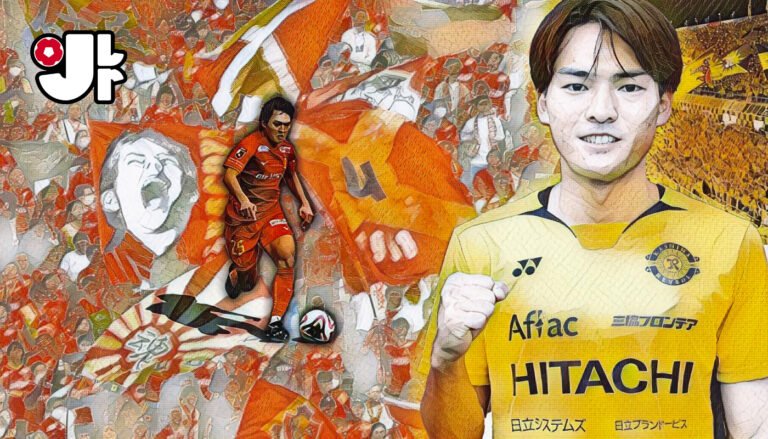
At 43 years old, Yasuhito Endo has probably been around for so long that two, or three different generations of J.League fans know him. He hasn’t been as flashy as Kazuyoshi Miura; he hasn’t imposed himself like other players who tried Europe. Nevertheless, every time you try to apply a “bird’s eye view” on Japanese football, his name will and must come up every time.
The newcomer
“Yatto” followed his older brother’s footsteps, Akihiro, in falling in love with the sport. He won the 1995 High School Championship with his school, Kagoshima Jitsugyo High School, and proved to be an asset from his rookie year. So much so that Endo did something unusual at the time, jumping from high school to pro without going through university – after having also a small period abroad, in Brazil.
And it’s strange how much Endo shaped Japanese football by his debut, which happened with a team that would then fold that year: Yokohama Flügels. In his first year, under head coach Carlos Rexach, he found the first games and won the Emperor’s Cup. It was a magical moment, ruined by the awareness that was it for the club – ANA just pulled off the financial backing for the team.
So Endo moved to Kyoto, where Purple Sanga collected an insane amount of future talents in those years. Park Ji-sung played with Endo; Daisuke Matsui played with him; Kazu Miura – returning from a disappointing stint in Croatia – ended up in Kyoto. Nevertheless, Kyoto Purple Sanga got relegated and someone promising like Endo couldn’t stay in J2. So he opted for the move which will define his career.
But Endo started as well seeing the Japanese national team more regularly. He didn’t get the call for the senior team until 2002, after the FIFA World Cup, but he did get some time with the U-20 – reaching the final in the 1999 FIFA U-20 World Cup and being part of the “Golden Generation” – and with the U-23 – although he was only a pre-registered member for the 2000 Olympic Games in Sydney.
The absolute star
The move which changed his life was to Osaka. At the time, Gamba Osaka were just another mediocre team in the Japanese developing league. The best result ever had was fourth in 1997. But with him and Akira Nishino on the bench, Gamba became a trailing force throughout the 2010s. From 2002 to 2015, the club ended up out of the Top 3 in only four out of 14 seasons (although one of those meant relegation to J2 in 2012).
But “Yatto” became a legend not just because of that. His coolness, his craft on the midfield, and his offensive vision almost made him a quarterback translated into football. He could see everything and be reliable physically. He stayed at 32 years old when Gamba got relegated and he could have lost his spot in the national team. He brought Gamba back from hell and led them to their second J1 title (as an MVP).
But if Endo was at the top of this game between 26 and 30 years old, why he never got to Europe? Well, he could have. Plymouth Argyle came forward with an offer to join them in 2008, but the no. 7 decided to stay for his family. His quality was visible – so much that Sir Alex Ferguson, when Man United faced Gamba Osaka in the 2008 FIFA Club World Cup, said how LDU Quito (the Copa Libertadores champions) didn’t have a player of the quality of Endo in their ranks.
So no Europe for him, despite even Genoa were rumoured to have asked info around him after the 2010 FIFA World Cup – but Endo didn’t like the Italian style. But Japan could always count on him – winning two AFC Asian Cup, featuring in three FIFA World Cups, plus playing in the FIFA Confederations Cup. A career over the 2015 AFC Asian Cup, despite he would have loved to continue.
The pedestal
Endo gained almost a god-personality in Osaka, and it was difficult to sit him on the bench, because of his physical shape. He was clear when in 2020 he started playing less and less under Tsuneyasu Miyamoto, former team-mate and then head coach: “As long as I’m a player, I want to start. I want to give my best”. This forced Endo to take an unexpected route: leaving, although initially on loan.
This is why he joined Júbilo Iwata, a struggling club that could grant him minutes on the pitch in J2. Endo started immediately and found the right fit as a club – Júbilo were not fun to watch, being physical and organized. But Endo, in J2, filled the gap in terms of offensive creativity, although being 40. Others ran for him to make his vision come true. And so Iwata got promoted back to J1, lasting only one year.
Yasuhito Endo will always have a spot in the Top 10 of Japanese players of all time, even with players getting better and better over time. But there’s no doubt that he’ll remain the best J.League player ever – he carried so much in terms of significance and it’s gonna be hard seeing another one with his talent staying his whole career in Japan. His legend won’t ever pass away.
What’s next now? It seems pretty clear. While announcing his retirement through a video, Endo also has been appointed as a top team assistant coach for Gamba Osaka, returning after four years. Endo said once that if he wasn’t a football, he would have loved to be a fisherman. It’s the underlying trait of this legend – the calm: “I’m not nervous, I don’t panic – he said once -. I don’t feel any stress”. Neither we feel it while watching him play.
If you wanna look for more… discover the other 10 retirements we’ve mentioned in 2023 here. Or if you wanna look at the other articles that came for our “Sayonara” column, just go here. Looking forward to the start of the new season!


Thanks for this great piece. I was lucky to see Endo play with Gamba a few times on my visits to Japan in the 2010’s. Always a great treat. To me, he is one of the greats of Japanese football of our time.
Thank you, Sebastiano. He was my favorite player alongside Steven Gerrard, so I had to write something as well.