It’s a torrid night in Tokyo. It’s the end of June, and the infamous first stage of the J1 League – just reintroduced by the championship, despite protests – is coming to an end. FC Tokyo are closing this stage with a home game against Shimizu S-Pulse, who have been dead last in the table. Despite that, S-Pulse are not going down without a fight – they’ll lose 3-2, but by giving FC Tokyo a run for their money.
After the match, there’s a special moment – a local kid saying goodbye. And not just anyone, but a special product of the youth ranks of FC Tokyo. He debuted briefly in June 2013, playing one minute against Sanfrecce Hiroshima. He’s been nominated for the J.League Best XI in his debut season – something managed just by other two players at that time (and not just two random players: Shinji Ono and Yuji Nakazawa).
But where is he going? Germany called. Actually, there were four offers on the table for FC Tokyo – and Chelsea were interested too on the kid. But he opted for Bundesliga – specifically for Mainz, who put on the table the lowest offer for both FC Tokyo and among the clubs interested, but a high percentage for his resale. He played the Asian Cup and he’s been one of the best notes of it. He’s ready to rock the world.
Little did we know at the time that Yoshinori Muto would have missed the goals that as a 22 years old we were expecting from him. It wasn’t (mostly or solely) his fault, but that’s the deal. And it wasn’t easy to lift himself up from those missed expectations – but he did so being the hero for the most entropic squad of the league. If Vissel Kobe celebrated their back-to-back J1 titles, a big credit goes to him.
The Golden Kid
Born in Setagaya in 1992, Muto is a kid proudly associated with FC Tokyo. It’s been since the 4th grade that he’s been involved with the club – alongside other future J.Leaguers like Toshiya Takagi, Yoji Sasaki, Yosuke Kamigata, and Hiroki Yuma. Actually, Muto could have been already in the roster of the first team as a “special designated player” when FC Tokyo played in J2 in 2011.
But Muto rightfully chose Keio University and decline the offer: “If I do the leap now, I won’t be able to make it”. A wise decision, who made Muto wait a bit, let him polish his play, and gave a full-time spot in 2014. The club couldn’t be prouder – Muto debuted on Matchday 1 and became the first rookie to start an opening J.League match for the club since Yuto Nagatomo in 2008.
Under Massimo Ficcadenti, the rookie year is a blessing. By Matchday 21, Muto has scored already seven goals and broke the record for most goals in a rookie campaign for FC Tokyo. He also matched the general record of 13 goals by a rookie, once established by Kazuma Watanabe with Yokohama F. Marinos. After that, the Asian Cup came through – Muto wasn’t a starter, but Aguirre considered him as a joker throughout games.
That growth didn’t stop there. Once he landed in Mainz, Muto had a decent score in his first year (seven goals in 20 Bundesliga matches). Injuries limited him in those three years, but he racked up 20 goals in 66 games with the German side. He also became the second Japanese player ever to score a hat-trick in the Bundesliga after Naohiro Takahara. And the World Cup was just around the corner – what could have gone wrong?
Injuries and Struggles
Actually, a lot – first up, Japan. Aguirre left after the Asian Cup, but Muto remained in the group under Vahid Halilhodzic. He scored just once in those three years – in a friendly in Iran – and he hasn’t honestly played that much (just 88 minutes between 2016 and 2017). The head coach is gone in March 2018, and Muto gets called up nonetheless in Russia by Akira Nishino… to play 82 minutes in the infamous and pragmatic defeat against Poland.
Once Hajime Moriyasu tooks over, there’s a news – Muto is actually moving from Mainz to England. Newcastle United saw the potential, and the Premier League is opening up to Japanese players. Bummer is that the adventure of Muto with the Magpies will be terrible: massive expectations, rookie year with just one goal scored, and then Steve Bruce came along. Tactics were not clearly a fit for Muto – and a goodbye was just a matter of time.
But where? Yes, because Muto played a lot in the Asian Cup – where he actually got only because of Takuma Asano getting injured. Nevertheless, little did he know that the final lost against Qatar will be his last match to date with the national team. When it comes down to leave Newcastle, some Bundesliga clubs are interested – but Muto chooses a loan to Eibar, who back then were in LaLiga and where Takashi Inui was playing.
And while he loses his spot with the Japan national team, he loses as well relevancy among Japanese players. Eibar finished dead last, Bundesliga clubs were not interested anymore, and Newcastle couldn’t see any purpose for him. It was a dreadful situation – which pushed towards only one solution: coming back to Japan. This time, though, not in Kanto, but to Kansai – where Vissel Kobe seemed to stack players like baseball cards.
The Rebirth
It’s hard to put in words the miracle that Muto put together. His arrival at Vissel Kobe came at a point where the club was finally taking off, but they just lost Kyogo Furuhashi, who joined Celtic that Summer. Can a 29 years old Muto, beaten down and out of spirit, replace that? It seemed so. Five goals in 14 games, and Vissel reached third place. But the struggles were just around the corner.
In 2022, Muto got injured again and scored just six times in 26 matches of the J1 League. Is he cooked? Can he actually be still relevant? Yes, he can. Look at his goal-per-minutes-ratio in these years in Kobe: one goal every 237 minutes in his return year, then 348 in 2022, then 292 in 2023, and 238 this year. He scored 10 goals and provided 10 assists in 2023, becoming more incisive in front of goal this season (13 goals and seven assists in 2024).
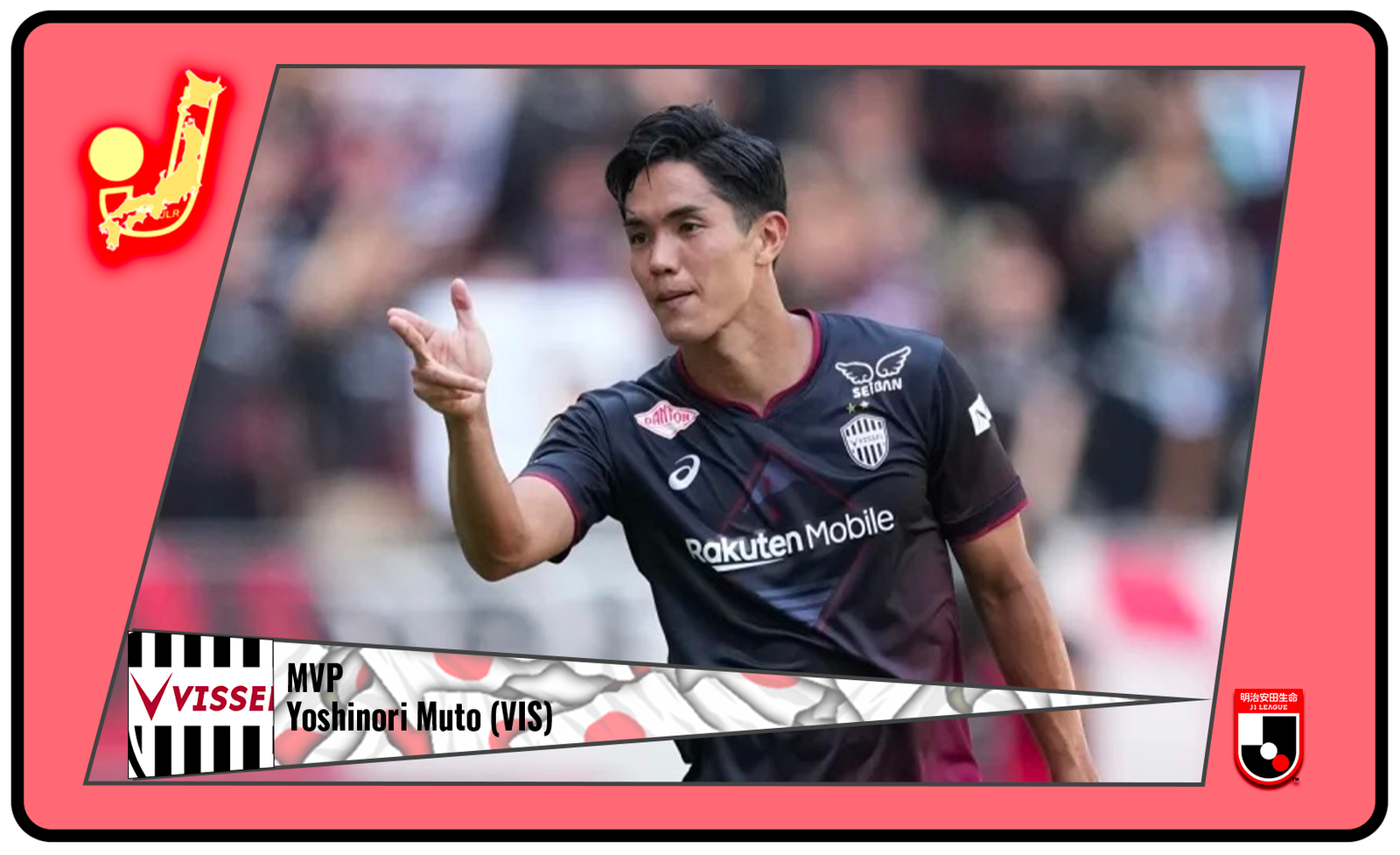
He reached again the Best XI after nine years from his first time, repeating the feat this year, and matching it with the MVP – which was assigned as well from our readers. And we often don’t agree with the choices done at the J.League Awards, but – just like for Yuya Osako last year – we can’t deny this is super-deserved. It’s a perfect redemption story – with baseball cards finally proving their value.
Players (and men) are defined by moments, and Muto did just that this year in a lot of occasions: the goal to seal the win away at Zelvia, exactly when Machida were thriving on the table; the two assists to win the game in Hiroshima, when Sanfrecce were about to pick up the pace; the brace in Yokohama to win against Marinos, and the decisive equaliser in Chiba against Kashiwa Reysol, where a loss would have thrown everything away.
The Golden Kid has become exactly what he was tipped for – just not in the timeframe we forecasted or expected.
Thanks for reading also this piece. The J1 League recapping piece over the Regista Awards of 2024 is coming soon, but you can also read here the article over Jun Ichimori’s renaissance and his rise from a JFL team to the J1 spotlight.



[…] been even close in our polls and, we think, at the J.League Awards, where Muto won the MVP award. Read here how his figure transitioned from the “Golden Boy of Japanese football” to a senator capable of […]