One-hit wonders. A light in a strange career, which wasn’t made of sparks and constant success. A sudden corner of attention in an otherwise normal trajectory. There are seasons or years like these, with players capable of rising to the occasion when it’s needed the most. Just think of sudden protagonists, who made the front cover for a certain period, without repeating themselves after that season.
“Lost Treasures” is a column that featured a certain number of episodes until now, all talking about these kinds of players in the history of J. League. To pick whom to feature in this column, we looked at all the Best XIs composed by the J. League committee at the end of every season and chose four players who made an enormous leap, just to rarely or not repeat themselves in the successive seasons.
Another specific detail: we picked just J. Leaguers, who enjoyed most of their career in the Japanese championship, albeit there have been two exceptions. It’s been some time since the last piece in this column. We enjoyed a trip to Memory Lane with Yoshizumi Ogawa, the man who inherited the legacy and the number of Dragan Stojkovic at Nagoya Grampus – and won it all.
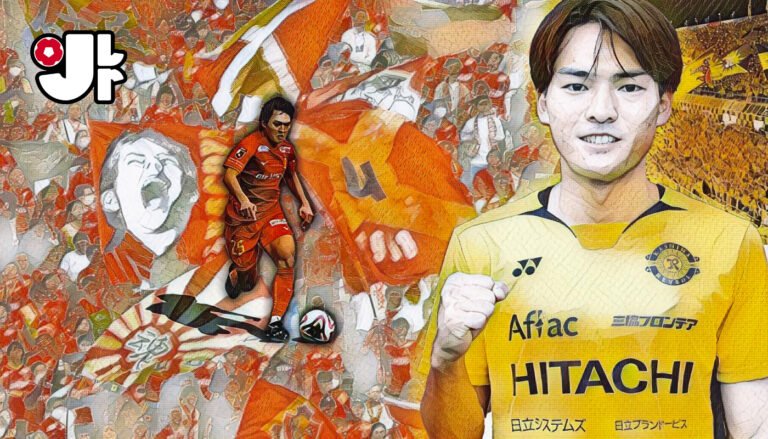
And today we’re going to move on to a Brazilian who played extensively in the J.League, both in the first and second divisions, and was featured in the Best XI in 2015. He played for numerous Japanese teams, but the final part of his career was the one in which he impressed the most. He looked otherworldly – capable of doing plays that others could just dream about. Dyanfres Douglas Chagas Matos – known simply as Douglas – was an astronaut of the J.League-sphere.
The Mysterious Object
Class 1987, Douglas – a native of Morros, a small city in the state of Maranhão (North-East of Brazil) – became a pro at the age of 17 years old. He played for Moto Club de São Luís, one of the biggest clubs in the region. Three years, then a loan to Madureira, before signing for Tombense. From there, another loan – this time to Figueirense, in Série B. But Douglas was barely playing – that must be why he considered Japan as an option.
His first touchpoint? Tokushima Vortis. The club was in the J2 League, and Douglas stayed there on loan from Tombense for 3.5 seasons. An incredible amount of time, in which Douglas grew up constantly – until reaching 12 goals scored in 2013, plus a fundamental goal in the play-offs semifinal to bring Vortis to the last act, in which they defeated Kyoto Sanga and reached J1 for the first time ever.
2014 was the first time that Douglas ever played in the first division. Vortis were counting on him and finally bought him, but the first season in J1 was a shock – zero goals in 13 games. To his credit, Vortis were terrible that year, but they decided to let him go on loan somewhere – by replacing him with Julián Estiven Vélez (a former Colombian national team player) and Adriano (the Brazilian who did well in Osaka with Cerezo and Gamba, but he was 32 and with no perspective at the time).
The choice was Kyoto Sanga, but injuries, the missed play-offs, and just five goals in 17 J2 matches were not a great result. Back then, Douglas was a 27-year-old Brazilian striker with fewer league goals in the first two Japanese professional divisions than years on his resume. What could be next for such a prospect? Maybe a goodbye to Japan after five years, or just a life living as a J2 or J3 striker.
The Miracle
Little did we know about how football can be funny. Even grotesque sometimes. For some reason, Hajime Moriyasu and Sanfrecce Hiroshima saw something in him. In reality, we didn’t know that Sanfrecce had already Douglas in mind throughout 2013, when Naoki Ishihara left after the second J1 title, and they wanted the Brazilian as a replacement. The move took 12 more months to happen, but it was a revelation.
It’s not like Douglas took the league by storm at the beginning. In the first season with the two-stage league back, the Brazilian scored six times in 17 games in J1. It was already an improvement, but nothing that knocked the fans out of the park. The real revelation was the second part of the season: 15 goals in 16 games, including two braces and two hat-tricks (especially the one in the last matchday against Shonan Bellmare).
If you add his goal in the second leg of the J.League Championship final against Gamba Osaka, Douglas was the start of the team for the third J1 title of the club and the last of the Moriyasu era. To this exploit, you must add as well what the Brazilian put together at the 2015 FIFA Club World Cup, where a brace from him granted Sanfrecce third place after defeating Chinese giants and ACL champions Guangzhou Evergrande.
2015 ended for Douglas with 25 goals in 45 games, featuring in the “Best XI” of the season, and the first explosive season of his career. It could have been the beginning of a glorious stint with one of the strongest teams in Japan, instead… Douglas made another decision. After years of suboptimal salaries, he probably took his chances and decided to cash in – by leaving Japan and signing for UAE giants Al-Ain FC.
The Prodigal Son
Goals-wise, the stint with Al-Ain was comparable to Sanfrecce. Three hat-tricks, 25 goals in 47 games, and one UAE League title. But unfortunately, beyond those numbers, Douglas’ name will probably stick to one major regret for Al-Ain – the 2016 AFC Champions League final, where a missed penalty in the second leg at home destroyed any chance for the UAE side to lift the trophy.
This triggered a strange next move: after two years in the Emirates, Douglas moved to Alanyaspor, scoring five goals in the process. But once J.League knocked again at his door, the Brazilian striker couldn’t say no. That’s why he joined Shimizu S-Pulse in the Summer of 2018, leading to the most incredible 18 months of his career. At that point, Douglas was already 30 years old – but he reached his prime.
Shimizu S-Pulse were 11th when they signed Douglas – he scored 11 goals in 15 games, bringing them to seventh place (still today, the best season S-Pulse enjoyed in a while). And 2019 topped that, in one of the most incredible individual seasons. Douglas didn’t even start the season, because they found some arrhythmia symptoms in his heart, so he needed to go back to Brazil to cure himself.
To top that, Changchun Yatai FC – a rising club in the Chinese Super League – tried to lure him away from Japan, but Douglas and S-Pulse refused the offer. The Brazilian didn’t score until Matchday 12, but then didn’t stop, scoring in seven consecutive games, and almost equalling the record by Julio Salinas (eight). He closed the 2019 season with 14 goals, including the fundamental one to win against Sagan Tosu and avoid relegation.
But more than the 25 goals in those two years, it was HOW Douglas was doing that. He was an absolute dominator – not in numbers though. He wasn’t pulling any Haaland or scoring at the rhythm of Yoshito Okubo in the Frontale years, but his goals were otherworldly. Mid-air bicycle kicks, powerful headers, even full-pitch runs to assist other goals – he was unstoppable. It wouldn’t have been a scandal to see him again in the “Best XI”.
The Last Years & Legacy
At 32 years old, Douglas decided he wanted to go back to winning ways. That’s why he probably entrusted Vissel Kobe with a final run, which started right away with a title – the 2020 Japanese Super Cup, in which he scored. In two years, he scored 14 times in J1 and gave us some glimpses of that outlandish flair he had at S-Pulse. But he couldn’t last forever, and it showed in the two final years of his career.
The final chapter was with Kashiwa Reysol – and Douglas, at age 35, had clearly run out of steam to pull off his superpowers. He featured just 17 times over two J1 seasons, scoring four times – none of them came in his last season. That’s why Douglas announced his retirement in February 2024 – and that’s okay, because if you look at his Instagram profile, you can clearly see he’s enjoying life after retirement back in Brazil.
What’s his legacy, then? This might be fan service, but one “Best XI” entrance seemed too few for a player like this. Douglas wasn’t supposed to be here and get all these accolades, especially looking at how his career unfolded in its first part.
One of the most impressive foreigners ever seen in the last 20 years of the J.League. Not one of the strongest, because he was too unconstant to be so.
One comment on “Lost Treasures – Douglas”
[…] Lane with Douglas, the Brazilian striker who didn’t score that much for a decent time, and then found the form of his life between Hiroshima and […]
To provide the best experiences, we use technologies like cookies to store and/or access device information. Consenting to these technologies will allow us to process data such as browsing behavior or unique IDs on this site. Not consenting or withdrawing consent, may adversely affect certain features and functions.
Functional
Always active
The technical storage or access is strictly necessary for the legitimate purpose of enabling the use of a specific service explicitly requested by the subscriber or user, or for the sole purpose of carrying out the transmission of a communication over an electronic communications network.
Preferences
The technical storage or access is necessary for the legitimate purpose of storing preferences that are not requested by the subscriber or user.
Statistics
The technical storage or access that is used exclusively for statistical purposes.The technical storage or access that is used exclusively for anonymous statistical purposes. Without a subpoena, voluntary compliance on the part of your Internet Service Provider, or additional records from a third party, information stored or retrieved for this purpose alone cannot usually be used to identify you.
Marketing
The technical storage or access is required to create user profiles to send advertising, or to track the user on a website or across several websites for similar marketing purposes.



[…] Lane with Douglas, the Brazilian striker who didn’t score that much for a decent time, and then found the form of his life between Hiroshima and […]