There are key-players who made the history of Japanese football (we mentioned some of them a few weeks ago to highlight some historical transfers)- That’s for different factors: whether for seniority, impact, or European success, these guys have left an impact on the evolution of Japanese football and its movement. And you could easily come up with several iconic names – Hidetoshi Nakata, Shunsuke Nakamura, Keisuke Honda, Shinji Kagawa, etc.
Anyways, if you had to name 10 Japanese players from this category, probably Takashi Inui’s name won’t come up. And that’s understandable, because Inui didn’t have a meteoric rise to world stardom, nor enjoyed a clear success with his teams. He had pieces or sparkles of those – always hinting at the chance that his time might come now. But it didn’t, not at least in a way his skills would have justified.
We had those moments. The time he scored a brace at the Camp Nou. The years in which he was mesmerizing with Cerezo Osaka, both with and without Shinji Kagawa. The goals scored in Russia at the 2018 FIFA World Cup, which (almost) led Japan to a debut in the quarter-finals. Those were all moments which should have led to something else, but it didn’t materialize – whether because of a rough patch or the player missing the final leap.
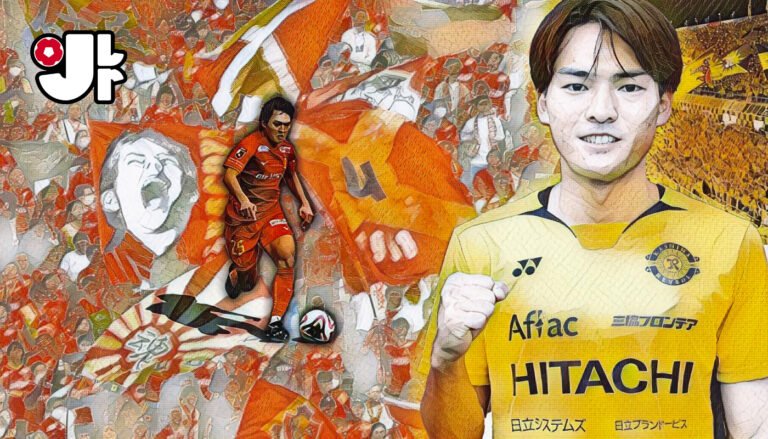
And yet, Inui is getting older way better than other generational players in his position. While others suffered on the bench, or retired, the winger is actually enjoying a nice stint at Shimizu S-Pulse. His playmaking wizardry isn’t getting older, actually it’s getting better – because clearly Inui can not run like he used to 10 or 15 years ago. But it doesn’t matter, when you’re equipped with a football-QI like his.
The Potential
Born in 1988, Inui was the talk of the town despite being born in the Shiga Prefecture, where there wasn’t (and isn’t) a pro-team. That’s because he won the High School Championship in 2006, with the playing style of Shiga Prefectural Yasu High School being labelled “sexy football”. Inui immediately joined Yokohama F. Marinos the year after. Unfortunately, 18 months were not enough to emerge and Inui joined Cerezo Osaka – first on loan mid-2008, then permanently.
There he formed first a wonderful partnership with Shinji Kagawa and the two of them ignited Japanese football for 18 months. Then Kagawa left Osaka to move to Dortmund, and Inui picked up the pieces – but not enough to get attention from prestigious European clubs. He first signed for VfL Bochum in the second tier, doing really well – he scored seven goals in 30 games, with the club just missing out on promotion. But he did get promoted anyway.
When Inui jumped to Bundesliga and Eintracht Frankfurt, he had an amazing debut campaign, helping the team coming back to European competitions. Unfortunately, the successive two seasons were harsh – especially when Thomas Schaaf took the place of Armin Veh. This meant looking for a new challenge, away from Germany – that’s where Eibar and LaLiga came into play, buying him for just €300,000. It was such a dream for Inui that he was even available to give up some money of his salary just to make the transfer done.
For three years at the Ipurua (just 8,164 seats available), Inui clearly showed: a) to have something special; b) that Spanish football was way more of a fit for his brand of football compared to Bundesliga. He scored 11 goals in 89 league games under head coach José Luis Mendilibar, and Eibar became a mid-table team (closing tenth in 2017 and ninth in 2018), despite being one of smallest-budgeted clubs in the whole championship.
The Regrets
And that’s where there are many. For example, the move to Betis, which initially looked like a natural step forward – Inui was 30 and Real Betis and Quique Setién could have been the coach to develop him further. Instead, the move collapsed in terms of success before being loaned to Alavés and then ended up back at Eibar, but with the side getting relegated (although Inui was the Japanese player with most games in LaLiga’s history, before being overtaken by Takefusa Kubo).
Even the return to Cerezo Osaka in the Summer of 2021 became a small regret, and that’s because Inui has always been a bit hot-headed. Already in his first stint with Cerezo, he was sanctioned by the club in 2011, after the AFC Champions League derby against Gamba Osaka: when Inui was subbed out after a poor first half, he smashed a glass in the locker room, and back then coach Lévir Culpi decided just to suspend him for four games – taking into account the apology from Inui.
That didn’t happen in April 2022, when Inui was captaining Cerezo in a game against Kashiwa Reysol. Back then head coach Akio Kogiku opted to take him out, and Inui – a very competitive person – didn’t take it well. He started yelling at the coach and the staff, and even if Kogiku wasn’t in favour of a long punishment, Inui was banned from practice for a month and excluded for six matches. After the suspension, Inui didn’t come back and his contract was mutually terminated.
And then there’s the national team. Inui actually debuted with Japan in January 2009, just six months after moving to Cerezo Osaka. Back then head coach Takeshi Okada saw something in him, making him debuting despite playing in the second tier. But then his national team career took a strange development for the next 10 years – for example, he played just three more times in the successive three years.
Inui featured in four competitions with four different coaches: at the 2013 FIFA Confederations Cup under Alberto Zaccheroni (two minutes in the game against Brazil), in the 2015 AFC Asian Cup with Javier Aguirre (played all the matches and scored one goal against Palestine), in the 2018 FIFA World Cup under Akira Nishino (being the star of the team against Senegal and Belgium) and the 2019 AFC Asian Cup with Hajime Moriyasu (where he was strangely a reserve).
The last match Inui ever played with the national team was in March 2019. He was already 31, things were not going well with Real Betis, and other players were starting to develop. But one must ask how things would have turned out if Inui got his space at the peak of his performances, and he kept his cool as well in an environment like Japan – where unity of intent comes before the individual.
The Present
As we were mentioning before, when Inui left Cerezo Osaka after falling out with the management, his career could have been over – even in Japan. He was 34, he had a minor impact with Cerezo after his return, and this kind of fallouts in Japanese football tend to be a mark (check the career trajectory of Yosuke Kashiwagi for further inspections). He trained for a couple of weeks with Fagiano Okayama, thanks to the ties with head coach Takashi Kiyama.
Instead, Inui joined Shimizu S-Pulse, who were having a terrible season, being dead-last in the top-flight. Inui found his way back to shine again, deciding to stay despite the relegation to J2 in 2022. The 2023 season was amazing, and his competitiveness came out again – when S-Pulse lost the play-off final against Verdy due to a naïve PK conceded by Yuji Takahashi, Inui came out publicly saying: “He shouldn’t have slid. That was an unnecessary foul – he needs to be a little smarter”.
The outburst was seeable also on the pitch, but the final words from Inui were crucial: “For now we’re a J2 team – something needs to change if we really want to go up”. And it did – 2024 was solid, and even this year Inui put together more minutes than the last year at Eibar, even earning a back-to-back selection into the J2’s Best XI (plus, the J2 won with S-Pulse in 2024 was the first title in his career). But there’s more.
Inui turned 37 in June, and if you do a brief comparison to other stars in Japanese football’s history who reached his age, the winger is doing pretty well. When he was 37, Keisuke Honda was in the middle of a career-break which lasted two years, and after having changed several clubs around the globe. Both Junichi Inamoto and Shinji Ono were already in “load management” mode with Hokkaido Consadole Sapporo.
Hidetoshi Nakata retired at the age of 29 after the 2006 FIFA World Cup, Daisuke Matsui was barely relevant at Yokohama FC, and even Shinji Kagawa – his old buddy, who will turn 37 next March – is not exactly shining with Cerezo in his second stint, after some mediocre stints in Belgium and Greece. The only one who kept the comparison was Shunsuke Nakamura, who was still thriving at 37 with Yokohama F. Marinos and kept his pace almost at 40.
Last but not least, it’s not easy to reach this level of success in Japanese football from Shiga Prefecture, one of the few to still not have any pro teams. And while still being active, Inui even found the time to open a YouTube channel – probably preparing his post-career trajectory. He’s ready to live it all. In the end, it’s like they used to say: “Competition is a sin”. And that’s the favourite one for Takashi Inui.


Good article. Definitely Japans best player at the 2018 world cup 👌