J.League turned 32 this year, and we have still a few players left who are older than the league. No, we’re not referring to Kazu Miura, but rather to players who were born in the 80s and are still around even at the highest level. If you look at the Top 25 of the players with the most matches played in J1, you can find many familiar names: Shusaku Nishikawa is second all-time, but you have Masato Morishige, Kensuke Nagai, Akihiro Ienaga.
From a few weeks, into that Top 25, you can see also a foreign player. He’s indeed the one with the most games in J1 who’s not Japanese and rounds off this special table. He featured more than 400 times, all with the same club – Cerezo Osaka. Actually, he never left the pink and blue side of Osaka since he joined in 2009, when the club wasn’t in J1, Shinji Kagawa, Yoichiro Kakitani, and Takashi Inui were still there, and Akinori Nishizawa was still playing.
It seems like a different geological era, but Kim Jin-hyeon couldn’t probably imagine what would have happened after signing for the Japanese club. He became not just a South Korean role model, but he also led the way to signing many keepers from the rival country in the J. League (some of them still to this day: Jung Sung-ryong, Kim Seung-gyu, Gu Sung-yun, Kwoun Sun-tae). In a certain way, he wrote history pages without knowing it.
Today, he’s not the starter anymore for Cerezo Osaka, but even in 2025 he found himself again defending the posts in the league and in the cups. He’s 38 years old, and he played just 16 times for the national team, but Kim Jin-hyeon has done already a lot in Japanese football and he’s focused on the present, always: “I’ve never thought, “I want to go to Europe someday.” I just want to do my best in the match in front of me and fight without any regrets.“
Keeper by accident
And to think that Kim would have done something else. Born in Suwon in 1987, the young South Korean found himself being pretty good at several sports, but in elementary school they tagged him to football because he was tall and already making some strides. Despite being always a goalkeeper, he never gave up on improving his footwork technique. He tied himself to Dongguk University, first enrolling in the high school and then joining the football team in university.
In 2006, someone noticed him from the South Korean national team, calling up for the U-20. Kim went on to be the no. 1 at the 2007 FIFA U-20 World Cup, in which South Korea exited in the group stage. He was supposed to be part of the team who has eventually played the 2008 Olympic Games in Beijing, but an injury took him out and prevent him to be in China. Nonetheless, another opening was on the horizon.
Kim indeed started familiarizing with Japanese language; he visited the country in November of ’08 and learnt Japanese to the point today he doesn’t need any interpreter for an interview. When a Japanese club reached out to sign him, he was at first scared to move there; but after some study with a private tutor, he improved his Japanese and enjoyed life in Osaka. Yep, because Cerezo Osaka decided to give him a chance to play at the palace.
Lévir Culpi, the Brazilian head coach, was impressed by what Kim showed in training – it took the goalkeeper just five days to decide to move. Kim Jin-hyeon embraced his new Japanese life, becoming happier about the choice made. That happened also because, on the pitch, things were going greatly – to the point that Kim Jin-hyeon became a starter at Cerezo Osaka despite being a rookie; actually, the club will stick by him through thick and thin.
Gadget Arm
At the time, Cerezo Osaka were in J2 and the other options for no. 1 – youngster Kenta Tanno, J2-er Masahito Suzuki, and return loanee Daisuke Tada – weren’t exactly thrilling. Culpi put all his chips on Kim and it worked: Cerezo got promoted, and J1 Kim found himself being again the starter, despite some injuries slowed him down. South Korea brought him to the 2011 AFC Asian Cup, and Kim got also his first cap with South Korean national team in 2012 for a friendly game against Spain.
Meanwhile, Cerezo Osaka started to struggle. Talents were blossoming, but they were also leaving, and Cerezo got incredibly relegated back in 2014, but Kim stood up. He had a wonderful run, ended in becoming the no. 1 for South Korea at the 2015 AFC Asian Cup: the Taegeuk Warriors lost the final against Australia, but Kim Jin-hyeon was nominated “Best Goalkeeper” of the tournament. Of course, offers came to leave Cerezo Osaka.
Nonetheless, Kim decided to emulate Gianluigi Buffon. Like the Italian goalkeeper stayed with Juventus despite being relegated to the second tier in 2006, the South Korean goalie opted for the same playbook: “Cerezo supporters were fundamental to make the keeper that I am today. As a man, I don’t think I should run from my responsibilities just because the situation is bad. I want to come back to J1 with this club”.
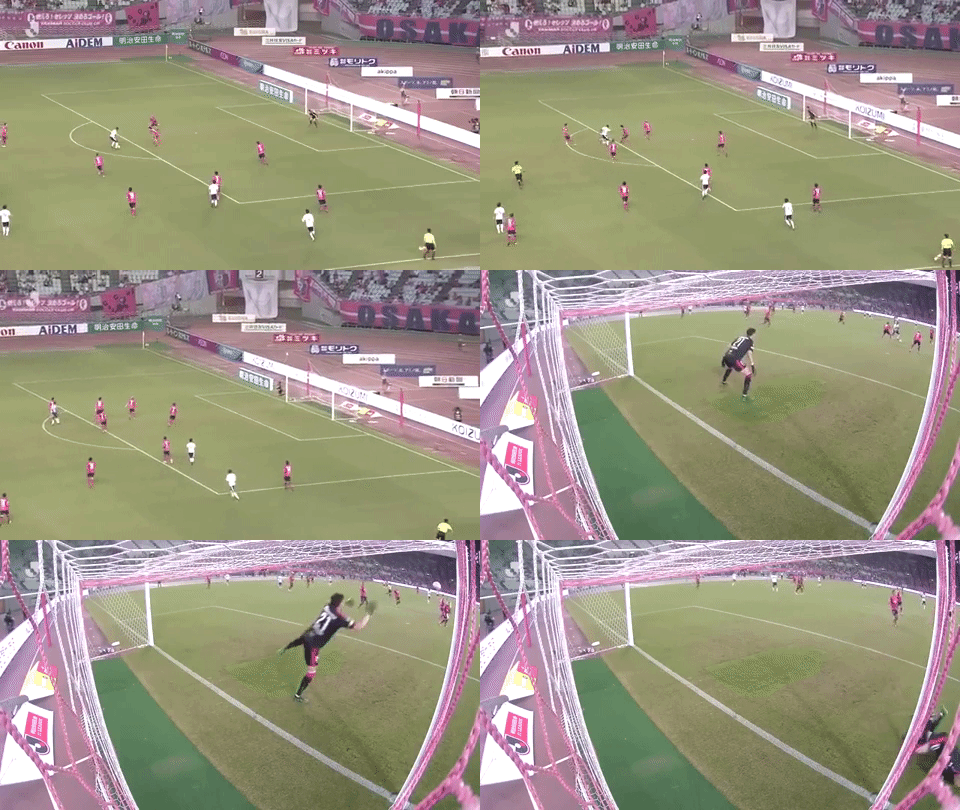
They found also a nickname for him – “Gadget Arm”, because his arms were always at the right spot to save the day, long and unpredictable like Inspector Gadget’s. Cerezo Osaka needed two seasons to come back, and they did it only via play-offs. Teams like FC Seoul and Kashima Antlers pushed to sign Kim, with the South Korean opting to leave only AFTER bringing back Cerezo to J1. Instead, he stayed: “It’s rare for a foreign player to stay this longer with a club; after eight years here, I couldn’t leave”.
Finally, a winner
And that choice paid off immediately. Cerezo Osaka had a great season under South Korean head coach Yoon Jong-hwan – third in the league, back in the AFC Champions League, and winning three trophies in the space of three months: the 2017 J.League Cup, the 2017 Emperor’s Cup, and the 2018 Japanese Super Cup. In all of the finals, Kim Jin-hyeon was the starting keeper; this golden age got him onto a plane for Russia 2018, and to feature in his third AFC Asian Cup in 2019.
But even when Yoon left, and Cerezo replaced him with Spanish head coach Miguel Ángel Lotina, Kim recorded more records. He had unbelievable saving percentages (the best in the league in 2019), but he also adapted to build up the play from behind. The South Korean no. 21 said it himself: “Last year, my style of football changed, and I felt that I could still grow. […]. I don’t think I’ll ever be satisfied, but I want to keep working hard to get as close to that point as possible.”
Cerezo Osaka wrote a new record in 2019, conceding just 25 goals from 34 games – the best a defence ever did in the J1 League. Kim featured in all those 34 matches, and stayed the starting keeper for Cerezo despite some alternatives throughout the years. In the last years, he became the foreign player with most games in J1, the first foreign keeper with 100 clean sheets in J1, and the most present ever player for Cerezo Osaka (overcoming president and legend Hiroaki Morishima).
Even today, when he’s not the starter anymore (Koki Fukui took over and we talked about it), Kim Jin-hyeon is pretty aware of his spot in history: “I’ve been playing here for 15 years. Regardless of whether I’ve adapted to Japan or not, I hold one of the foreign players slots. I have to show something different than the other players. That’s been the case for 15 years, and it hasn’t changed. That’s my responsibility.”





[…] taste. Until now we’ve been talking mostly of folk heroes, although you might argue that being a Cerezo Osaka keeper for 20 years isn’t that folk. Well, we’re taking it up a notch this time, since we’ll tell the story of a […]