I think I was talking with one of the panelists a few weeks ago, while he was communicating to me on Discord his picks for the polls. And we came to the conclusion that… man, J3 League is amazing. Being the last step of the pro-pyramid, but also the first for many teams coming from below, provides a lot of fun, surprises, and often your first impressions or forecasts prove to be mistaken.
And the 2025 season made no exception: we have already one promotion (Tochigi City FC doing the double leap), and another miracle on the cards (Vanraure Hachinohe are heavy favourites, but also FC Osaka would be pretty surprising, given how they changed head coach mid-season). And the play-offs – which have already gifted an instant classic in the maiden edition – promised to be tense until the end.
To review the season, we summed up a small panel to pick the possible options, then saw the votes coming through polls by our readers and followers:
And it’s not even over if you think about it:
- The play-offs are here for a second edition.
- We’ll see another J3-JFL play-out, this time with Azul Claro Numazu trying to avoid the drop against Reliac Shiga, hoping to bring football to the Prefecture after being runners-up in the JFL.
- Next year we’ll see a change of calendar, with the season transitioning to a Summer-Spring schedule.
But first, a recap of what’s been happening in 2025.
Best Team | Tochigi City FC (57,1%)
In the pre-season, we highlighted already how the club was ready to surprise – because of their structures, their transfer market window, the drop of Tochigi SC to J3 in the same year. In the end, all of this happened, but Tochigi City FC went for the extra mile, entering the promotion conversation really early. On Matchday 5, Tochigi City were already in the Top 2 and, besides for three matches, they’ve always been there throughout the season.
It’s not the first time that a newly-promoted team manages to climb through the Japanese ladder and conquer back-to-back promotions (e.g. Iwaki FC, Renofa Yamaguchi). But just like Iwaki, this didn’t feel accidental – the squad is there, the project is solid, the vibe is good (especially at home, where the average attendance isn’t massive, but the percentage of how much the stadium is full… is noticeable).
Flop Team | Matsumoto Yamaga (57,1%)
The crisis at the club was visible already in 2020, when they got relegated from a second year in J1, and they found themselves incapable of managing the expectations of coming back to the top-flight. From there, things only escalated to the lowest point: an incredible relegation to J3, the loss of the few talents that the club actually developed (e.g. Ayumu Yokoyama), managers coming and going, a roster with no valuable prospect.
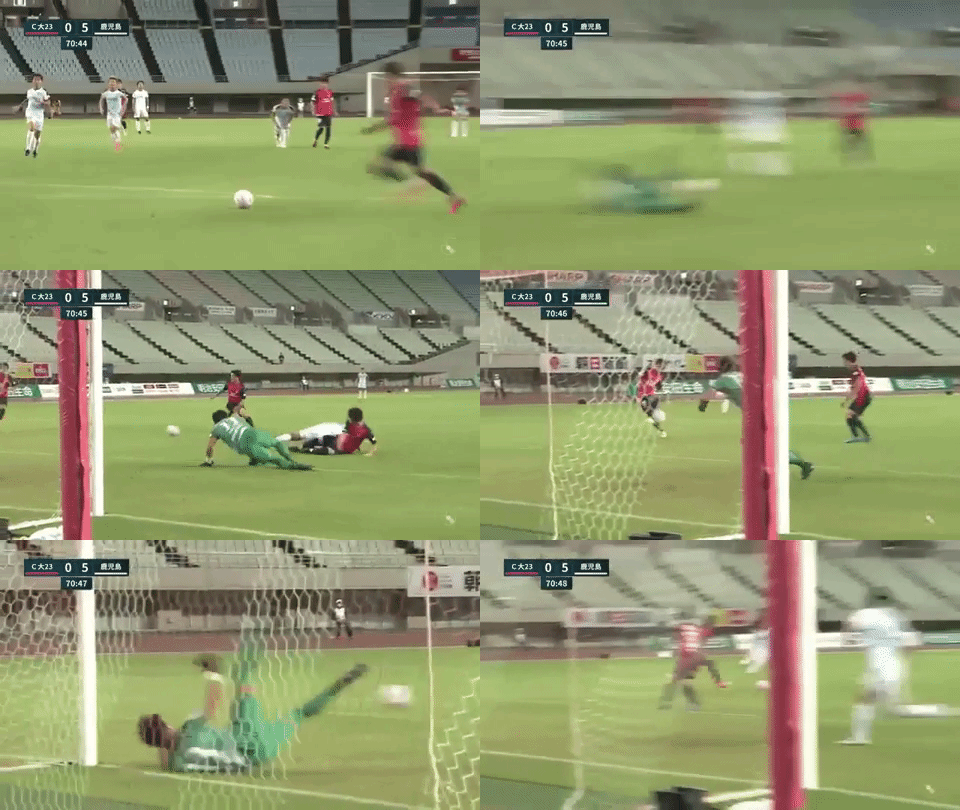
It’s even hard to find a lowest point of the season… was it the 5-0 loss at home against Kochi United SC? Was that the losing streak of five games in the last weeks? Or the disaster that almost happened at their stadium? On October 3rd, a steel frame of 11 meters and weighing 500 kilos, collapsed on the stands. Luckily there was no match scheduled, but it could have been a tragedy.
And this pushed Yamaga to play first in Kofu, then in Nagano (at the Parceiro’s stadium), and the last game has been in Tokyo (!). It’s a failure of massive proportions. Last but not least, even the players who saw some sparkles – like Sora Tanaka – suddenly shut down in terms of performance. Someone might point out that Matsumoto needs a different ownership and the fans deserve way more than this embarrassment.
MVP | Keigo Hashimoto, Tegevajaro Miyazaki (53,8%)
No need of a small paragraph – Hashimoto’s season has been nothing but extraordinary. You can read here his journey in Miyazaki, and why Tegevajaro has to thank a lot their captain.
Best Goalkeeper | Shogo Onishi, Vanraure Hachinohe (66,7%)
It’s been a long ride for Shogo Onishi. At age 23, he joined Ehime FC in the J2 League, but he barely played. When he signed for Azul Claro Numazu in 2017, his fortunes didn’t change that much (23 league games in two seasons). He seemed destined to be a back-up keeper forever, but then joined Kagoshima United FC in 2019: he didn’t play that much in J2, but he became the starter back in J3. All of this before going North.
Onishi joined then Vanraure Hachinohe in 2023, and he wasn’t the no. 1 right away – this time because of injuries, who kept him out for most of that season. When he came back, head coach Nobuhiro Ishizaki didn’t have any doubts: starting in 2024, even captain in this great season.
He kept 20 clean sheets until now (54,1% of the matches with one game still to go) – which is a massive number, a testament to Hachinohe’s defensive setup, but also to his efforts between the posts.
MIP | Yusei Toshida, Zweigen Kanazawa (50%)
Koichi Sato, Mutsuki Kato, Masamichi Hayashi – Zweigen Kanazawa had some interesting options at the no. 9 position while living the J2 life. And that was the worry last year, when the club – back in the J3 League – had as the top-scorer Yuji Kajiura, who plays as… central midfielder. That was certainly a problem to solve, and many thought that the arrival of Patric, a J.League legend, would have made the difference.
The Brazilian did score nine league goals, but six of them came from the bench, keeping the role of a joker. Instead, it was the breakout year for Yusei Toshida, and it was pretty much unexpected. Between his days in Kumamoto and the stint with Kanazawa, Toshida had scored four goals in three seasons. In 2025, he bagged 12 of those in 36 league matches. 2026-27 will be the test to understand if this was a fluke.
Best Rookie | Toi Yamamoto, FC Osaka (50%)
Speaking of keepers, Toi Yamamoto was indeed a surprise. FC Osaka had the best defence in 2024, and that was because of Tatsunari Nagai, the no. 1 of the club for three seasons. Nagai had wonderful years in Osaka, having 16 clean sheets in 2023 and 18 in 2024 (48,6% of the games), conceding only 30 times in 37 matches. When he left for Shonan Bellmare last Winter, replacing him was a high order.
FC Osaka opted to do everything in-house – Yamamoto can be considered a rookie because he joined in 2024 from Kyoto Sangyo, but he hasn’t played a single game last season in any competition, barely making it to the bench. In 2025, he was awarded the starting spot and put together 13 clean sheets in 35 matches (37,1% of the games with one to go), and conceded just 31 goals. The difference was barely noted thanks to his qualities.

Best Signing | Ryuji Sawakami, Cerezo Osaka » Vanraure Hachinohe (58,3%)
Do you know what a “journeyman” is? Okay, Ryuji Sawakami is the embodiment of that. He joined Cerezo Osaka in 2016, playing mostly for the U-23 side in the third division. He featured 14 times in the top-flight, before being let go for different pastures. Imabari, Sagamihara, Tottori, Fukushima – he was everywhere, and in none of these adventures had double digits of goals.
He joined Hachinohe last Winter after scoring just four league goals in two years. He seemed a back-up option, and instead Ishizaki put him up front, with Sawakami finding the right formula at 32 years old: 11 goals in 37 matches, with a strange rollercoaster of performances (he scored just once in the first 15 matches and rose up in the heat of the season).
Tough to imagine him repeating this in J2 (if Hachinohe can finish the job on Saturday away at Ryukyu), but he’s been fundamental for Vanraure’s run towards a promotion shot.
Best Wish | Byron Vásquez, Machida Zelvia » Tochigi City FC (58,3%)
Iwaki FC, Tokyo Verdy, Machida Zelvia. JFL, J2, J1 – everything seemed to develop right for the Chilean winger, until it didn’t. In this article we explained why a loan to Tochigi City FC and the promotion to J2 might have saved the career of Vásquez.
Best Foreign Player | Matej Jonjić, Tochigi City FC (46,7%)
Last Winter, we celebrated the arrival of the Croatian center-back as “THE” bargain of the J3 League market. Tochigi City FC pulled it off, and even if Jonjić was already 34, it seemed a wonderful intuition for the third division. It was indeed – Jonjić had a season like 2017, when back then he scored five goals in 34 league games and he was the anchor of Cerezo Osaka’s defence.

The same happened this season: 32 games, six goals (including a brace in Kitakyushu), and the defender was a constant in Tochigi City’s progress through the table. Furthermore, I think Jonjić will be a solid asset also in the second division. And his goal opened the flood gates in the last home match against Nagano Parceiro, a goal which basically meant promotion to J2.
Best Goal | Keito Kawamura: Kagoshima United FC v. FC Gifu, MD15 & Tatsuya Kondo: Tegevajaro Miyazaki v. Kagoshima United FC, MD7 (44,4% each)
Kagoshima United FC will definitely have some nightmares about this season. They started the season very well under new head coach Naoki Soma, who had already a promotion to J2 in his resume with Machida Zelvia. Nonetheless, they lost themselves along the way – for Round 27 and 28, they were in the Top 2. Then they threw away the two title-deciders against Vanraure (0-1 away) and Tochigi City (0-3 at home).
From there, the form just dipped massively. The club has already made public that Soma won’t retain his job. After those two decisive defeats, Kagoshima racked up 12 points in the last seven games – and none of those matches were against a club in the Top 8. And now… they even face the threat of playing their play-offs semifinal away, since both FC Osaka and Tegevajaro Miyazaki overcame them in the table.
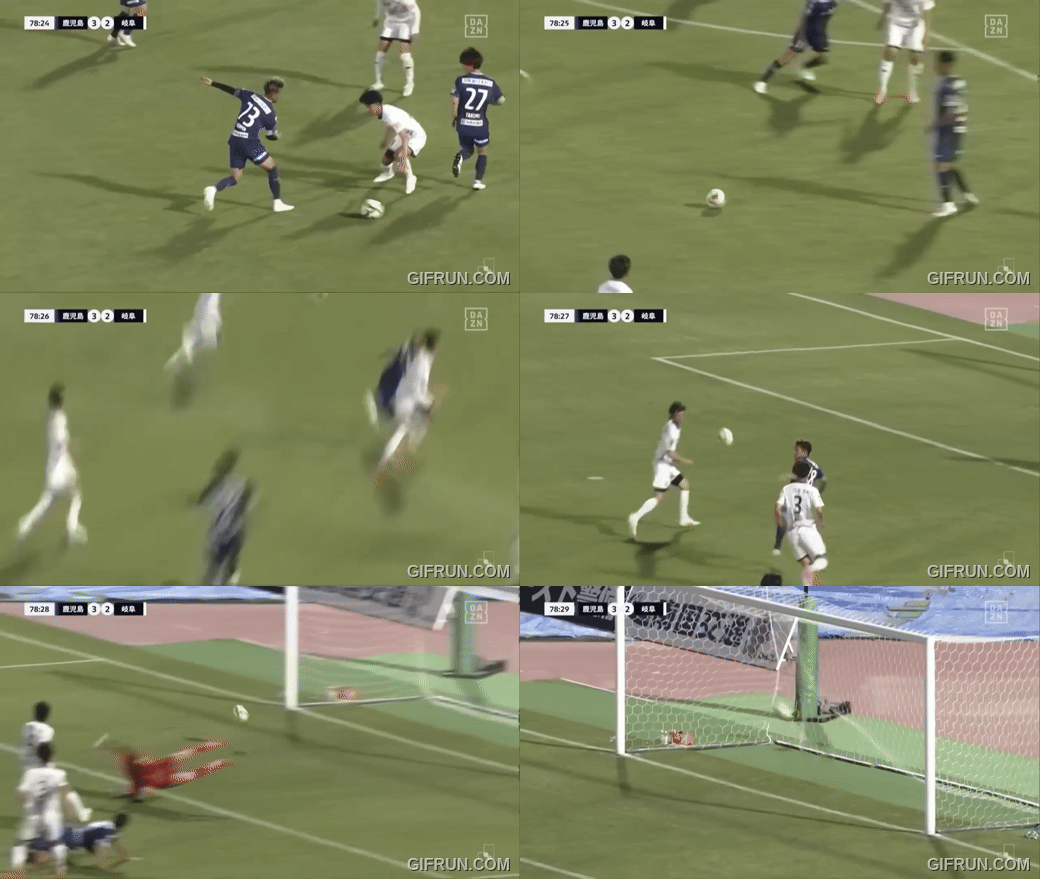
But the goals were good – with KUFC having the best offense of the league (67 goals until now), and two of them won ex aequo this special category. Personally, I prefer the scissor kick of Tatsuya Kondo to scrap a point in Miyazaki, but Keito Kawamura has been a revelation in J3, and scored 10 goals, including a winning effort against FC Gifu on Round 15 (in one of many comebacks provided by KUFC this season).
Best Manager | Norihiro Ishizaki, Vanraure Hachinohe (61,5%)
I mean, there’s gotta be enough literature around him on this website. In the pre-season of 2024, we told the story of Ishizaki, how he came to be a head coach and the various étapes of his career. In July of this year, when Vanraure were at the top of the table, we highlighted how important Ishizaki was to put everything together, given also his results in the third tier.
At 67 years old, Ishizaki is one step away to seal a miracle. This would be his fourth promotion, and the head coach has already almost 250 games under his belt in eight seasons of J3 with three different clubs (making him second all-time for matches coached in the division). If you add to those the 456 games coached in J2 and the 152 in J1, we’re talking of more than 800 dugouts in his life.
He screams “institution” from all over his body. And Japanese football needs these living landmarks to develop and progress.
Thank all our panelists for featuring here, we can’t wait to see them again in action for the 2026-27 season. Regista Awards have just begun, since the nominations for J2 and J1 are still on the way. Thank you for the support!



[…] wait to see them again in action in 2025. The Regista Awards for the J3 League are already readable here, while the ones for the top-flight are coming in a week or two. Thanks again for following this […]
[…] In the meantime, you can read the 2025 Regista Awards for the J2 League (here) and the J3 League (here). It’s been a blast to have another year of the Regista Awards: thanks for your […]