Japanese football has a plan and the headquarters want to stick with it. That’s why in late 2013 it was announced that a third pro-division – J3 League, which pushed Japan Football League to be the 4th tier, 1st non-professional – was ready to start the successive season. It happened on 9th March 2014, when the league kicked off and Keisuke Endo scored for Machida Zelvia the 1st goal-ever in the championship.
Four years later, J3 League has given us several crazy moments, three last game-titles (only Zweigen Kanazawa sealed the deal with some games to play in 2014) and many stories. I think it’s potentially the most interesting division in Japanese football, because we will see many clubs going by this division, rising their chances to become relevant or going down after years of sunshine in the first two divisions.
But the most important thing is that we have several records. And if you look at the all-time scorers’ table, you quickly realize something: (almost) no one is pushing the bar or adapting to a higher brand of football. J2 has become a hurdle for classic J3 goal-scorers. And we have some examples.
The new, the young and the runner
In this consideration, we are leaving out people who are probably closing their careers in J3 League. We are not expecting Yuki Sato, Keisuke Endo or Yoshinori Katsumata suddenly leaving Nagano or Kataller to play few minutes in a higher division. But there are different cases from them.
Just look at Takuma Sonoda, who recently joined back J3, since he was loaned by Tokushima Vortis to Kagoshima United. While this is a good move for every part involved – Kagoshima got a solid striker, Sonoda can finally play and Tokushima leaves another striker behind their shoulders, even if for six months –, Sonoda was probably expecting something else when he signed last winter for Vortis.
He scored 31 goals for Azul Claro Numazu, bringing the club from JFL to almost winning J3 in their debut year (19 goals in J3!). But in 2018 season, Sonoda played just 91 minutes in Tokushima: to put in perspective, 90 of those 91 minutes came in a Emperor’s Cup match. He played just ONE MINUTE in J2. He’s already at 75 after his first game with his new squad and now he’ll try to find back his groove at Kagoshima (little prediction: he’ll probably succeed).
Another good example of this setback is Rei Yonezawa, a promising kid from Cerezo. The pink side of Osaka has a good tradition in launching new stars and the club was hoping to see a new Minamino. Yet, it didn’t go that way: Yonezawa played a lot for the U-23 side and also featured in J3 with Blaublitz Akita in 2015, before coming back to Cerezo.
Unfortunately, Kiyoshi Okuma never fielded him, so he chose to go on loan to Renofa Yamaguchi for 2017 season. After 17 caps and zero goals, he went back to Cerezo Osaka U-23 and immediately delivered with five goals. As today, he scored 23 goals and he’s the highest-scorer ever in J3 for a reserve side (but who knows, Kazunari Ichimi could still reach him). But what will happen when (FINALLY, I add) U-23 will cease to exist in J3? That could be a problem.
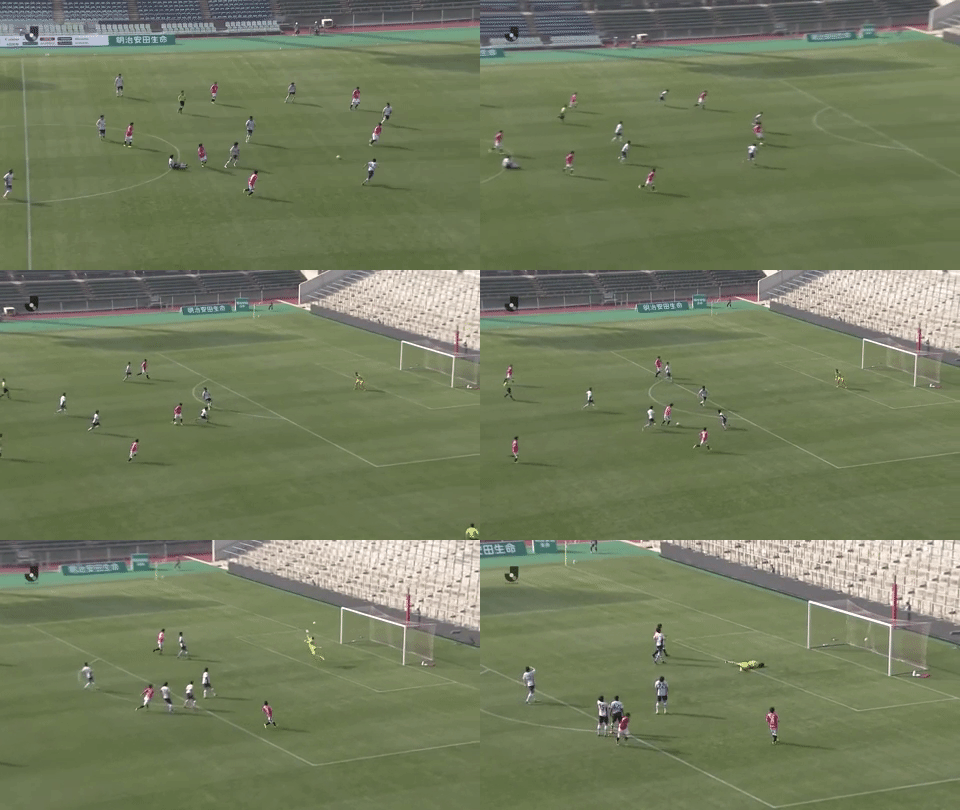
And the final case in this paragraph is Keita Tanaka, a speedy midfielder and former captain of FC Ryukyu, a happy football island that you should not leave. While the squad has progressively risen in the last years, Tanaka scored a lot after a first disappointing J3 season with Nagano Parceiro: 22 goals in two years.
For 2017 season, Tanaka opted to leave Okinawa and signed for Mito HollyHock. But he played too few games (5) and so he’s gone back on loan to FC Ryukyu, where he found back his old groove: 7 goals in 16 games and the club was basically flying in the second part of 2017 season. Now he’s back at Mito HollyHock, but he’s not exactly shining even in 2018 (he started just three games in J2, playing nine times and scoring twice).
One-hit wonder?
Of four J3 completed seasons, I personally cherish 2015. We saw a relegation/promotion play-off, but most of all we witnessed the best club to ever stepped up on a J3 pitch: Renofa Yamaguchi were amazing that year. A typhoon of goals (96!), which still got to almost lose the league and just find promotion at the last minute of a 2-2 draw in Tottori.
The poacher of that team was Kazuhito Kishida. And while his partners in crime found better deals or fortunes – Yatsunori Shimaya recently signed for Sagan Tosu after teaching football in Tokushima, while Takaki Fukumitsu gradually found space in Cerezo Osaka’s line-up –, Kishida can’t today grant himself a starting spot at Renofa, where Ado Onaiwu is currently ahead of him.
And it’s not like the other two seasons in J2 went that good: the no. 9 scored just four times in 2016, seven in 2017. Yet, his first two years with Renofa were terrific: put at the centre of Nobuhiro Ueno’s 4-2-3-1 spectacular system, Kishida scored 49 times between 2014 and 2015, with a record-season of 32 goals in 2015. He could score in any way, yet something broke when the system didn’t support him that much anymore.
And other forwards stepped up in his place. In 2016, Masato Nakayama – just bought from Gainare Tottori to be his back-up – lived a break-through season, scoring 11 goals and then moving to Montedio Yamagata. In 2017, with Renofa risking relegation all season-long due to many goodbyes in the winter market, Kishida scored more than the year before, but the midfielder Kazuki Kozuka was the squad’s top-scorer and goals by Leonardo Ramos were far more important to avoid relegation.
And in 2018, while the no. 9 scored just three goals, Ado Onaiwu is living the season of his life. If this isn’t karma, I wonder…
Embodiment of troubles
But there’s a name who can actually represent the best these hurdles. And that name is Tsugutoshi Oishi, the man who is leading the all-time scorer’s table of J3 League. We can recalling him mostly through that record, because he’s no longer seeing the pitch in Yamaguchi. In a 4-3-3 system and with just one spot as center-forward, Oishi played just 49’ in 2018, being behind Onaiwu and Kishida.
Yet, his career promised something else. Class ’89, Oishi lived some seasons under FC Kariya, an Aichi-based side who mostly featured in Tokai First Division (in Japanese Regional Leagues). After scoring several goals, he ends up being the no. 9 for Fujieda MYFC in the first season of J3 League. And he immediately delivers by scoring a lot: 17 goals in 2014, 14 in 2015. He even punishes Shimizu S-Pulse in a famous Emperor’s Cup match where Fujieda snatch a big away victory (4-2!) before losing to Montedio Yamagata (and he scores again).
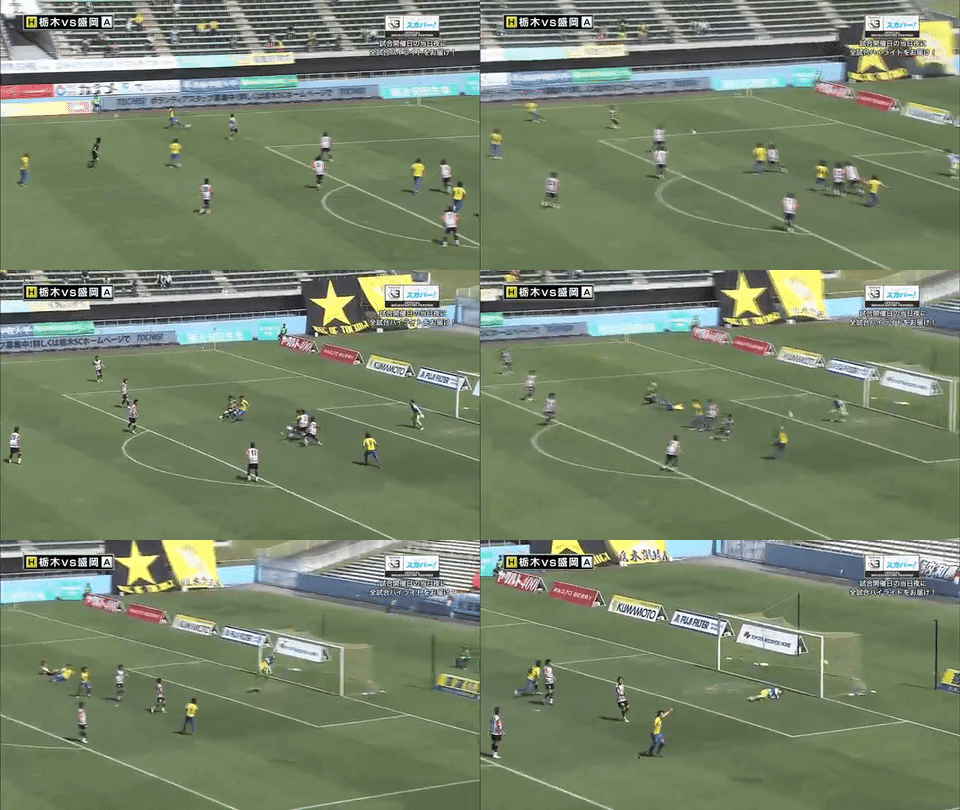
You would expect him to go up, but he picks just-relegated Tochigi SC to be their striker and bring them back to J2. Unfortunately, Oita Trinita are in the way; despite his 11 goals, they won’t be enough to conquer promotion. No problem, since there’s a J2 club who wants Oishi anyway and that’s Renofa Yamaguchi, which have been going under huge renovation. But the move doesn’t work: Oishi scores just three goals and falls out of favour under new manager Carlos Mayor.
Now he’s not playing and probably a J3 return could be at the same time a solution and a defeat.
Little hopes
After this read, you would say that J3 players seem condemned to end up playing always in J3, especially if they have good-scoring seasons. Yet, that’s not completely true: there are two small exceptions.
The first one is Koji Suzuki, no. 9 of Machida Zelvia. He also excelled in J3 League for two years, featuring with Machida Zelvia. He even played in J2 in 2012, when Machida faced their first-ever season in the division. After being relegated, the club chose him as their no. 9: 15 goals in Japan Football League, 31 in the next two years in J3, with the top-scorer title in 2014.
When everything went for the best and Machida even got promoted back to J2, Suzuki had a crazy scoring-form in 2016: 12 goals in 25 matches. Then a big injury in a game against Renofa Yamaguchi put him on the stands for a whole year, hitting also the 2017 season, when he could only score two goals in 11 games. But 2018 put the striker back on the J2 map: Suzuki is a regular in the centre-forward position and featured five times as a scorer in a championship contender. Not a great amount, but he’s back despite that threatening-career injury.
The other exception – I’d say the real one – is Noriaki Fujimoto, twice top-scorer of J3 in 2016 and 2017. With Kagoshima United FC, Fujimoto impressed for how many ways he could find the net. He scored 39 goals, but the most incredible thing here it’s that Fujimoto didn’t impress in his four years-stint in Japan Football League. In fact, Fujimoto played for SP Kyoto FC, formerly known as Sagawa Printing Kyoto Soccer Club. The squad shone in their last years, even becoming Clausura Champions in 2014 Japan Football League (among 30 matches, they were indeed the team with most points: 61), but in 2015 the club was disbanded.
That club featured today’s J. League players like Tetsuya Yamaoka (Kagoshima United FC), Taiki Kato (today at Zweigen Kanazawa) or Akihito Ozawa (Nagano Parceiro). Along them, there was Fujimoto, who wasn’t exactly a prolific striker: 23 goals in four seasons, from the “o” in 2012 to “9” in 2015. Then Kagoshima and J3 happened, with Fujimoto bursting his way into the league and even scoring the first J3-ever goal for the club (a penalty in Yokohama).
If he stayed in Kagoshima, he would have easily overcome Oishi’s record. Instead, Fujimoto opted to stay in Kyushu, but move East, precisely in Oita, where the club needed someone alongside Yusuke Goto. Yet, Oita Trinita feature a lot of strikers this year: him, Goto, Baba, Mitsuhira, Hayashi, Isa and Kawanishi. In fact, it wasn’t easy to find space for Fujimoto, since manager Tomohiro Katanosaka is rotating his options up front: all his strikers played at least 11 J2 games this year.
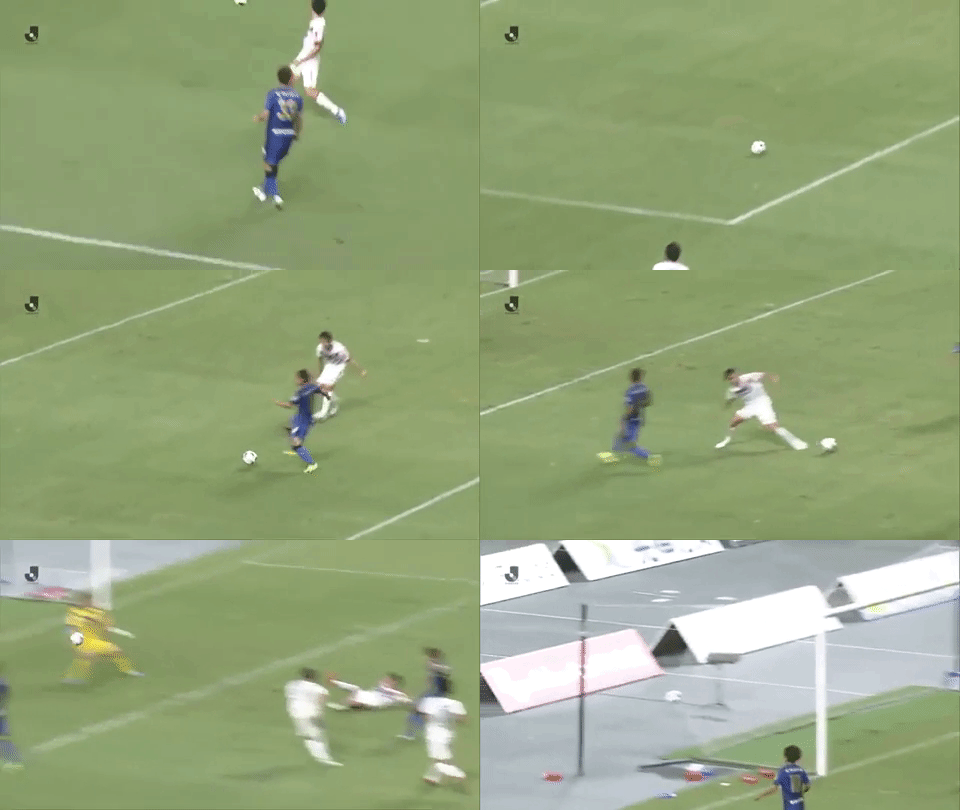
Yet, the former Kagoshima no. 9 is proving himself to be an interesting player: he immediately scored in his first-ever game in J2 (at Tochigi) and – despite a long break from playing: he was fielded for just 12’ between mid-March and mid-June – he found back some space into the starting XI, scoring 5 goals in 14 games and mostly showing that he has some glimpses and moments of a J1 player.
Will he break this curse over J3 strikers? Who knows, it’s hard to say. But if Fujimoto will be able to play J1 football next season, maybe with Oita, at almost 30 years old, it’ll mean that the J2 setback is done and dusted. Forever.