Sandro, Jean, Evaldo, Hideki Sahara – if these names don’t say anything to you, no worries. I guess even a J.League fan would struggle to put them in context. But I wanna try: Sandro Chaves de Assis Rosa was probably the most famous one (having played more than a decade in the J.League with three different teams). Jean Carlos Witte, also Brazilian, had as well a nice stint in Japan with two teams, plus he played for the U20 Brazil.
Evaldo Silva dos Santos was a darker player in the lines of the J.Leaguesphere – he never actually played a single minute in Japan. And Hideki Sahara lived his whole career in the capital city of Japan, but he featured 90% of his career for Kawasaki Frontale (and he’s now the deputy of head coach Hasebe). And that’s the fun thing – these four names have one trait in common: they wore the no. 3 for FC Tokyo until 2009. And after that year, the number became exclusive property of a man.
I always liked in Japan the fact that numbers are not retired. Actually, like we’ve witnessed with Sanfrecce Hiroshima’s no. 6 (from Toshihiro Aoyama to Hayao Kawabe) and with Gamba Osaka (from Yasuhito Endo to Takashi Usami), the numbers are a rite of passage, a way to pass on to the next generation. And at a certain point someone will have to ask themselves this question about that no. 3 in red and blue. But not now.
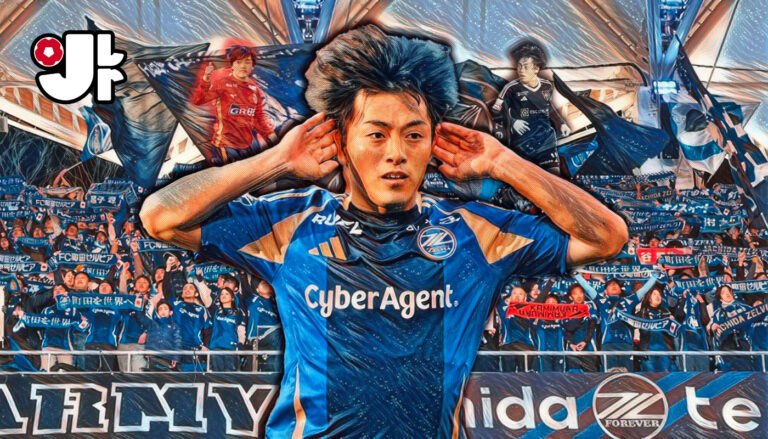
Masato Morishige has reached 500 games in J1, played with two teams – Oita Trinita and FC Tokyo. He just took the chance of deciding a home game by winning it after slotting home a PK against Yokohama FC in the 103rd minute. He’s not in his prime anymore, but he’s seen so much with the club – and he’s deservedly the recipient of a new episode of “The Centennial Club”, although a bit late (we know).
The Beginnings
Born in Hiroshima in 1987, like many, Morishige started playing because of his older brother. With his long hair, he eventually ended up in the youth ranks of Sanfrecce Hiroshima, alongside another excellent J.Leaguer – Tomoaki Makino, whose story is told here. Morishige was initially fielded as a striker, but he was converted into a defensive player by… Nobuhiro Ueno, the architect behind the Renofa Yamaguchi rollercoaster from 2015.
Ueno said: “He’s not fast enough to play the forward position, but he reads well the situations and he’s more suitable as a holding midfielder”. Sanfrecce won’t keep him, but Ueno encouraged Morishige to keep going. Then he enrolled into Hiroshima Minami High School, and then joined Japan U-17. It was the beginning: Sanfrecce Hiroshima didn’t approach him, and Tomohiro Katanosaka – another architect, but at that time Head of Scouting at Oita Trinita – saw something in him.
Morishige always credited Katanosaka as the man who paved his way into professionalism, and the head coach at Oita Trinita, Péricles Chamusca, saw him more as a center-back. Funnily enough, Morishige debuted as a pro on March 12th, 2006… against Sanfrecce Hiroshima. Two J1 games in 2006, 20 in the successive seaso, then the promotion into the starting lineup when Oita lost Takashi Miki to Nagoya Grampus.
Oita Trinita won the 2008 J.League Cup, played two international tournaments, and was part of a legendary squad – a squad capable of conceding just 24 goals in 33 games (a record) and who came 4th in that 2008 season (best result-ever in J1 for the club). Furthermore, Morishige started racking up caps with Japan: the 2007 U-20 FIFA World Cup, the 2006 AFC Youth Championship, and the 2008 Olympic Games in Beijing.
The Build-Up
Unfortunately, Oita got relegated to J2 in 2009 and financial struggles forced Trinita to sell their talents. Kawasaki Frontale and Urawa Red Diamonds were ready to snatch him, but FC Tokyo got him before other. Little did Morishige know that he was going to face another immediate relegation, although the one from FC Tokyo was surprising. The club got into J2, but Morishige decided to stay and even got more responsibilities – vice-captain, free kick taker.
What followed was a great run for Morishige. FC Tokyo won the J2 by a big margin, and then coupled that with the 2011 Emperor’s Cup. The centre-back became the captain of FC Tokyo in 2013, when Yasuyuki Konno left for Gamba Osaka. FC Tokyo grew so much that Morishige got four consecutive spots into the J.League Best XI (from 2013 to 2016). The club played AFC Champions League twice and had a run at the title in 2015.
In all of this, Morishige finally entered the conversation for the national team. Head coach Alberto Zaccheroni clearly liked Maya Yoshida and Yasuyuki Konno as centre-backs, but Morishige offered some physical strength that Konno didn’t have. That’s why Morishige got the call-ups, won two EAFF E-1 Championships (2013, 2015) and was the last FC Tokyo player ever featured in the World Cup. Unfortunately, the 2014 FIFA World Cup was a disappointment.
Morishige was a special kind of defender – he was often praised by opponents’ head coaches because of his presence and tactical read of the game. The no. 3 became a column for the club (with a lot of personality on the pitch), but probably didn’t know that the best was about to pass. From 2017, in fact, Morishige won just one trophy with FC Tokyo – the 2020 J.League Cup – and saw the club becoming a perennial mid-table club.
The Legend
After that, Morishige kept his status at FC Tokyo – in 2019, he became the first player to feature in all league games, with FC Tokyo losing the title on the final day against Yokohama F. Marinos. But he lost his spot in the Japanese national team – the last time he was called up was March 2018, the last game played with the Samurai Blue was in March 2017 against Thailand. He snatched indeed a fifth and final appearance into the J.League’s Best XI in 2018.
Nonetheless, the form never left him. For a 38 years-old player, Morishige is in decent shape and reached a historic milestone against Cerezo Osaka a couple of weeks ago: he became the eleventh player to feature in 500 games in the J1 League. He was the second-oldest to reach that kind of feat at his age (38 years, 24 days) – only Nobuhisa Yamada did it later than him with Urawa Red Diamonds back in 2013.
A record of which Morishige wasn’t so aware indeed: “I didn’t think too much about it, but it’s the result of doing one step at the time. Looking at the number alone, it’s huge, but I’d like to continue improving. In the end, I love football, so that feeling is the most important thing. I faced a lot of struggles, but the most important role for a player is to express himself on the pitch, and I want to continue to do that as much as I can”.
Morishige has a curious record – he scored seven goals in the last 10 minutes plus injury time of a game to win it for his team. The penalty against Yokohama FC was just the last heroic of a J.Leaguer who made history – and you can hear in the background the kind of support the no. 3 got when he stepped up to the PK spot.