March 15th, 2015. It’s a quiet afternoon in the Kanagawa Prefecture, and J3 is starting for their second season ever. SC Sagamihara host the J.League U-22 selection, in which we can spot future national team members, possible European prospects, and some J.Leaguers. On the other side, there’s still an old Naohiro Takahara leading the charge for the upcoming season of the black and green side.
SC Sagamihara are playing with Tsuyoshi Sato in goal; Yusei Kudo, US player Mobi Fehr, Hirolki Omori and Yusuke Mori in the back-line. Then Torò and Yusuke Sudo as holding midfielders, plus Keita Sogabe, Taira Inoue, and captain Takahara completing the line-up. The result will be an easy 3-0 win for the home side, in what will be the last season for the U-22 experiment of the J.League.
We can then fast forward nine and a half years later, to August 25th, 2024. And this time we’re in the Kagawa Prefecture, where Kamatamare Sanuki (unfortunately) were supposed to host Fukushima United FC for the 25th match of the 2024 J3 League. No line-ups from this game, because approaching thunderstorms pushed the game further in time, but something stays. Between that first game and this game, there have been so many things happening.
And there’s one common link, a name that was missing from the first line-up and that was ready to start from the bench in this away match. That someone is Hiroki Higuchi, who is about to become the player with the most games played (262 before today’s postponement) in the history of the third division, ready to take over from Naoyuki Yamada, the captain of Vanraure Hachinohe and former Blaublitz Akita.
The beginnings under Mount Fuji
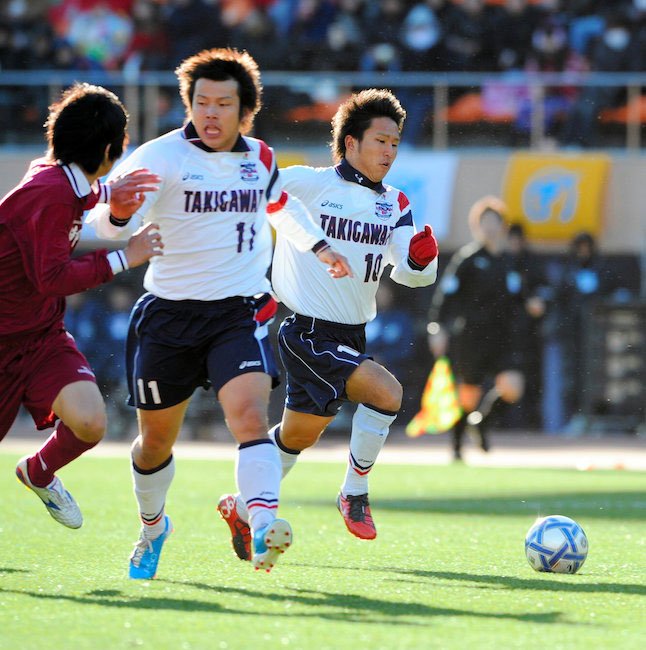
To get to those 262 games in J3, Higuchi has gone through a long road, which started in Takarazuka, Kyoto. Born in 1992, the young Hiroki enrolled at 16 into the Takigawa Daini High School. And he wasn’t even meant to be a striker – he was playing as a side midfielder. Then the coach converted him into a forward. And in the meantime, Shimizu S-Pulse were eyeing him for a spot in their squad.
And it wasn’t by accident, because Higuchi won the National High School tournament with Takigawa, being also the MVP and the top scorer. Back in 2011, S-Pulse were confident to have an extremely talented youngster in their hands – and they needed it too. The strange thing, though, is that in five seasons in their roster, S-Pulse will never field Higuchi in any official game. A lot of loans, instead, will come.
S-Pulse thought that some playing time in J2 would have done the job. That’s why Higuchi was sent twice on loan to FC Gifu, where he played both in 2012 and 2013. 35 games and eight goals in the rookie campaign, 34 matches and three goals in the sophomore year. Excellent numbers for a kid of 21 years old. Enough to gain a better loan, this time to Shonan Bellmare – who were just descended in J2 and needed more depth.
Unfortunately, Higuchi won’t see too much playing time in Kanagawa, featuring just 11 times and scoring once (even scoring on debut). At that point, it seemed the kid encountered a road block, and S-Pulse decided to send him even further down the ladder. It was indeed J3 time, with a loan to SC Sagamihara – and it worked: 11 goals in 31 games, Higuchi was finally blossoming. But it wasn’t enough for S-Pulse.
Fukushima-bounded
After four loans, S-Pulse – back then still a solid team in J1 – didn’t see any use for their anticipated youngster. So they let him go and Higuchi decided to move upper North, signing for Fukushima United FC. And the team wasn’t exactly thriving: in their first two seasons in J3, FUFC came seventh both times, in a league that at the time welcomed 12-13 teams. And FUFC won’t improve their results that much (besides 2021, when they came fifth).
Nevertheless, Higuchi found his space to thrive. He started with nine goals in the first year, and although he never reached again (for now) a double digits of goals in each of the seasons played in Fukushima, he did indeed gathered some records. He scored for 10 consecutive seasons in J3 (a record hold only by him), and he’s now third in the all-time scoring chart (with 56 goals).
And it’s been a long-standing performance by him, since he was in Japan’s national team conversation back in 2011, when he was playing for the Japan’s selection of high schoolers. Right after joining S-Pulse, Higuchi even featured in the Düsseldorf International Youth Soccer Tournament. We’ve seen lesser heroes wearing the jersey of the national team (yeah, the mind always run to that Japan-Uruguay match under Aguirre).
Higuchi is the man for Fukushima United FC. He holds several records with them:
- Most games with the club
- Most goals with the club
- 100% conversion rate of PKs with the highest amount shot (7)
- Third for minutes played in the history of the club
Okazaki II
And there’s a funny story that ties him to a great of Japanese football’s recent history: Shinji Okazaki. Both born in Takarazuka, both featured for the same high school, both started at Shimizu S-Pulse their professional careers. In fact, when Higuchi joined, Okazaki was about to win the 2011 AFC Asian Cup and move to Stuttgart. When it happened, Higuchi was allowed to inherit the no. 23 won by Okazaki at the club.
Unfortunately, that didn’t materialized because of an overlap in transfer windows between Japan and Germany, so Higuchi took the no. 22. But still – that’s a huge testament of trust and a strange coincidence. Even now that Shinji Okazaki retired – it happened last year after an adventure in the second Spanish division -, Higuchi still professes the will to play with him one day.
For a long time, Akio Yoshida – “Mr. YSCC” – was the leader for the table around games played in J3. Now three players have overcome his achievements – there’s also Kei Munechika of Kamatamare Sanuki. This has been a testament of time, about how J3 League has been evolving – e.g. we’re gonna have playoffs this year, it’ll be an absolute debut of this mechanism in the lowest division of Japanese professional football.
Higuchi has been accompanying this evolution from a remote place of Japanese football, because Fukushima are already a miracle to be at this party and they will have probably to watch themselves in the next years to avoid relegation from J3 if other realities will grow. But he’s been fundamental to keep this miracle alive – and he could have taken the record earlier if it wasn’t for an injury around May.
The weather decided otherwise, but the history is on Higuchi’s side. He’s just 32 years old and he’ll get time to write even more pages of this book.