J. League has turned 25 years-old in 2018 and many players are actually tied to the championship. It might be because J. League represented a low point in their careers or maybe they’ve actually grown into Japanese football, creating their own space and profile through a stint in the land of the Rising Sun.
“When We Were J. Leaguers“ is a new column of J. League Regista, where we’ll try to recollect with former J. League players their memories about Japan, their careers and the moments they spent in the championship. Behind the decision of coming to Japan, there are wishes, ambitions and goals which we can’t imagine: talking about their stories is a way to understand them better, in a more complete context.
Our first guest is one of the five Italian players who have ever featured in the Japanese professional world. He isn’t a former Italy NT member – like Massaro or Schillaci – nor a recent guest of J. League – like Desmond N’Ze or Michele Canini. We’re talking of Giuseppe Zappella, who played a year for Urawa Red Diamonds between 1998 and ’99, at the dawn of professional football in Japan.
He has lastly been in the staff of 2006 World Cup champion Fabio Grosso during his last managerial stints between Juventus Primavera and Bari, but Giuseppe agreed to chat with us about the year he spent in Japan in the late 90s.
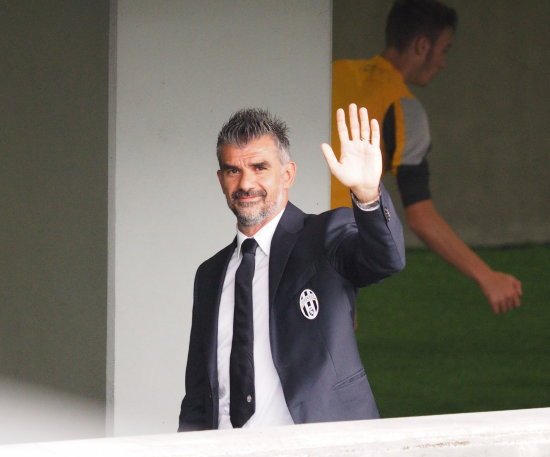
You were raised by AC Milan youth ranks, among many champions and potential young stars. Then you played for Como and Monza. How a Japanese opportunity rose for you? And how did you value it, since you would have been the third Italian player in J. League after Salvatore Schillaci and Daniele Massaro?
A Japanese offer was made in December 1997: it came from my agent, who said to me there was this chance, but still nothing solid. Then the offer became reality, but we had only a few days to decide: are we going or not? I talked with my wife, but there weren’t that many doubts: it was a professional chance we had to take.
I was quietly on vacation (in Summer of 1998) and just after a few days of coming back, I left Italy for Tokyo, after settling the bureaucracy to move there. I knew that only two Italian players featured in the J. League until then, big names like Massaro and Schillaci.
Urawa Red Diamonds are currently a big club in J. League, maybe the most followed among Japanese fans of the championship, and they’re the defending continental champions, strongly supported by Mitsubishi. But when you moved to Japan in ’98, the Saitama-based club didn’t have that leverage; instead, they got relegated to J2 in ’99 (the only time in the history of the club). What do you remember of your arrival in Japan?
As soon as I got in contact with the club, I realised how they were indeed a top club: their offices, the official store, and the training centre. They still played at the old stadium, the Urawa Komaba Stadium (they moved to Saitama Stadium only in October 2001): the new stadium was under construction. But the balance of the league was different back then, because three teams were dominating the J. League: Jubilo Iwata, Kashima Antlers and Yokohama Marinos. The Reds were a good team, but it was too complicated to compete for the top.
In my vision, firing Mr. Hara (Hiromi Hara, a legend for Urawa Red Diamonds and also for Japan NT) was a huge mistake: the methods of who succeeded him – Aad de Mos – were too harsh and different for the Japanese players.
I’ve left the club some months before the ’99 relegation. Reds’ supporters were always the best in J. League; already back then, it was impressive how many of them were following us, especially in away games.
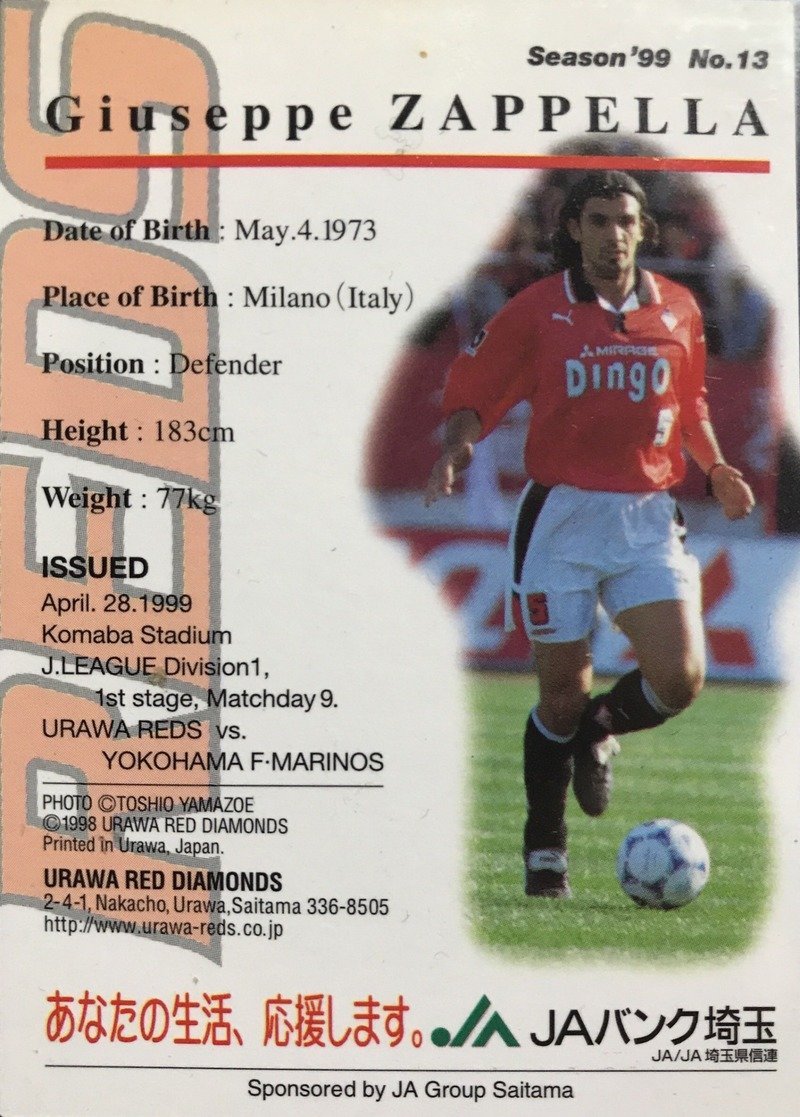
When you arrived, Hiromi Hara was the manager. He has been a legend both for the club and the national team during THE 80s and 90s (today he’s a member of the J. League committee). For how much you could understand, it was Hara’s choice to bring you TO Japan and reinforce the squad?
Hara-san was a legend because he was a wonderful person. I didn’t understand Japanese, but his profile was seen as a guide in the club: when I watched the faces of my teammates, I immediately figured out the respect they felt for him. There was a full trust in him, and I was really happy that he gave a green light to sign me.
Not only Mr. Hara, though, because you had the chance of playing alongside with other legends. Japanese ones, like a young Shinji Ono and Masayuki Okano. Or foreign stars, like Txiki Begiristain, who was a pillar at FC Barcelona and then excelled as a director both in Catalunya and Manchester City. How was it to share the field with them? And how was the experience with Japanese players?
Shinji Ono was a unique player: he used both feet with the same effect, and he had the vision of play. He was good in front of the goal and even better with an assist, but the thing that impressed me the most was how humble he was. He picked up all the balls used in practice after the session was over: an impeccable behaviour with both staff and club members, and he was always available to do that without anyone having to tell him.
About Txiki Begiristain… well, there he could compete in humbleness with Ono! I didn’t believe it at first: a player who won everything was available to teach me anything about that reality when I first arrived in Japan. He was always there for you to clear some things out. And he was still a fine player; he was incredible! I also cherish a great memory with the other foreign player, Željko Petrović.
Let’s just say my relationships were mostly with them, because the linguistic hurdle was too hard to overcome.
In Italy, football is lived in an almost unbearable atmosphere, more urgent every year that goes by. Maybe it’s due to the huge football tradition and history in the sport; probably the environment is different in Japanese football, both during THE 90s and now. What impressed you the most about the routine and life in your one-year experience in Japan?
I think football in Japan is seen as a sports-related entertainment, taken more lightly, both by fans and clubs. I remember the first time as a player at a match: no police, just stewards. Fans shared the same public transportation to go to the game; only inside the stadium, there was an away fans sector, but it wasn’t as well-controlled as in Italy.
I lived in the centre of Tokyo: to reach the Urawa Red Diamonds’ training centre, I took the bus (10 minutes of travel, never late!) to reach the Ebisu subway station and then two subway lines to reach the training centre. 45 minutes of trip, but every day was a unique experience: in Italy, you have to take the car to move and go to the training sessions. Every time I went out in the city, I felt like I belonged to a real metropolis of the world.
Like we said, just one year. In Summer ’99, you left Saitama and went back to Italy. Would you have preferred to stay FOR A LONGER time? The decision TO LEAVE is due to the new manager, Aad de Mos? Or you felt it was the right time to get back to your country?
Unfortunately, the negative results in the 1999 season led the board to change the manager. De Mos talked to me, saying that the foreign spots were only three, and he wanted to bring in new players. So I opted to go back to Italy. But still today I have a regret: not looking out for more abroad opportunities by only considering the Italian hypothesis (Avellino wanted me and I took that chance).
Two decades have gone by from that experience, and only two more Italian players have featured in J. League. Desmond N’Ze played little time between Gifu and Shizuoka, while Michele Canini accepted a loan move to Tokyo since Massimo Ficcadenti was the manager in the club of the Japanese capital. Given your experience and the J. League evolution in the last 20 years, would you recommend such experience? And what’s your final memory of that adventure?
I would not only recommend the Japanese football experience, but I’d invite today’s players – especially the ones who feature in lower leagues – to test every possible abroad experience. There are realities all over the world, which probably have the same level as our Lega Pro (now Serie C, the third tier of Italian football). They do give you a chance to live around the globe and live an immense cultural experience.

Just think about the language: if you play in two-three different leagues, you could learn languages that will open some doors in the future. I’m saying this because I’ve stayed too few months to actually learn Japanese (unfortunately I didn’t put that effort, yet I had some spare time: silly me!) and this is the other great regret I bring with me.
About Japan… Well, my daughter was born in Tokyo. Any other thing would be superfluous.
I wanna thank Mr. Zappella for the time he gave to JLR, and we all hope he’ll have another experience in coaching. Who knows, maybe it’s the time of a Japanese return? See you next for another episode of this newborn column!
Hi there. This is a really cool piece. We’d be very keen to host your content on footballfoyer.com. Get in contact should you have an interest. Thanks.
[…] the first guest we had for this column, it’s to move from Italy to Croatia. Eastern Europe-based players have […]
[…] the first guest we had for this column, we’re moving from Italy to Croatia. Eastern Europe-based players have […]