It’s not always easy to talk about all the profiles you’d like to mention when it comes down to the J.League. You’d like to cover players who don’t always get the spotlight, but they would deserve a shoutout for what they did in these years. And that’s why J. Legends was born as a column – there are men who spent their career devoted to places or realities that don’t always get a proper narration, and today’s protagonist is a good example of that.
Episode 4 has a different taste. Until now we’ve been talking mostly of folk heroes, although you might argue that being a Cerezo Osaka keeper for 20 years isn’t that folk. Well, we’re taking it up a notch this time, since we’ll tell the story of a young kid who came from the North and lighted up the J.League by becoming a legend in one of the biggest football clubs in Japan. And yet, his career is far from over.
“Kashima-ism” is something of a term I found in an interview talking with our protagonist. He learned it from legends in Ibaraki like Atsuto Uchida, Hitoshi Sogahata, but mostly Mitsuo Ogasawara – also another man from Tohoku. He learned the concept along the years: “When I think about these three people, I ultimately come to the word “guts.” […] Their focus was always on themselves, and they were always telling themselves, “Get more motivated. Do more.” I think that’s what the Kashima-ism that I learned is all about.”
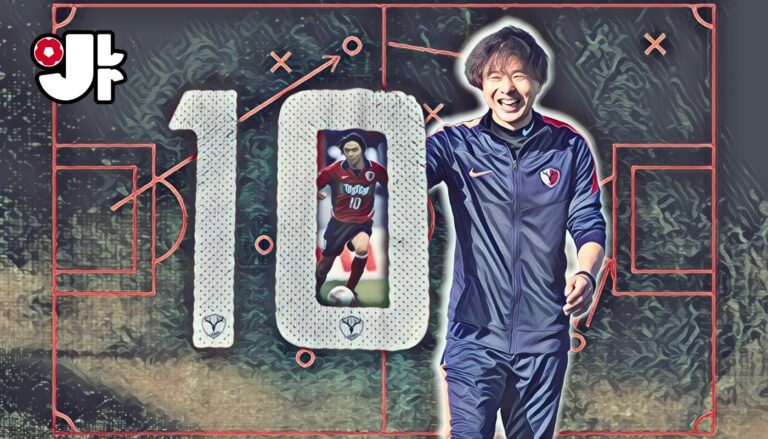
From the outside, Shoma Doi doesn’t strike like a tough character. His style on the pitch as well isn’t resembling of that grit-and-grind mentality that we’ve seen from Kashima Antlers since their birth. But his attitude does. When he was younger and joined Kashima, he was almost converted into a full-back, but he never gave up, and used that time to improve his defensive game. Doi has been used all his experience to improve, and he aims to do the same now in his home town, Yamagata.
In the Lion’s Den
Doi was born in Yamagata City, the capital of the homonymous Prefecture, back in 1992, and he didn’t leave until he was 13 – when Kashima Antlers made an offer he couldn’t refuse. He joined the club in the youth ranks, alongside some illustrious names. In fact, when Doi was promoted to the first team in 2011, he was enlisted in the senior roster with Gaku Shibasaki, Takahide Umebachi, and Gen Shoji. Two of them ended up being Antlers pillars and featuring in the World Cup for Japan.
Kashima Antlers were at the tail-end of their winning cycle and ready to face a restyle. The youth helped, although it was a rocky start – Doi featured in just 10 matches in the first two season as a pro. 2013 was a bit better, with 18 caps and the first two goals as a pro (although he had already some trophies in his cabinet, like back-to-back J. League Cups in 2011 and 2012, plus the 2012 and 2013 Suruga Bank Championship titles).
Nonetheless, the real breakout season came in 2014. Toninho Cerezo – who coached the team already for six years at the beginning of the 2000s – was back and put faith in Doi, by giving him a lot of pitch time. Especially in the league, the midfielder featured in all matches, scoring eight times and providing five assists. And the growth was testified also by another rite of passage in Japanese football: numbers.
Yeah, because there’s the tradition of inheriting the number of a great players also at Kashima Antlers. No. 8 meant Takuya Nozawa, one that I didn’t shy away from defining “the greatest to never feature for Japan” (and it still holds some degree of truth nine years from that piece). No. 8 was also worn by Antlers captain and legend Mitsuo Ogasawara in the early 2000s, so there’s a weight with that jersey. Doi wore it without fussing too much about it.
Growing Old
Despite Kashima entered a stage where they didn’t win anything but the AFC Champions League (and it’s a big “but”…) between 2018 and 2024, Doi was one of the legends at the club. He had an impeccable physical shape, since he never went under 31 games per season between 2014 and 2023. He was also capable of evolving from a tactical standpoint, since new head coach Masatada Ishii turned him from side midfielder/winger to a secondary striker under his tenure.
Doi made history also about global football. In fact, Doi was the first to score a penalty under the VAR rules in FIFA competitions – exactly in the quarter-finals of the 2016 FIFA Club World Cup against Atlético Nacional. Furthermore, the cabinet of the midfielder is incredible: he won basically with Kashima, including three J.League Cups, two Suruga Bank Championships, a J1 title, an Emperor’s Cup, a Japanese Super Cup and the AFC Champions League.
In the end, minutes decreased when Doi was about to turn 30. Take the 2022 and 2023 seasons: despite two different coaches – Swiss manager René Weiler and former Antlers player, Daiki Iwamasa, who also shared the pitch with a young Doi in a few matches –, the no. 8 played just 863 minutes in 2022 and 784 in 2023, most of them coming off the bench. The arrival of Ranko Popovic made his role redundant and Doi then decided to leave mid-season in 2024.
Nonetheless, I would give you an incomplete picture without mentioning Doi’s involvement with Japan… which wasn’t that much. But it’s a fun story. In December 2017, Japan are hosting the EAFF E-1 Championship, and Hiroshi Kiyotake got injured, so back-then head coach Vahid Halilhodžić to call Doi… who was about to get married. The manager even apologized: “I know he was preparing his wedding. He doesn’t need to cancel it, just to come a few days”. Incredibly, Doi came through and featured in two games – which are also the only caps with Japan.
The Great Return
For a man born in the North and who spent his whole career in Ibaraki, there was no other option than coming back home. That’s why Doi left Kashima in July 2024, and joined Montedio Yamagata in the second division, with the option of leading the team and just coming home to play football. And you could tell Doi was still able to make the difference at a lower level: he scored five goals in just 14 matches, bringing Montedio to the playoffs (where they lost in the semifinals against Fagiano Okayama).
Nonetheless, Doi was happy to come back. He had another good season in 2025, scoring eight goals in 34 matches and being the captain (although Yamagata came just tenth in the table). The happiness was mixed with bewilderment: “I’m surprised to be in Yamagata right now. I’ve been away for almost 20 years, so much that I don’t what to call home.” Doi also revealed that Yamagata approached him already a few years back, citing the need of proving himself at Kashima despite the troubles.
Leaving Antlers wasn’t easy, but Doi has been clear about his purposes in Yamagata: “In the last years there, I often played while injured. Now my physical condition has improved, and I wanted to play to show I have still something left in the tank. I think it is my mission to move things in a positive direction, both on and off the pitch, even if it is something small.” He didn’t lose any time in 2026, scoring already against Tochigi SC.
For me, Doi has been always the embodiment of a classy player, a bit like Yojiro Takahagi or Akihiro Ienaga. The best message over his legacy has come probably by another pure diamond like Yoichiro Kakitani, who told “Soccer Digest Magazine”, defining him as a genius: “He has great technique. When I watch Kashima’s games and the ball comes his way, I can’t help but lean forward and say ‘Wow!’. I can’t get enough of his amazing plays here and there”.
Maybe that’s what we all did throughout Doi’s career.