Some expressions are not easy to come up with. One of those that stuck in my head since I’ve heard was “The Possimpible”, which is an acrasis between “possible” and “impossible”. And it comes from an extraordinary place, buried in time. I don’t know how many of you remember and/or have watched “How I Met Your Mother”.
One of the main characters was Barney Stinson, a wacky and flamboyant character with always some tricks up his sleeve to win women over. This time, though, just wants to help a friend find a job. To do so, he advocates his sales techniques to his friend Robin to put together a video resume that will convince some TV networks to offer her a job (and avoid going back to Canada).
One of the taglines of that reel is – wait for it – legendary: “Nothing and everything is possimpible”. And that’s exactly how I feel every time I watch JEF United Chiba having a… season. Not a bad or a good one, just a season. It was tough in these 17 years to find a non-eventful season by JEF United, and even 2025 wasn’t that different.
But the ending, for once, wasn’t full of tears or disappointment. In a full Fukuda Denshi Arena, JEF United Chiba played and won the play-offs final against Tokushima Vortis, granting themselves a long-awaited return to the top-flight. And like Barney Stinson said in that reel: “Success doesn’t just come to you. It’s rather a state of mind”.
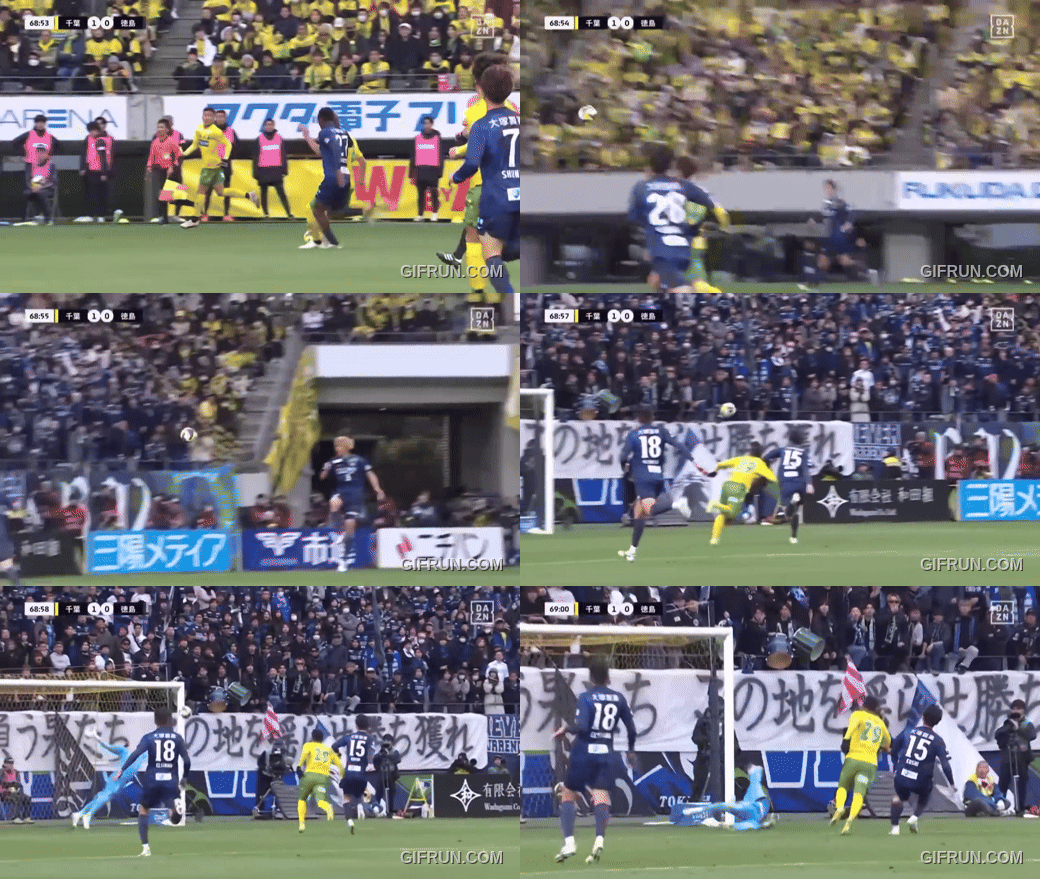
The Failures
JEF United Chiba got relegated back in 2009, when they were three away from having won their second J.League Cup, and they had their best period in the club’s history under head coach Ivica Osim. When Osim became the head coach of Japan, JEF United started drifting away, despite being one of the “Original Ten”, the clubs that started the maiden season of the J.League in 1993.
From there, it was one suffering after the other. JEF reached the Top 6 each season between 2010 and 2014. They had a terrible stretch between 2015 and 2020 – reaching the play-offs again just once in those years. In 2025, they played in the J2 play-offs for the sixth time in their history – they reached three finals, but they lost the first two against Oita Trinita (2012) and Montedio Yamagata (2014).
It didn’t matter that some prestigious head coaches managed them – like Takashi Sekizuka, Shigetoshi Hasebe or Yoon Jong-hwan. It didn’t matter that a JEF United Chiba player was the top scorer twice in these 17 years (Kempes in 2013 and Hiiro Komori in 2024). It didn’t matter that some solid players wore this jersey – in random order: Tomoya Miki, Yamato Machida, Matheus Saldanha, Koki Kiyotake, Ado Onaiwu, etc. Somehow, the oldest roster in the league (28,3 years old) couldn’t manage the pressure.
And even in 2025, despite JEF United starting the season with 10 wins in the first 11 games (which is the third-best start EVER in the history of the second division) and spending 25 out of the 38 rounds in the Top 2, still… it wasn’t enough to clinch direct promotion, finishing one point behind V-Varen Nagasaki.
And that happened despite JEF United Chiba having a monstrous roster – two starting keepers, Daisuke Suzuki as the captain, Taishi Taguchi in the middle, and a string of forwards that other clubs can just dream of (Hiroto Goya, Daichi Ishikawa, Naoki Tsubaki, plus Carlinhos Junior and Kaito Mori).
The Context
To give you some perspective on what happened since 2009, when JEF United Chiba played the last season in the top-flight:
- In these years, minnow clubs like Shonan Bellmare, Avispa Fukuoka all won their first trophy.
- Many other clubs played at least once in J1, including Tokushima (twice), Yamagata (twice), and Okayama (once for now).
- JEF United Chiba had a reserves team back then in the JFL, disbanded in 2011.
- JEF United Chiba had some national team players, such as Seiichiro Maki.
- Kashiwa Reysol, their fierce rivals in the Prefecture, did a full rollercoaster: they came back to J1, won the title as a promoted team, won other three trophies, got relegated again in 2018, got promoted again in 2019, and they’ve been there, taking over Chiba’s football dominance.
- Japan hadn’t played a knock-out game yet in the World Cup outside of the tournament hosted on home soil.
- Machida Zelvia and V-Varen Nagasaki were not even a pro-team, featuring in the JFL.
- J3 didn’t exist and was a long way from being created.
AND SCENE. It was so crazy that we even psychoanalysed JEF United Chiba’s fans in one article back in 2021.
The Merits
Of course, the credit for this long-awaited return must be shared among many. First of all, the head coach, Yoshiyuki Kobayashi, deserves a shoutout. He retired in 2013 after being mostly with Tokyo Verdy and Omiya Ardija (although he featured for six months at… Kashiwa Reysol), then he got into assistant management, first at Vegalta Sendai and then at JEF United Chiba. He was hired in February 2023, and he has one of the best PPG ratios in recent history among JEF managers (1.64 points per game).
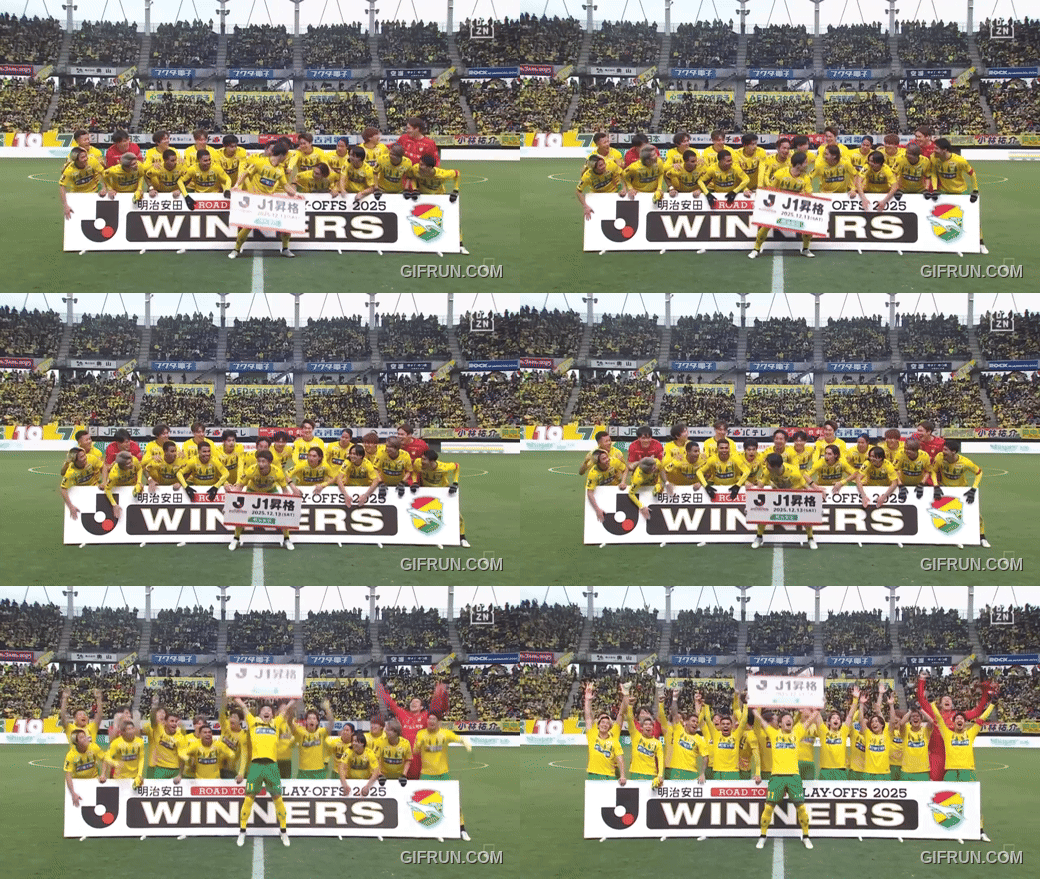
The squad was stacked, but the players delivered in the end. All the signings from last Winter – José Aurelio Suarez, Koji Toriumi, Carlinhos Junior, Daichi Ishikawa – worked pretty well. When some of them got injured – like Suarez – first Ryota Suzuki and then Tomoki Wakahara did their job in replacing him. The wingers department was also pretty much full, and JEF United Chiba did an extra mile in the Summer to add some more depth (Zain Issaka from Montedio Yamagata, and the loan of Kaito Mori from Yokohama FC).
JEF United Chiba were the best away team in the league (alongside Mito HollyHock), they were the third-best team once they were down (it happened 18 times this season, they got 17 points out of it), and they never lost once they took the lead (they actually have the best PPG ratio in those situations: 2.82 PPG, basically a sentence – they won 20 of 22 games they’ve taken command of).
Last but not least, the fans deserve a massive shoutout. Since the club fell into J2, JEF United Chiba had an average attendance always around the 10k-mark – sometimes going over that, sometimes close to that. Attendances took a dip already before COVID, with the last 10,000 average crowd back in 2016. Fans gathered again around the team after COVID, reaching an average of 10,431 in 2024. This year, they broke the record: 15,549, the best average attendance for the club since… 1994. They were the second biggest average crowd after V-Varen Nagasaki’s, and just for a few hundred.
It’s funny to observe how Ibaraki and Chiba Prefectures got their J1 derby together. And if there was never an Ibaraki Derby in J1, the last Chiba Derby in the top-flight dates back to 2009: two draws, plus another draw in the J.League Cup. To find a derby win by JEF United Chiba in a league game, you have to go back to August 2005. The only time JEF United Chiba won a derby in the last two decades was in a 2019 Emperor’s Cup match, which finished at penalties.
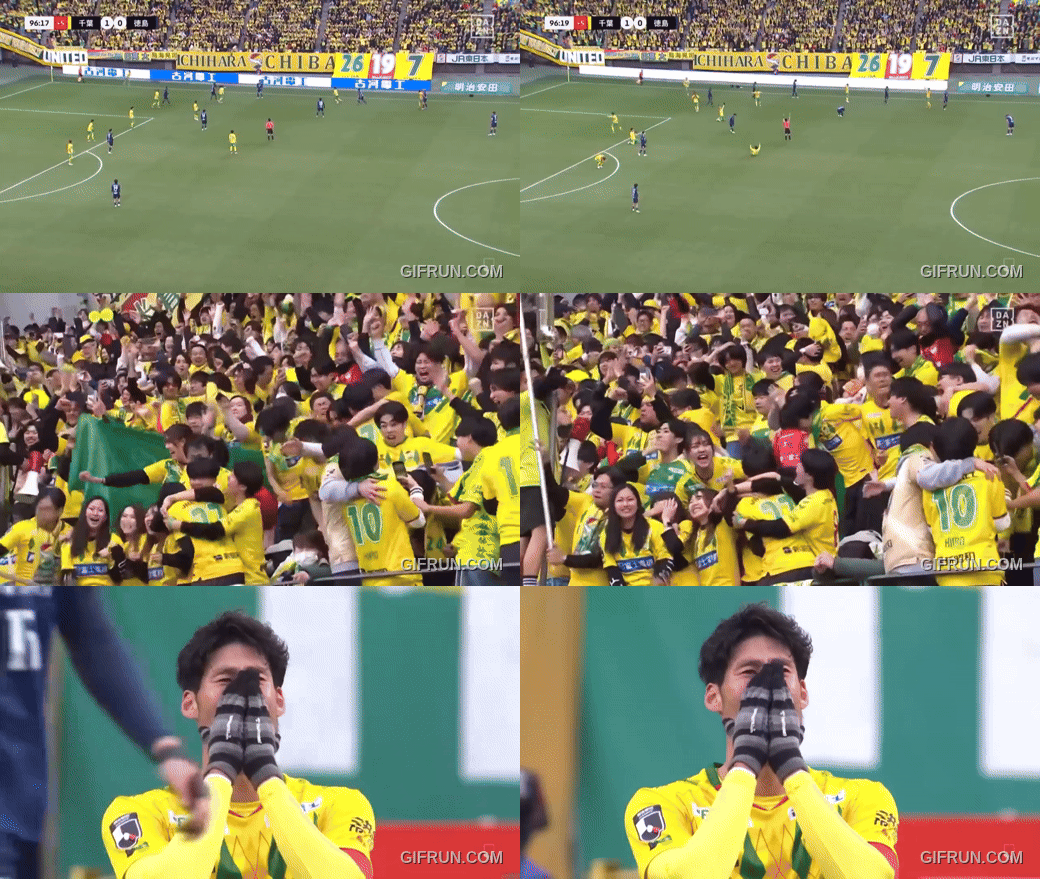
It seems impossible to think about it, but Chiba will finally have their two teams back in J1. It’s probably the same place Barney Stinson described once in that episode: “To the place where the possible and the impossible meet, to become… the possimpible.” A land where JEF United Chiba seem to live.