Substitutions are an essential tool in football. You can change the destiny of a game with just one move, especially if the player sent in can be decisive. But how is it to be constantly subbed in and never find a starting spot? Well, the protagonist of our story did live through that with his first club. Despite winning five titles over five seasons with such a club, he could never start.
He then left the first time on loan, but it didn’t work out. He left a second time, this time for good, in the hope of finding a better tomorrow. But it seemed that wasn’t going to work out… until the change became himself. What if I play in a new role? And what if changes my career? Big questions for a big forward, who came to J.League from Okinawa – and it’s not super easy to reach the pro world from there.
The chance to change his career came in January 2024, in a training camp in Miyazaki. “I’m sorry, I don’t have anyone to play there – could you give it a go?”, his coach asked him. The forward did it, and had fun doing it: “I was surprised too. It was fun and fresh. I felt like I was a kid again, trying new things”. And the experiment stayed because now the forward isn’t one anymore, and his pitch time changed.
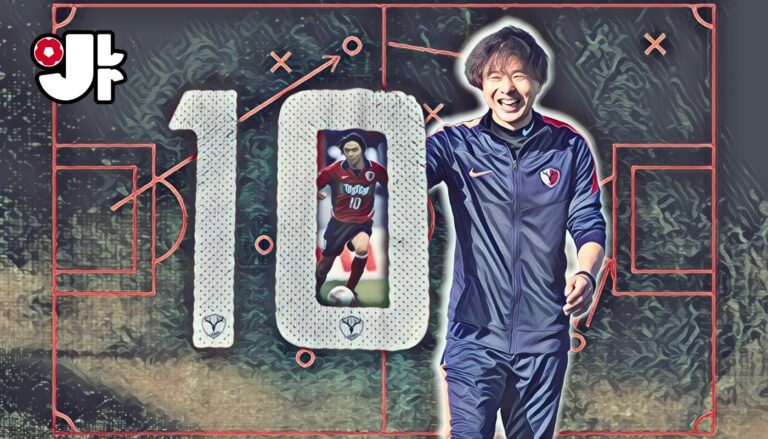
Kei Chinen doesn’t get subbed in anymore. That’s because now he starts, he has to play all the time in all games – just like it happened in 2024, where he never got subbed in for the first time in his entire career. Kashima Antlers turned his life around, and Chinen is probably enjoying his current role more than before: “It was harder to be a forward”, he admitted a few months ago.
The Ganaha’s Heir
Born in Okinawa in 1995, Chinen followed in his brother’s footsteps and started playing football. Funnily enough, he entered the club as a center-back. He kept playing, and basically gave up on college, thinking he didn’t have enough adaptability towards being disciplined. He even temporarely gave up football, but came back to graduate from high school and joining the Aichi Gakuin University.
He was so eager to enter the football program that he pleaded with head coach Masaaki Sakaida – who played for a decade for Nissan Motors, the pre-J.League form of the Yokohama F. Marinos – to join the team. After some physical tests, Chinen was admitted, and he started with the B team. He improved enough to feature in the senior team and became a sensation in the Tokai Student Soccer League.
That’s why Kawasaki Frontale were studying him closely. And it must be written in the stars that the head coach who selected him to join Frontale was indeed Toru Oniki, who back then just became the head coach of Kawasaki, replacing Yahiro Kazama. That 2017 was his baptims of fire – he didn’t play that much, but enjoyed the club’s run towards the first J1 League title ever.
Chinen scored one goal both in the J.League and in the J.League Cup, putting together just 10 games. But he won immediately – and most of all, he recalled another former Frontale player coming from Okinawa: Kazuki Ganaha. Indeed, Oniki saw something similar in him: “There are similarities, but I think Kei can do more. There’s potential for him to develop into a good player”.
Success and Concern
2018 saw minutes rising for Chinen – he started the first match of the J.League, and he racked up 27 games in J1, plus 10 goals in all competitions. Chinen kept that kind of “joker” role, playing as a backup and being an element of the rotation in a winning team. But Kawasaki Frontale didn’t need him as a starter – whether they had Yu Kobayashi or Leandro Damiao up front, they were good.
In the end, Chinen was exactly what Frontale needed. He didn’t play as a starter because he was way more effective entering the middle of the game, and used his strength and stamina to shuffle the cards on the table. Oniki used this move a lot, and it’s not an accident if, by looking at Chinen’s stint with Frontale, he gathered 144 caps with the club in all competitions, but 94 times as a substitute throughout the games.
Chinen had a tryout somewhere else in 2020. When he understood minutes were not there for him, he moved on loan to Oita Trinita – a club which lost both Noriaki Fujimoto and Ado Onaiwu. But despite Katanosaka’s game plan counting a lot on the no. 9, Chinen let down expectations: he scored just three times in 29 games, losing his certain starting spot and scoring less than Tatsuya Tanaka (8) and Yuya Takazawa (6).
When he came back to Kawasaki, he stayed with Frontale two more years, but at 27 years old, he wanted to prove his point somewhere else. That’s why he picked Kashima Antlers as the next destination – maybe a grit-and-grind kind of football would have worked for him. But that’s where his career changed trajectory, after a first year in Ibaraki in which he hadn’t played that much, and scored even less (just five goals in 21 J1 games).
New Role, New Life
In 2024, Kashima Antlers hired Ranko Popović as the head coach. The aim? Try to reach again the AFC Champions League spots. Midfield was a dream one – former prodigy Gaku Shibasaki and young upcoming Kaishu Sano. The problem was that Shibasaki got injured in training camp, and that’s where the Serbian manager thought of something diabolical: why don’t we play Chinen in the midfield?
In the end, he had strength, which was fundamental in that role – and Antlers didn’t have too many options in that position. Chinen started as a holding midfielder in the opening match in the J.League against Nagoya Grampus, a 3-0 away win. He never left that spot, played 33 matches, and won 138 duels in the whole season. Not just that – Chinen featured in the “Best XI”, the first Okinawa-born player to do so.
Now that the switch is official, and Chinen became even vice-captain at Antlers, a circle was closed when Kashima hired Toru Oniki as the new head coach. As Oniki remembered the start of Chinen with Kawasaki, he insisted on the ductility of his players: “I couldn’t imagine it either, but I like players who can fit multiple positions. We gotta have different solutions in our hands”.
Funnily enough, Chinen just decided another game, this time against Nagoya Grampus, and Kashima Antlers are easily sitting second in the table, just behind Kyoto Sanga. In the end, it was like Ranko Popović said that day in Miyazaki: “My theory is that good players can make it regardless of their positions. The important thing is for him to accept the role and enjoy it”. Chinen did something more than that – he’s thriving in it.