Mid-2011. We’re almost coming into Summer. Same YouTube trip, looking for Japanese players to discover, since I was just reapproaching Japanese club football after a long time. Meanwhile, though, the server points me towards a strange video. There’s a kid with a Barcelona shirt.
He plays for the youth sector of the Catalan club, and no one has ever heard of him, if it wasn’t for that heavy tag: “Japanese Messi”. It’s probably because of his reflexes, his skills in bringing up the ball and dribbling every possible opponent. Of course, references to Captain Tsubasa keep flowing, but you can see there’s something behind the useless hype.
That kid is Takefusa Kubo. He was only 10 years old back then, but the people who discovered him in an FC Barcelona youth camp in Yokohama weren’t anything short of praising:
“The best of those kids, by far – said Oscar Hernandez, his trainer at Alevi D –. I remember how I was impressed by him. The best player of that camp was awarded a trip to Barcelona and then we decided to follow his growth”.
An absolute investment for the club, with the young Takefusa even speaking a little Spanish. You would have probably thought of another wonder kid ready to disappear when things get tough. Takefusa Kubo, though, doesn’t seem to belong to that category. And Japan played a massive part in making him the player he is today, the same one who is owning the J.League despite being a 17-year-old kid.
Why he’s back
Born in 2001 in Kawasaki, Kubo was selected in August 2011 to play in La Masia and grew under Barcelona’s care. In his first season for the Alevin C, he was the top-scorer with 74 goals in 30 matches: a massive number, but nothing unheard of (just look at Michael Owen’s number before shining with Liverpool). Everything seemed to go pretty well for this gifted kid.
After all these efforts, you would also say that’s strange seeing him back in Japan. The point was never a chance at all. After four years in Barcelona, the club was found guilty by FIFA: apparently, the Catalans violated international rules about transfer policies for U-18 players. Nothing new, unfortunately, but this made Kubo unavailable for a different development in his career.
This basically forced his return home, a return that Kubo probably hadn’t planned. A return that saw him jump ship to the other side of the Tama River, playing for FC Tokyo. Despite no one seeing him play in Japan, the hype was real: having featured for Barcelona put Kubo in a different position, way ahead of many talented Japanese footballers.
Everyone immediately felt this was a temporary return, just like an Erasmus for a student abroad. Takefusa Kubo is Japanese, but it probably didn’t feel like this, given his stint at Barcelona at such a young age. Seeing him back in Japan, actually featuring in J. League and with a pro-club, gave fans a chance to taste if this kid was the real deal.
Oh, little did we know.
A slow growth
In 2016, FC Tokyo were just under new management: after Massimo Ficcadenti left, Hiroshi Jofuku came back, but his second reign with the capital’s club didn’t work. Yoshiyuki Shinoda didn’t work as hoped, and the squad was in shambles. To get by until the end of 2017, the board changed the manager again, with Takayoshi Amma just surviving the season.
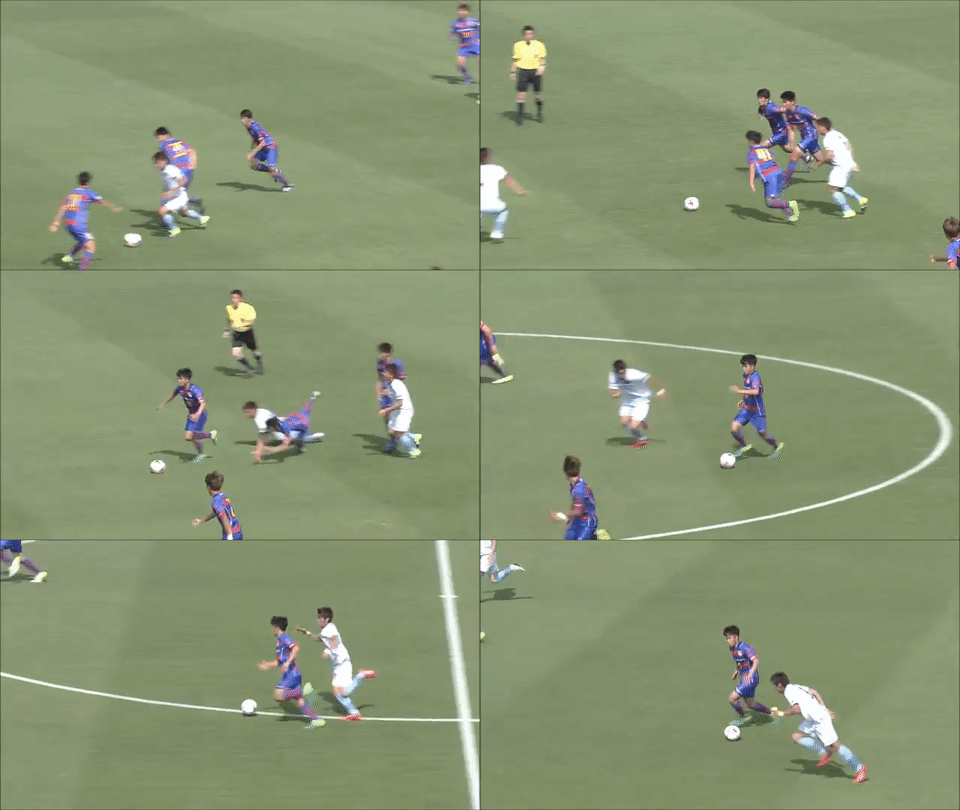
In all of this, Takefusa Kubo made it immediately clear that playing with kids wasn’t an option anymore. FC Tokyo fielded him with their U-18 side, but the former Barcelona prodigy – who, by the way, was playing football with kids two to three years older than him – proved that he was already beyond that level. FC Tokyo won back-to-back U-18 titles, and Kubo hoped to progress.
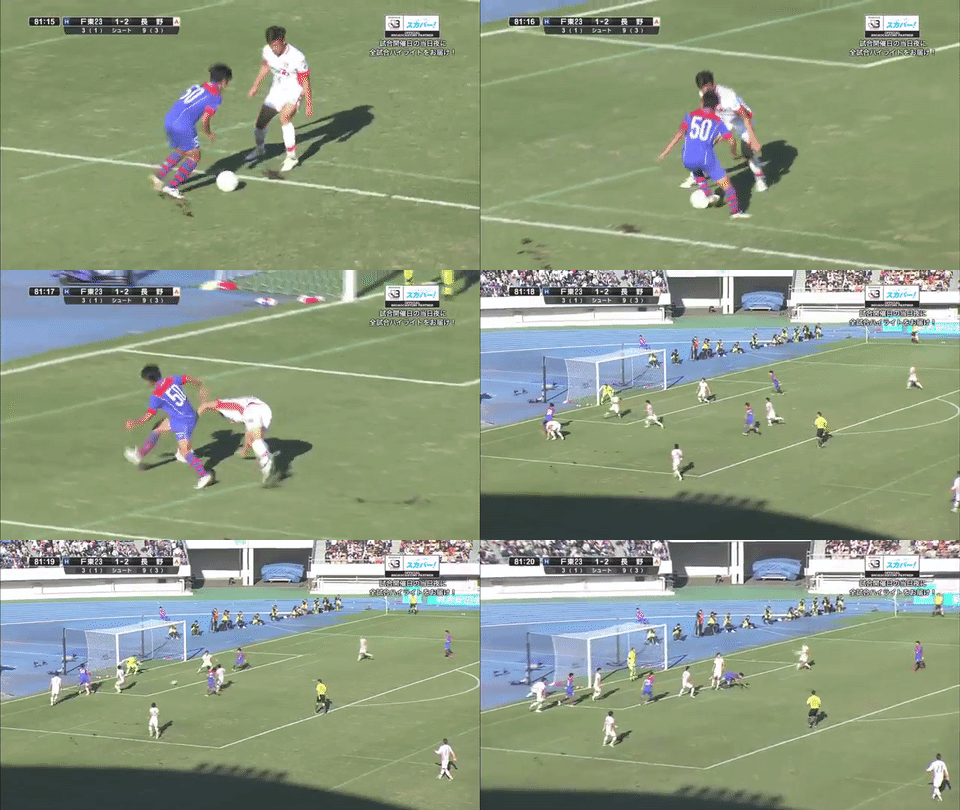
Meanwhile, the club opted to register him as a pro-player and send him to the U-23 side, which in 2016 was featuring in the J3 League for the first time. And on November 5, 2016, a crowd of 7,653 at Komazawa Park Stadium was eager to see the professional debut of the next big thing in Japanese football. He also broke a record, becoming the youngest player to ever feature in a pro football match in Japanese history.
It was just a glimpse (three appearances, no one for a full game or a starter), but it was enough to spark curiosity. In 2017, Kubo mainly featured with the U-23 team, even scoring his first pro-goal against Cerezo Osaka U-23. He then scored a second against Gamba Osaka U-23 in November, but most of all, he was given some chances of featuring on the first team.
Kubo made a couple of appearances during J. League Cup and most of all debuted in J1 League at the end of a terrible season. First 23 minutes in an away defeat in Hiroshima, then 10 minutes on the last matchday of the season, closed with a 0-0 home draw against Gamba Osaka. Which, accidentally, is the team of his next manager, who’s also the current one and a good part of his maturation despite being 17 years old.
Signs of greatness
That growth has also been evident through displays with Japan’s youth teams. Kubo was dominant in the continental stage, even underage, and he was good in the world stage, playing first the U-17 World Cup and then being called for the U-20 WC in South Korea. He was basically a super-sub, but he was already decisive on his first appearance against South Africa with an assist.
Meanwhile, in Tokyo, there had been a change. Kenta Hasegawa became the manager of the club, with a different and expert approach to change the future of a crumbling club. This move was also beneficial for Hasegawa, who won everything with Gamba Osaka, but whose fans couldn’t stand his cycle anymore, probably closed already after the 2016 season. So, a chance for both parties to start over.
Somehow, it worked. FC Tokyo had a blistering start in the 2018 season, when they were the runners-up of the league for many weeks, being in the Top 3 for 17 matchdays. From July, the season was substantially screwed, with Hasegawa’s boys winning only two out of the last 14 matches. It seemed like Gamba’s 2017 season all over again, but it wasn’t, because the turnout of this year has been radically different.
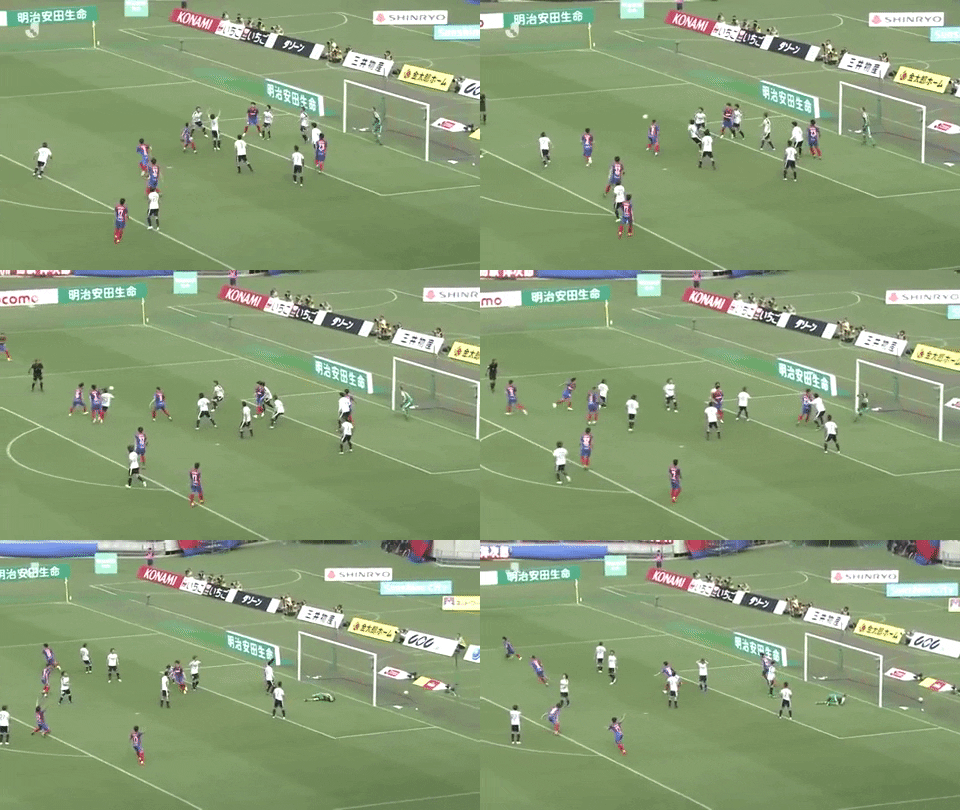
At the two-week break for Copa América, FC Tokyo are clear at the top of the table with 33 points, losing only once and hammering every possible opponent at home. The Ajinomoto Stadium became a fortress (eight straight wins), and there’s no case against FC Tokyo topping the table, because they’re a solid team. There is no star, but maybe because the real star here is Take himself.
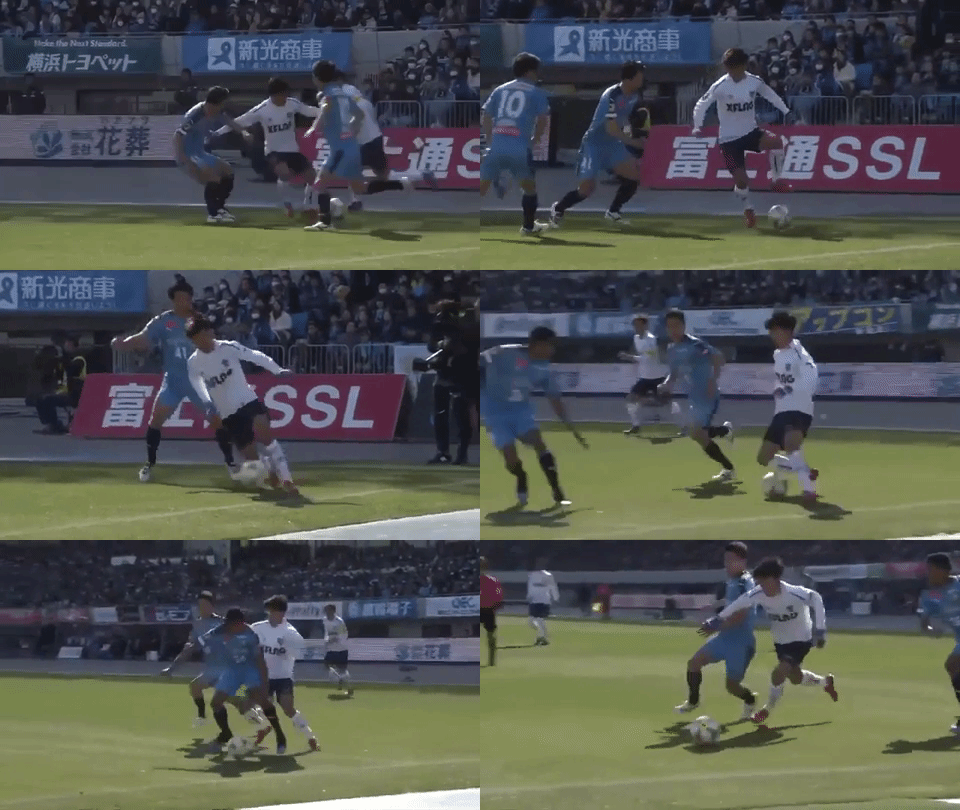
In 2018, the season was contrasting. Kubo proved himself to be too good for J3 (three goals in 10 matches), but there wasn’t any space in the first team, with the kid mostly featuring in the J. League Cup. Without a cap in the seniors’ squad, Kubo opted for a loan at Yokohama F. Marinos, where he played more and even found the first goal in J1. After five games, he came back to FC Tokyo, where plans changed.
Surrounded by many expert players in J. League – captain Keigo Higashi, striker Diego Oliveira, Akihiro Hayashi, Kensuke Nagai, Masato Morishige, with also rising profiles like Kento Hashimoto and Sei Muroya –, Kubo gave his best, free from any tactical chain, even if Hasegawa is using him as a link between midfield and the forwards. While he’s starting as right midfielder in the 4-4-2, he’s actually a decentered “10”, a winger, the link for Nagai and Oliveira.
The final leap
Although he’ll turn 18 in a few days, there’s no doubt Takefusa Kubo will be one of the best players of Japanese history. It might be risky to declare this now (do you remember Usami bossing J. League and then living on the bench in Germany?), but his potential has been analysed for many years, and it’s there; you can’t deny it.
The question now is another one: can Kubo impose himself in Europe? Can he virtually go back to Barcelona and conquer the world, maybe even dreaming of being the real heir of Lionel Messi’s throne? Tough to say. I’d say impossible due to Leo’s place in the history of football. But there’s a point to crack here.
If he goes back to Europe (this isn’t still clear), Kubo won’t have to overcome a linguistic hurdle, because he speaks decent Spanish. He won’t have to work too much on his technique, rather on his understanding of the game and on his muscular strength (yeah, that frail figure may not be enough to win it all in Europe). With that talent and those communication skills, half of the work is already done.
The final leap won’t be easy for Kubo, who might have become accustomed to the unbelievable attention in his regard, but he’s still a 17-year-old (sometimes I have to remind myself of this concept) and needs space to grow freely, without feeling trapped by his golden skills. In a few days, he’ll certainly play his first matches with the Japan national team, for whom he might also appear at the Copa América.
We don’t know if this home game against Oita Trinita will be remembered as a send-off match, a good-bye. Will this winning brace and this unbelievable play on Rei Matsumoto be the last flashes in Japanese club football? Surely, though, this Summer will be a decisive one for his career and his life; this Japanese Erasmus, somehow, served the purpose of making this experience unforgettable.
[…] Tokyo. And actually he did a solid job in the first two seasons, with echoes of a title-run in 2019 when Takefusa Kubo was around. Then something broke anyway, despite winning the 2020 J.League Cup: rough performances to watch, […]