I’ve always been fascinated by the concept of “mirai”, which is the Japanese term for the future. And I’ve always been fascinated from a Japanese perspective because, as Europeans, we’re not used to thinking too much of the future. It’s probably a feat lacking in our Western system (damn, I’m Italian – I should know way too much about this).
Instead, being passionate about Japanese football, I’ve always gazed with a mesmerising view at how Japanese people are capable of planning on the long road. For example, in 1932, Konosuke Matsushita – the founder of Panasonic – articulated to the nation his vision for the company for the successive… 250 years, broken down into 10 phases. That’s incredible.
And looking at the J.League, I’m thinking about the same view. Which clubs are looking in the long term, especially outside of their borders? Maybe these clubs are not even involved in a pro-world, but they nonetheless have the perspective of thinking about their future. And that’s why we called this column “Mirai Calling”: because the future is way nearer than we think.
And for some clubs, that future is now. Take Kamakura and what’s happening at Kamakura International FC, where the club has been launched with the intention of being international from the start. To talk about it, we’ve been in contact with Gen Enomoto, the person in charge of comms at the club, and we asked a few questions about the club’s trajectory.
How did the club come to life? And why was Kamakura picked as the venue for such a purpose?
Kamakura International FC was founded in 2018 by Kentaro Yomo (四方健太郎), with a strong belief that football could serve as a bridge between Japan and the world. At the time, there were very few clubs in Japan with a truly international vision or concept. Our mission was to create a club from scratch that embraces diversity and global perspectives, both on and off the pitch.
Kamakura was chosen not because it had a rich football culture—in fact, it didn’t—but because of its unique mix of tradition, international recognition, and strong sense of local community. We saw it as the perfect place to introduce something new, inclusive, and inspiring through football.
What’s your role within the club?
I’m part of the club’s communications team, where I help share our story with fans, media, and supporters in both Japanese and international contexts.
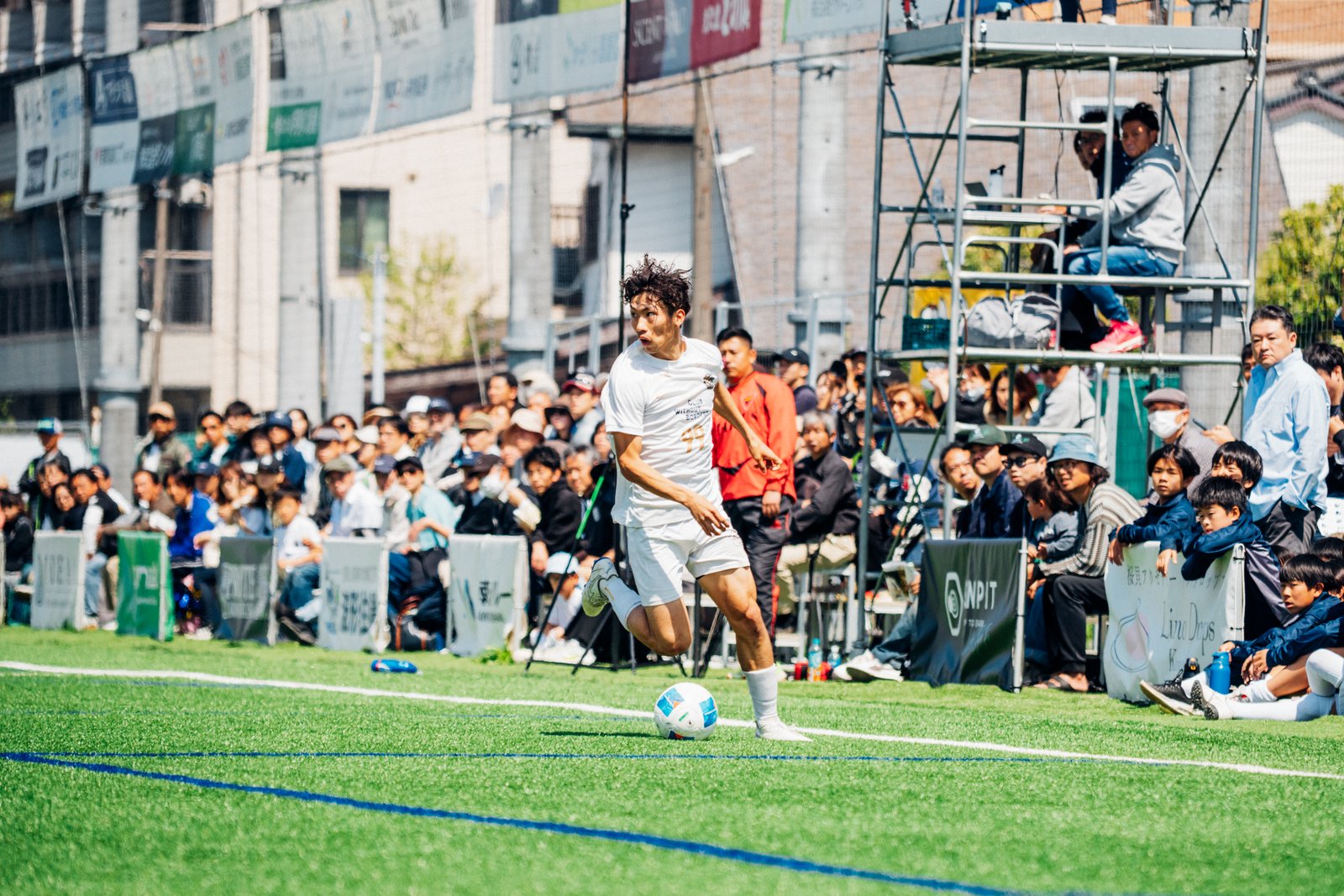
In addition to my role in communications, I also serve as a photographer for the club. Since I speak English and Spanish, I often support outreach and content that connect with people outside Japan. Through visual storytelling and multilingual communication, I try to reflect the club’s global vision.
You’ve already climbed two divisions within the Japanese football hierarchy. How has the club evolved since it was founded?
We started in the lowest tier of Kanagawa Prefecture football, and our first-ever training session had just one player. In our first season (2018), we won promotion to the 2nd Division of the Prefectural League. Then, in 2022, we achieved another promotion to the 1st Division after a dramatic comeback win in the playoffs.
During this time, we also developed our first home ground: “Minna no Hato Sablé Stadium”, a modest but meaningful venue in Kamakura. It was a symbolic step that allowed us to establish a stronger presence in the community and host matches with our own identity. Since then, we’ve grown not just on the field, but also off it—building a youth academy, expanding our team of staff, and enhancing our communication and branding.
I’m particularly impressed by your approach to the outside, to whatever it’s not Japanese. The website is already good, but it’s pretty well-built as well in English, and in the vision of the club, your goal is to overcome borders. Is it something that you have achieved until now? Recruits for 2026 are already open, I saw.
Thank you very much—we really appreciate that observation. From the start, we’ve aimed to build a club that is not limited by language, nationality, or borders. Our website and content are available in both Japanese and English, and we try to communicate in ways that allow people from outside Japan to engage with us naturally.
In that sense, we feel we’ve been able to carry out much of what we originally envisioned. That said, we’re still just getting started—we want to expand our reach, try new things, and keep evolving our international identity as a club.
And that’s reflected also in the communications department – Facebook, Instagram, Twitter, and YouTube all have a coherent approach. What was your idea on how to communicate the vision of the club once founded?
From the beginning, we saw communication as a core strategy—not just to inform, but to inspire. Our vision of “Club Without Borders” had to be reflected in everything: our shirts, our social media tone, our community activities, and our partnerships.
Rather than relying on traditional formats, we’ve tried to tell stories—of players, fans, staff, and the city itself. We use Instagram, Twitter, Facebook, YouTube, and other platforms in a unified way to share not just results, but the culture and values behind the club. We believe that design, photography, and storytelling that resonate visually can go beyond language and help us connect with people from many different backgrounds. We want anyone, anywhere in the world, to feel they can connect with us.
There’s also the Goldcrest Stadium Kamakura, which opened last year. What was the intent of the project?
The opening of Goldcrest Stadium Kamakura in 2025 was a major milestone for us. The project was made possible through the support of local businesses and crowdfunding, and it symbolises our commitment to building something meaningful with the community.
That said, the current stadium is still a temporary solution. Our long-term goal is to build a permanent stadium in Kamakura—one that will become a true symbol of our club’s identity and vision, and a hub for local culture and international exchange.
You’re currently playing in the Kanagawa Prefectural Amateur League, which is the seventh level of Japanese football, below the Regional Leagues and above the Prefectural Leagues. What’s your goal in terms of results?
Our main goal is not only about climbing divisions. What truly drives us is our vision of becoming a “Club Without Borders.” We want to build a lasting presence in Kamakura, including a permanent stadium, and use football to bring people together across backgrounds, languages, and countries.
Of course, we hope to progress to higher tiers such as the Regional Leagues and ultimately the J.League. But every step is part of a bigger journey: one that invites more people to take part in something meaningful and global, right here in Kamakura.
We want to thank both Kamakura International FC and Gen Enomoto himself for the availability shown for the purpose of this interview. If you want to follow Kamakura International FC, I can’t recommend their channels enough, especially Twitter and YouTube. I would strongly recommend following Gen as well on Instagram, where you can find his amazing work.
“Mirai Calling” is a new column for J.League Regista – you can see many more here. And hopefully Episode 2 will come soon!