Take the 18 clubs in J1. Take the 22 clubs in J2. Take these 40 clubs: got them? Can you point out to the most humoral one? If we had to make a pick, ours would be Nagoya Grampus. The Toyota-funded reality has lived a huge fall, even if this happened steadily, without a sudden dismantlement. Once the legendary manager and club figure left the club, everything started to fall apart.
Yet this happened despite Nagoya lived through a rollercoaster, coming back and forth from enthusiastic times to absolute disaster and misery. Not even a managerial change changed something last season, but nevertheless Grampus were one of the most active clubs in the last two Winter transfer market windows, only to end up avoiding relegation twice for an inch.
In 2020, it seems clear that this season is gonna be crucial for the club, because they desperately need a real silver-lining here. And Massimo Ficcadenti will have to get that by changing the core of Grampus’ football brand from the roots, switching from an ultra-offensive amusement park to a defensive side capable of gritting around and clinching solid results.
Something that Nagoya Grampus never have been in their recent past, let alone in their history.
The long and winding road
Among the 10 founding J. League clubs, Grampus – alongside Sanfrecce – were the most recent winners of the championship. We know about Hiroshima’s dynasty, but in 2010 Nagoya finally snatched the title with some games to play and a wonderful season by the club. Seigo Narazaki won the MVP (only goalkeeper to do that), Joshua Kennedy was the top-scorer and Dragan Stojković was named Manager of the Year.
After this crucial win, it seemed that Nagoya could push this positive moment further in time. They won the 2011 Japanese Super Cup, but then they steadily started to fall. They ended third that year, seventh in 2012 and thirteenth in 2013, ending so the stint of the Serbian manager and club legend in Nagoya. It wasn’t easy to pick up this legacy, but the board had some plans for that.
Akira Nishino was hired and that was huge, because Nishino had just ended his huge stint at Gamba Osaka, although his experience at Vissel Kobe lasted only six months. Nishino was a solid name to push for Nagoya, but the only thing he could with an aging roster was getting a solid mid-table position, ending tenth in 2014 and ninth in 2015. Unfortunately, nothing improved from there.
The board chose another club legend to pick it up, Takafumi Ogura, but it couldn’t have been a worst mistake: he represented one of the most puzzling choices we’ve witnessed for a J. League bench in the last decade. It didn’t work and Ogura had to resign in August; the club even tried to bring back the already retired Tulio and brought Boško Gjurovski – the former assistant of Stojković – on the bench for three months.
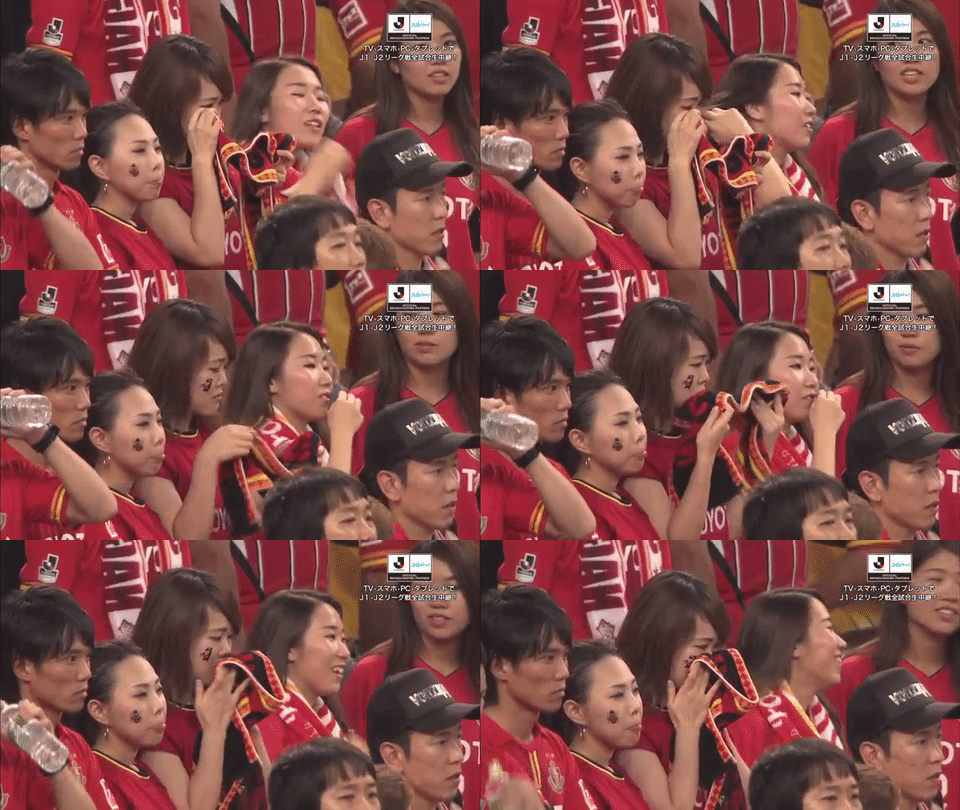
He tried his best, but a bizarre lost at home for 3-1 against already-relegated Shonan Bellmare pushed Nagoya for the first time in the second division. After the relegation, Grampus needed a revolution and they got it. The only detail? The results haven’t gone as forecasted.
The missed revolution
The Kazama-show was promised and a show was indeed. Unfortunately, for Grampus fans, the huge premises weren’t kept alive by the manager. At the time of his hiring, Yahiro Kazama had a massive reputation, despite he hadn’t won anything in his four and a half years-stint with Kawasaki Frontale and the reputation of always coming short on the finish line.
But this wasn’t a problem for Grampus, since they were mostly interested about the beautiful brand of football Kazama proposed at Frontale: Yoshito Okubo revitalized his career under him, Yu Kobayashi and Ryota Oshima flourished and Frontale always occupied a position in the left part of the table, coming second in the last season of Kazama at the helm of the club.
The Winter signings in that 2016-17 gap were actually promising. They lost a lot of senators – Myojin, Tulio, Takeuchi, Ogawa – and a couple of key-players – Nagai and Kawamata, for example –, but they also acquired solid profiles, such as Hisato Sato, Kazuya Miyahara and Yuki Kobayashi. They’ve also purchased several J2-leaguers and they saw the return of Keiji Tamada.
Despite these signings, revolution never got the right pace. Nagoya spent only six out of 42 games in the Top 2 and none of these moments happened in the second part of the season, the most crucial one. Actually, after 19 matches, Grampus were seventh. It took a huge change on the Summer transfer market – getting rid of many players while signing super-classy Gabriel Xavier – and an oversight from the referee in the playoffs final to get back to J1.
Most of all, the second part of the season showed the true spirit of Kazama-ball: being extremely nice on the eyes, but also massively disruptive in terms of emotions. Nagoya won 5-2 against Yamaga, 4-3 against Zelvia, 6-2 against FC Gifu, 4-2 against Gunma and most of all 7-4 at home against Ehime, in a game that probably embodies everything that Kazama stands for (going up 4-0, caught back at 4-4 and then winning with that score).
To put in place the plan Kazama had in mind, Grampus needed players with a high technique, with some skills. But most of all, they needed some stability, which is something harder to grant when you’re playing at a lower level. Nagoya closed the season with 85 goals scored (best attack by far), but also the sixth worst-defense (65 goals allowed).
There were problems with the defensive line and Seigo Narazaki – captain, legend and real spirit of the club – looked out of place in the Kazama-ball. In fact, the manager opted to bench him in the last games to field Yohei Takeda, who played the final part of the season and the two playoffs games. That’s why Kazama needed another boost in Winter 2017-18 to face the return to J1.
Kazama staged another revolution driven by Toyota-money, getting rid of another bunch of players – among them, there were fan-favorite Taishi Taguchi and Robin Simović – and acquiring huge players, like the Australian goalkeeper Mitchell Langerak and most of all Jô from Corinthians. The Brazilian striker had just won the MVP and scored 18 goals in Série A, granting Grampus sure goals to keep the pace.
And if Jô did play indeed a wonderful season – at least his debut in Japan was good, scoring 24 goals in 33 matches –, but the Kazama-ball still struggled, even in J1. Most of all, results were a constant rollercoaster. Grampus collected both the longest losing run in the league (eight defeats in a row) and the longest winless run in the year (15 matches without a W).
At the same time, though, Nagoya found themselves a run to avoid relegation after the World Cup break: they scored seven wins in a row, defeating squads such Kashima and Urawa. They closed the year surviving the relegation scare by drawing 2-2 at home against Shonan Bellmare and avoiding the playouts thanks to a Kentaro Oi’s own-goal against Frontale in the injury time, when the game was already over in Nagoya.
Despite another Summer boost – in 2018, Grampus got Eduardo Neto, Maruyama, Nakatani, Kanai and especially Naoki Maeda –, Kazama just survived and they finished the season with the fourth-best attack and the worst defense (tied with relegated V-Varen Nagasaki). Yet Kazama was indeed confirmed at the helm of the club. It seemed a last measure from the board, incapable of turning this around.
Another Winter revolution didn’t seem enough: Nagoya acquired Yonemoto, João Schmidt, Mateus on loan, Chiba and Akasaki, but performances on the pitch weren’t encouraging. And keep in mind that in all this mess, Nagoya did indeed develop a lot of talent: Yukinari Sugawara is currently playing for AZ, Ryoji Izumi and Ryota Aoki are decent players, Yuki Soma might be a JNT-member in a few years.
Yet, no balance and no constant results: in the end, Kazama-ball failed. Massively. Grampus found themselves indeed in second place after Matchday 12 (losing only once in those games), but then remained without a win for 11 games and three months. Actually, Nagoya won just two games in 23 matches, despite risking way less than the previous season.
In this mess, the board took a decision and fire Kazama, after the manager risked already to be axed mid-Summer. But that’s his successor to have been pretty surprising.
It’s restauration time
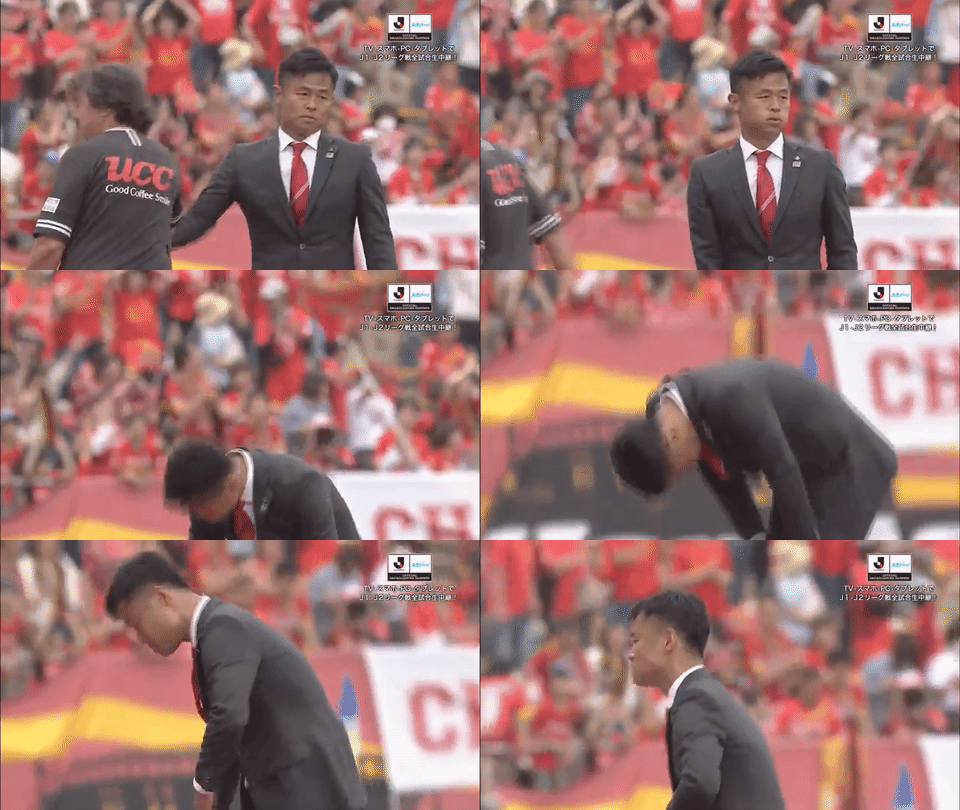
You can not have a wider jump in envisioning football and its application from Yahiro Kazama to Massimo Ficcadenti. Yet, the board of Nagoya opted for this move already in September, when the international break just ended and Grampus lost three in a row. At that point, Ficcadenti had the mission of avoiding a collapse: Nagoya picked up only six points out of eight games, but it was enough to avoid the drop.
Ficcadenti switched from the 3-4-2-1 to a four men-defensive line, in order to find a better balance for the team. It worked partially, because some players weren’t clearly good choices for the new manager. And still now, you have some doubts: in his first games of the 2020 season, the Italian manager opted for a 4-2-3-1 and most of all got rid of some elements – Edoardo Neto, Izumi, Akasaki – and got new pieces.
Hiroyuki Abe, Ryogo Yamasaki and especially Sho Inagaki look like players who could thrive under Ficcadenti. At the same time, Mateus and Soma are back from strange loans – none of them was confirmed neither at Marinos nor at Antlers – and now Grampus have a decent amount of talent to emerge from the relegation dogfight.
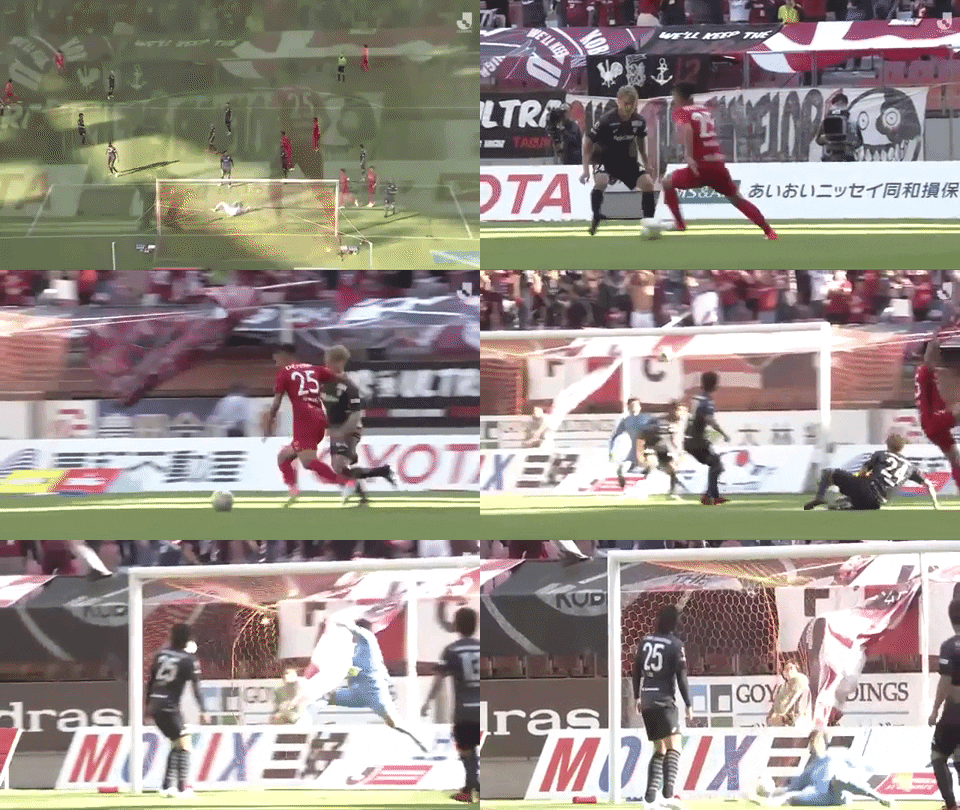
One final question is looming though over so much confusion: will overcorrection work? That mechanism that brings you to have the opposite behavior to the one you had previously, will it be enough? With Jô still missing, Ficcadenti has tried Naoki Maeda as a center-forward, while both Ryota Aoki and Gabriel Xavier have been benched. Spring will be crucial to understand what’s the goal for this roster.
In their pre-season showing to fans, Ficcadenti clearly stated that the squad has important values, a solid fanbase, but lost their winning ways. That’s the goal for Grampus for 2020: trying to avoid another season of suffering among relegation candidates and disastrous rosters. If they’ll manage to do that – while still raising some interesting talents –, then they might face a future that’s more than the pride for their local mascot.
[…] decent performances even under the previous manager – and the pre-season worry about the “over-correction process” from Kazama to Ficcadenti turned into an […]