December 2021 – it’s the messiest J2 League season ever, especially at the back, where everyone is on the run for salvation ‘til the last day. Everyone but some teams: among them, there’s Ehime FC. With the four relegations active for 2021, they couldn’t avoid the drop this time around. And since they were 20th the year before – in a blocked season because of COVID – you couldn’t say you were surprised about that.
When they got relegated, I think we all got the idea they wouldn’t come back. In the end, it’s super hard to do so. In 10 seasons of J3, not everyone made it back to J2. Kataller Toyama, and Gainare Tottori are still in the third tier. Tochigi needed two attempts, Giravanz Kitakyushu and Thespakusatsu Gunma several years, just like Roasso Kumamoto. Kagoshima United made it back to the second division only on the fourth attempt.
Plus, Ehime FC needed a clean slate. Too many old players, too many talents on loan, no foreign players at all – it was really hard to attract someone. And it was visible in their first season in J3 after a long time: Ehime came seventh last year, 24 points away from champions Iwaki FC and 15 points shy of Fujieda MYFC, who won direct promotion through the second place.
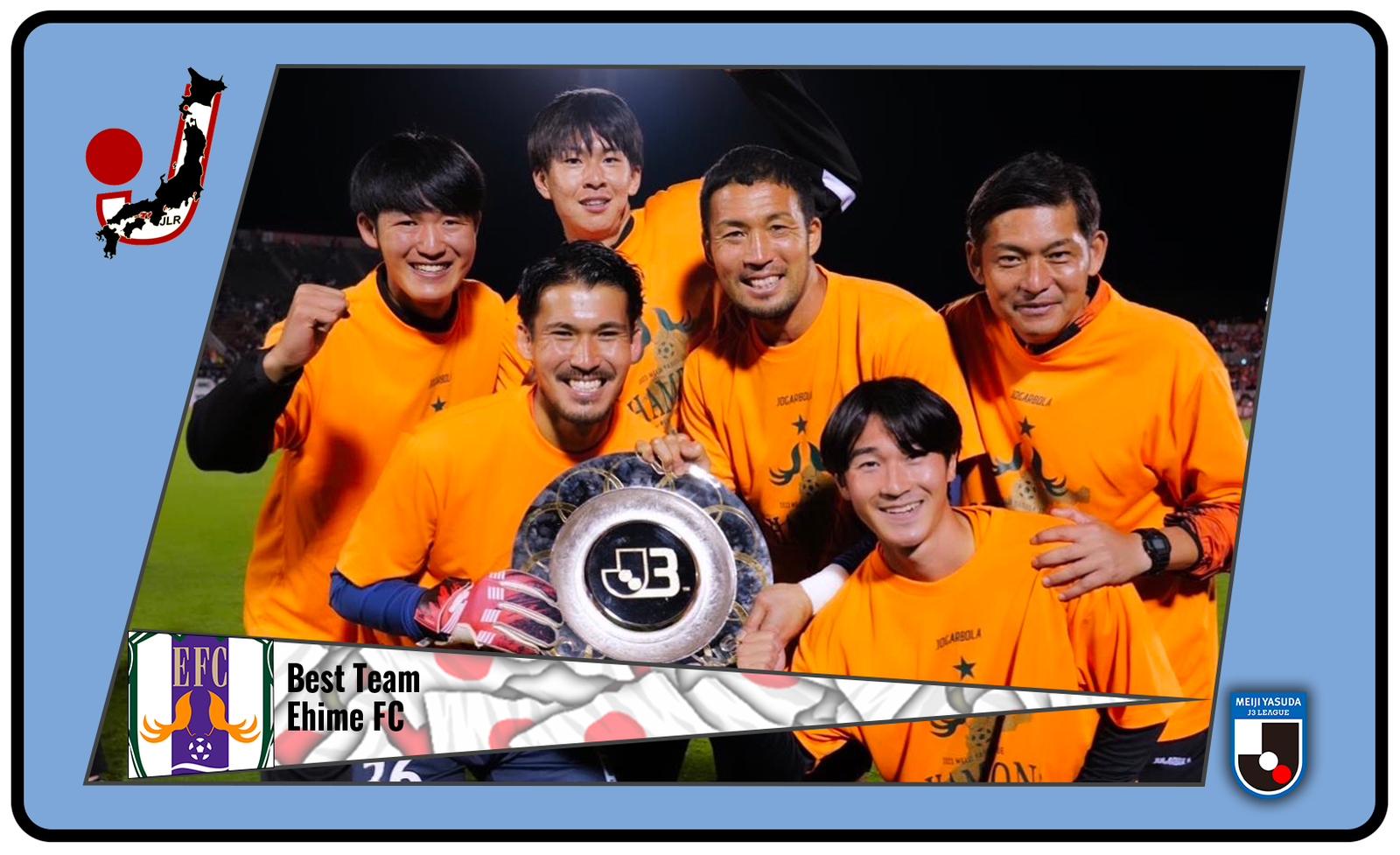
So how they could dominate this season? Well, we’re gonna find out, but that’s why the readers felt the need to award them the “Best Team” accolade for the J3 League in our Regista Awards. In a turbulent season – 11 teams changed their manager –, Ehime kept their cool thanks to a few key figures, and went through the storm with a trophy in their hands.
Back to the past
For Ehime it was as well a traumatic passage for another reason: the last time they played in a third division of any kind was in 2005. Back then, we had no J3 League, J2 League was composed by just 12 teams, and Japan Football League represented the third tier (although not a professional one). Back then, Ehime FC won the JFL – a league with 16 teams, including Tochigi, Tottori, Toyama – at the last hurdle.
66 points were enough to win the league and Ehime had by far the best attendance of the division (an average of 2,844, almost doubling Tochigi’s). The squad was mostly formed by unknown names, with Kazuhito Mochizuki being the manager. And you know who else was in the squad? Kiyotaka Ishimaru, the current head coach of the club, who was enjoying his final moments on the pitch by playing for Ehime for 18 months before retiring.
Given how relegation wasn’t introduced until 2012, and not every time it was possible to go down, Ehime represented a safehouse for developing talent in J2. Many talented players wore their jersey: Ryota Moriwaki, Yojiro Takahagi, Manabu Saito, Takumu Kawamura, Yoichi Nagashima. Furthermore, managers found their way into Japanese football through Ehime: we mentioned Ishimaru, but there were also Takashi Kiyama and Kenta Kawai.
And the results were great for a small market. In 15 seasons, Ehime ended up in the bottom two only twice: in 2008 there were no relegations, just like in 2020 (because of COVID). But they also had solid seasons, including the majestic 2015, when they reached 5th place in the table and challenged Cerezo Osaka in the playoffs, going out because of the worst ranking in the table.
The fall and the rebuild
2020 though made painfully clear that the growth of other realities in J3 and Ehime still being a small market didn’t make it easy for the club to survive in J2. As we mentioned before, the drop of Ehime was something expected at a certain point. Actually, their manager Noritada Saneyoshi made a miracle in keeping them alive until the end of the season.
There were some positives from 2022: Ehime got seventh, but they found new protagonists. Kenta Tokushige was amazing on goal despite the age, but the club lowered the average age of the squad. Motoki Ohara confirmed the sparks of class we already saw in J2 – and indeed he went to Mito HollyHock the successive Winter. Takumi Sasaki and Shunsuke Motegi were solid J3 picks for a great midfield.
And then there were two other details. The first: Kiyotaka Ishimaru. As we mentioned, he played for Ehime a couple of years, but when he retired, he actually stayed in the club. He coached the youth ranks for five years, then he had his first gig right in Ehime. He went to Kyoto Sanga, Matsumoto Yamaga (as an assistant coach), and Montedio Yamagata, but then decided to come back to home once things didn’t work out in the North.
The second detail is a suttle one, but we have to talk about Riki Matsuda. Initially we would have wanted to write a piece around him, but Ehime proved to be a juggernaut and everyone deserves a shoutout. Nevertheless, Matsuda – whose career as a striker has been mostly disappointing – has found new life in Ehime. For the first time in his life, at 32 years old, he scored 10+ goals in a season. And probably J3 was the right level to shine.
Orange is the new way
The J3 League was pretty up in the air at the beginning, but Ehime built an advantage in terms of self-confidence right away. In fact, Ehime started the season by losing 5-1 at home against Iwate Grulla Morioka, but then had a run of nine unbeaten games. They lost against Fukushima United and YSCC Yokohama in the span of two weeks, but then didn’t stop ever again.
From June to September, Ehime never lost. They digged a massive advantage, safe enough to keep Kataller Toyama and Kagoshima United at the bay, even when they lost both direct games in one week. To seal the title in mid-November, Ehime won the derby against FC Imabari – and who would have thought three years ago that Ehime would have been able to be further in development than Imabari at this point in time?
Ehime had the best home performance and the second-best away (only Nara Club did more points than them). They played well and there were fun to watch – best attack tied with Kataller Toyama, but defense will need to be registered. Ehime conceded 48 goals, the ninth-best defense in the league. To give some context:
- Giravanz Kitakyushu, who came last, conceded only 45 times.
- For a J3 champion – since the division has been launched – that’s the worst ratio of goals conceded per game (1.26). Only FC Ryukyu in 2018 (1.25) were over the average of 1.00.
Nevertheless, Ehime did pretty well in the J.League Awards, where Ehime took six of the eleven spots available (Shingo Tsuji in goal, Sora Ogawa and Reiya Morishita in defense, rookie Shunsuke Tanimoto and Shunsuke Motegi in the midfield). And now? It’s gonna be important to confirm the loans – Shumpei Fukahori from Thespa and Taiga Ishiura from Verdy – but it’ll be an uphill battle.
Ehime will need at least 17th on a 20-team championship to reach the 85th percentile of good performances in the league. Offensive football helps, but in J2 being a defensive side requests fewer improvements and it pays more in the long run (ask Thespakusatsu Gunma this season). It’ll be a tough challenge for Ishimaru and his guys, but let’s see.


[…] FC just took the J3 by storm this year. Through the Summer, they flew away from the competition – in this article here we’ve explained how they indeed went through a rebuild and what they have to do to sustain […]