The relationship between Japanese people and English has always been fascinating. English is a language that grants you the doors of almost any country of the world, given its simplicity and exposure. Despite that, not many Japanese people have embraced that – recent stats showed how a very tiny slice of the population can speak proper English, and recent international events like the Olympics haven’t moved the needle at all.
This often has opened the door as well to misunderstandings. I can never forget a small detail in “Death Note” on why Light Yagami gets the nickname “Kira” in the forum world within the manga. Reason? He’s executing many criminals through the Death Note, and that would make him a “killer” – but given how Japanese people struggle with some phonemes in the English language, this makes him “Kira”.
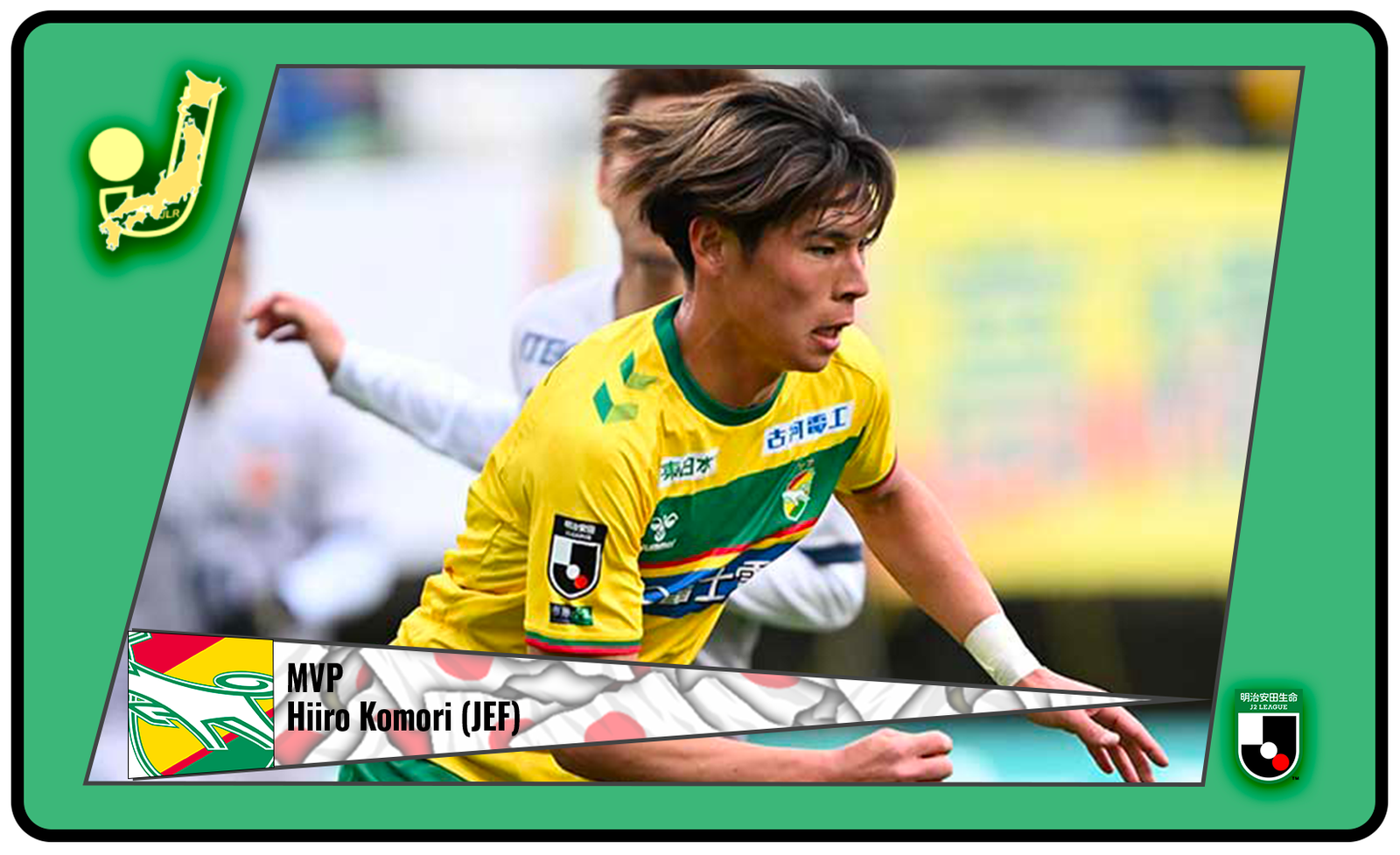
If you fear you’re entering a semiotic or linguistics class, I assure that’s not the case. But it’s funny how this process could be applied in another discipline and with a positive outlook. Take a player in J2, the one who’s been voted by our community the “MVP” of the 2024 season. He had an excellent rookie season, but he managed to surpass expectations in his sophomore year.
Hiiro Komori has a name that would naturally read “hero” in the English language – and that’s what he represented for JEF United Chiba in the last two seasons. With a missing shot at promotion, 36 goals in the second vision, and a bright future – you have to wonder though if leaving Chiba might actually be his only shot to progress. And not even looking at Japan, but even further.
Making of a Golden Kid
Hiiro Komori was born in August 2000 in Namerikawa, a small city in the Toyama Prefecture, facing the northern coast of Japan. It’s the city of the firefly squid, and Komori made himself seen for the first time at a national level throughout the Summer Inter High School Championship, when he won the top-scorer title with the Toyama Daiichi High School. It didn’t take that much longer to get noticed.
He enrolled into the Niigata Medical and Welfare University, where he kept growing – most of all, he played his first pro game. Indeed, he took part in two matches of the 2020 Emperor’s Cup – the one which famously saw only J1, J2, and J3 champions featuring because of COVID – plus two more in the 2022 edition, where he managed to appear in two further occasions.
Except that Komori – at his fourth year of university in 2022 – did more than just being there in 2022. In the Second Round against Kashima Antlers, the Niigata-based University was trailing 2-0, when Komori scored a header to shorten the distance (by the way, that university squad had in their line-up George Onaiwu, Shota Tanaka, and other possible J.Leaguers).
No one could just ignore this kind of performance – especially at JEF United Chiba. In fact, the club signed Komori as a special designated player in August 2022; two weeks later, he had his first pro appearance with the club, and then a back-to-back appearance on the pitch to round up two games under his belt for the 2022 season with the new club. But it was just the beginning.
Rookie & Sophomore
When JEF signed Komori, they were losing a bit of strength up front. They let Salomon Sakuragawa go on loan to Fagiano Okayama; they lost Brazilians strikers Matheus Saldanha (to Neftchi Baku) and Tiago Leonço (to Al-Dhafra); they gave up once it for all on Kengo Kawamata. They definitely needed new faces up front, and young Komori had to give that new spark alongside Hiroto Goya (an expert striker with some good seasons under his belt in J2).
Newly-appointed head coach Yoshiyuki Kobayashi didn’t stutter: he started Komori right away, and the rookie immediately repaid him on the pitch. Fifth for minutes on the pitch on the whole season, best striker of the team (13 goals + 1 in the play-offs), “Best Eleven” for the J.League jurors, and a streak of three goals in the first three games as a pro. Komori scored against Kofu, Machida, S-Pulse, Iwaki – there was no stopping.
But we know how rookies can fail to repeat themselves – that’s normal. Instead, Komori doubled down in 2024: he took over the no. 10 left by Tomoya Miki (who joined Tokyo Verdy), scored a goal every 135 minutes this season, and almost double the count from 2023 (reaching 23 goals in 38 games – so he also played all the matches of J2 this season). In the final part of the Summer, he had a run of 12 goals in just seven games.
The impressive trait about Komori is that he wears the no. 10, he plays like a no. 9, but in the end he’s a bit of both. He’s basically a 9.5, gifted with good feet, an all-rounder vision of the pitch, and a solid pitcher instinct. It’s tough to find a 23 years old with such a developed growth in just two years since his pro debut. And that’s why keeping him around for a third season in Chiba might be very hard.
Heroics out of Chiba?
Problem? JEF United Chiba didn’t make it out of J2. Kobayashi did a good job with them – it was indeed the best two-years stint since 2013-14, when JEF made it to fifth in 2013 and third in 2014 – but it wasn’t enough to end the drought. Chiba came fifth last season and lost the play-offs semifinals against Tokyo Verdy, then they were in the run to make the play-offs again in 2024, but lost the last two games (against V-Varen Nagasaki and Montedio Yamagata – tough gigs) and missed the post-season entirely.
So… give it another run? Tough to say. J2 will be competitive next season – we don’t see Consadole, Sagan and probably Iwata just existing in the second tier. Maybe two out of those three will run for direct promotion or at least play-offs. And JEF United Chiba don’t seem like a team who’s on the verge of having a dominating season to clinch the ticket back to J1 (although they’re just a couple of pieces away from that chance).
It’s tough to imagine Komori trying J2 for a third season in a row. In the history of the J2 League, with players that have scored 30+ goals, Komori has the 14th-best average goal-pro-game (one goal every 151 minutes) – the only other Japanese player and current J2 player with a better average is Akira Silvano Disaro (one goal every 134 minutes). But if Disaro had his chances in J1 with S-Pulse and Bellmare, Komori could have his first soon.
My personal hope would be to see even something we haven’t seen in a long time – Komori jumping directly from J2 to Europe. A Kagawa-esque move, if I may – looking at one of the Top 5 championship, even Portugal. What exactly has Komori less than the average striker in those leagues? At the moment, the experience – but it’s tough to say he’s missing something more than that.
[…] of Anderlecht). But confirming himself was even a harder sell for Komori – we talked in a special piece here what makes him an outlier and why he should move away from JEF United […]
[…] Awards in 2024 around the J3 League. J1 will come later, while you can find J2 here (the Awards and a piece over JEF United Chiba’s Hiiro […]
[…] 2024. We got already the editions around the J2 League and the J3 League, and we talked as well of Hiiro Komori and his rise at JEF United Chiba. Stay tuned for the next […]