It’s strange, isn’t it? The J.League turns 33 in May, and there’s enough time to consider something: eras come and go. There’s been a first wave of players who went abroad to mature and they came back to Japan with different ambition – for example, Hidetoshi Nakata retired at 29 to open a sake company and travel the world, while Hiroshi Nanami became a head coach, a pundit and still is connected to the Japan national team. They both played in Italy at the end of the 90s.
But this means as well that some players might not make it. The paradox is that, given how well Japanese players are doing in Europe and how cheap they’re compared to other places of the world, success stories are becoming way more than the rejections. It’s harder to find the latter type, but it’s not impossible. And it’s not anymore about you having success in Europe or not, but rather how you’re gonna jump back from that experience.
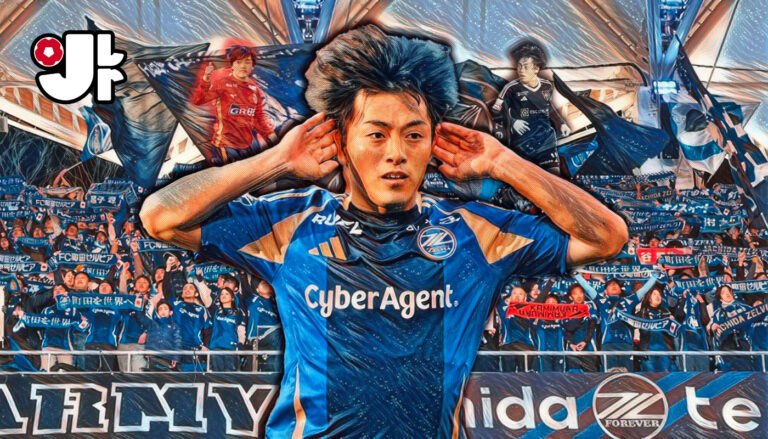
Recently, we talked about how Yuki Soma became a star of the league with Machida Zelvia after a solid stint in Portugal. We could name many players (and we have done that!) who returned to give a better contribute to the current state of the J.League. But there is also player who are lost after an experience abroad, despite immense talent – one very solid example is Shoya Nakajima, who was once tipped to be the star of the national team and he’s now average.
And the protagonist of today’s story has talent, flair, and a lot to talk about. Unfortunately, all seemed lost a few years ago – and it’s kinda of a habit for Gamba Osaka young prodigies at this point. The exception is that Ryotaro Meshino didn’t stay – he left Japan pretty early, without a consolidated profile. And despite turning 28 years old in a few weeks, his prime might actually come now, although in a very different technical suit from the one he showed us in his first years.
Black and Blue
Meshino had the signs of a future Gamba Osaka prodigy, the youth ranks who gave to the J.League profiles like Takashi Usami and many, many others. Born in Izumisano City (part of the Osaka Prefecture) in 1998, Meshino was already in the youth ranks of the black and blue while going in junior high school. He was a clear star – bringing home for Gamba a Prince Takamado Cup title in the Under 18. In his third year of high school, he was already registered as a special designated player.
At the time, Gamba Osaka U-23 were debuting, and this gave the club the space to test a lot of talents. Come to think it, among the four U-23 experiences in the third tier (FC Tokyo U-23, Cerezo Osaka U-23, J. League U-22 and Gamba’s), there’s no doubt that this program had the best rewards. A lot of players are currently decent J.Leaguers, although maybe looking for their sweet spot. Some of them even went to Europe.
And among them, Meshino was one of the brightest stars. He debuted as a pro in 2016, taking his time to mature and sparkle: one goal the first year, three in 2017, five in 2018 – until reaching eight goals in eight games in 2019. Clearly, he had the pace for the senior team, so head coach Lèvir Culpi gave Meshino his debut in J1 against Vissel Kobe in April 2018, playing the full 90 minutes. It was a first taste, but the year after Tsuneyasu Miyamoto gave the winger more and more minutes.
There was a time in which Meshino felt inevitable, invincible. Whether it’s a useless goal in a loss away against Sagan Tosu or the winner at home against Shonan Bellmare, the no. 40 coming off the bench was a joker that Gamba used a lot. Like a hummingbird (or Shion Homma to give a comparable example in J.League terms), he looked to work with a different pace – not a frantic one, but rather one step ahead of you. And someone noticed from the Old Continent.
All Around Europe
A real surprise came when Manchester City announced to have signed Meshino – not a first timer, since Citizens already bought Ko Itakura a decade ago before profiting out of his development with a sell to Eredivisie. The plan looked similar and so Meshino went on loan to Hearts in the Scottish Premier League, before the “Japanese experiment” at Celtic. The winger’s stay in Edinburgh was so-and-so: three goals in 19 games seemed too few to leave a mark, so Man City tried a different approach.
Meshino found himself in Portugal, in a football where probably his skills could have been a better fit. Rio Ave took him in with an option to buy, and the former Gamba actually performed better than Scotland: same scored, but with half the minutes, which means a more efficient contribution. Nonetheless, Rio Ave didn’t buy Meshino because of relegation, and he had to endure a third loan, again to Portugal: destination Estoril.
Unfortunately, he fell out of favour pretty quickly: nine games in the Portuguese Liga, only one goal, 109 minutes. At that point, Man City were probably tired to try their luck, and gave up. The next step? A return to Japan. Indeed, Meshino re-joined Gamba Osaka in July 2022: “I feel incredibly lucky to be here; now I’ve been exposed to different types of football, and I’m more thoughtful in my plays. The return? I haven’t felt like I’ve returned, but rather that I was brought back here”.
Meshino expressed gratitude for Gamba to bring him back, and remembered his past: “An agent told me Man City were interested in me. They were like: “We’re interested. We’ll pay the transfer fee, so would you like to come here?”. The deal took just one day. Despite it didn’t work out, I enjoyed myself abroad. Football is football everywhere – but Portugal was a better fit for my style of play. The biggest regret was that I couldn’t achieve the results I wanted”.
The Evolution
The return didn’t work out as Meshino hoped. In 2022, between Tomohiro Katanosaka and Hiroshi Matsuda, the winger found several minutes, but with the passing of time, Meshino disappeared from rotations. Between 2023 and 2025, Dani Poyatos was the head coach, and the winger played a lot of minutes in 2023 (27 caps in J1), but almost nothing in the next two seasons: 11 matches in 2024, nine in 2025. As a winger, Meshino seemed to have lost his sparkle.
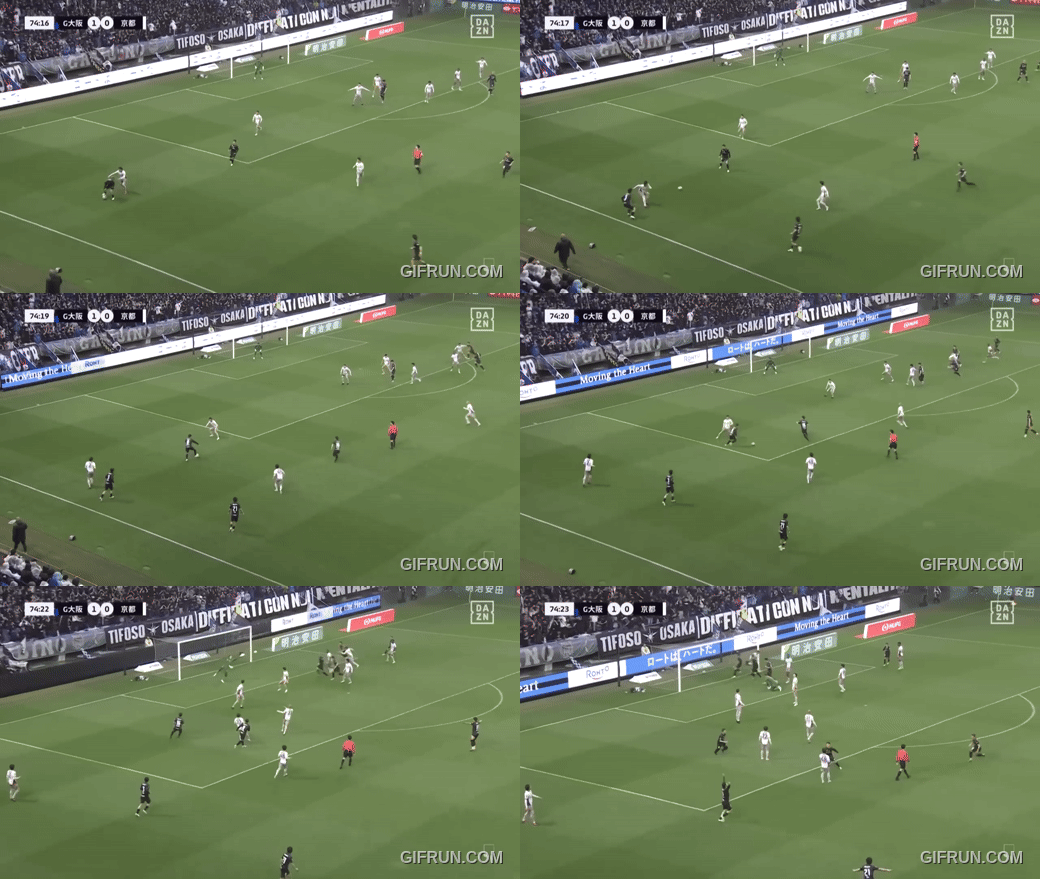
Things went so bad that even in our yearly article we advised Meshino to look for a J2 team and restart from there. Luckily for him, Gamba Osaka changed head coach and newly-hired Jens Wissing seems to have a very different opinion on Meshino. He already played more minutes in the J1 special transitional tournament than the whole 2025 season, and scored already two goals, including a wonderful curler against Kyoto Sanga.
In that moment – in his play, shoot, and celebration – I kinda re-saw the version of this player who charmed everyone in 2019. Meshino became something else – he’s now playing also as a “mezzala”, taking a similar development like the one Shu Kurata took in the last 5-6 years. Kurata, now 37 years old and another Gamba beloved player, used to play like a winger. When the pace didn’t sustain him anymore, he turned into a midfielder, and stretched his career.
In the best of Japanese tradition, I wouldn’t indeed rule out to see Meshino taking over the no. 10 once Kurata will retire. Meanwhile, it’s nice to see him back, with his flair and the flashy plays he can only provide. Only time will tell if his trajectory will be less of a cautionary tale and more of a pattern in the future of the Japanese football movement.