2022 wasn’t an easy year to navigate. The FIFA World Cup, the tough schedule, the stretched season – can you believe Urawa Red Diamonds will have to wait six months to play the 2022 AFC Champions League final? In the middle, many things changed and many will be changing with the development of the Japanese championship (we’ll have 20 teams in J1 from 2024).
What didn’t change are the retirements, who kept a pretty good standards in terms of quality. We said goodbye to many legends – after already saluting many heroes in 2021, including our top pick, Yuki Abe and his wonderful journey throughout Japanese football, between J.League and his small, but significant experience with Leicester City.
To pick eleven legends – with the usual “10+1 format” we chose in 2020 –, we looked through the retirements from this year and proposed this list. No honorable mentions this time: we go straight to the real deal.
- Michihiro Yasuda (安田 理大)
20/12/1987, 2006-2022 | Gamba Osaka, Vitesse (NED), Júbilo Iwata, Sagan Tosu, Vissel Kobe, Nagoya Grampus, Busan iPark (KOR), Albirex Niigata, JEF United Chiba, Matsumoto Yamaga
To be around for 16 years, you have to admit Yasuda was basically anywhere. From J1 to J3, from AFC Champions League to Europe, from the Japan national team to youth squads. He was good enough to have a stint in the Eredivisie, but never really solid to breakthrough in the national team. He featured for several powerhouses in J1, but we can’t remember him to be absolutely necessary for their fortunes.
- Akio Yoshida (吉田 明生)
03/12/1986, 2010-2022 | Arte Tatasaki, YSCC Yokohama
What can we say more than what we wrote back in June, when Yoshida broke the all-time record for J3 games played? His record might not last – Hiroki Higuchi, we’re looking at you – but the legacy of “Mr. J3” definitely will. Will YSCC retain their spot in the third tier without the soul of their team?
- Shingo Tomita (富田 晋伍)
20/06/1986, 2005-2022 | Vegalta Sendai
It’s incredible to find such a long-standing symbol in a club which has witnessed so much like Vegalta Sendai. When Tomita joined the team from the youth ranks of Tokyo Verdy 1969 – yes, Verdy has still that denomination –, brought in by his former coach Satoshi Tsunami, the midfielder immediately found some space in J2. Back then, Vegalta were far away from a J1 return, but it became more and more possible throughout the years.
Tomita was there for the promotion, for the ACL runs, for the title fight in 2012, during the healing from the 2011 Earthquake. He’s been the captain of Vegalta since 2015, and only a serious injury to his ACL in 2020 limited his time on the pitch. What’s his future after retiring? He’ll be a staff member for management at the club and he’ll surely give his contribution to Sendai, just like he did on the pitch.
- Hiroki Mizumoto (水本 裕貴)
12/09/1985, 2004-2022 | JEF United Chiba, Gamba Osaka, Kyoto Sanga, Sanfrecce Hiroshima, Matsumoto Yamaga, Machida Zelvia, SC Sagamihara
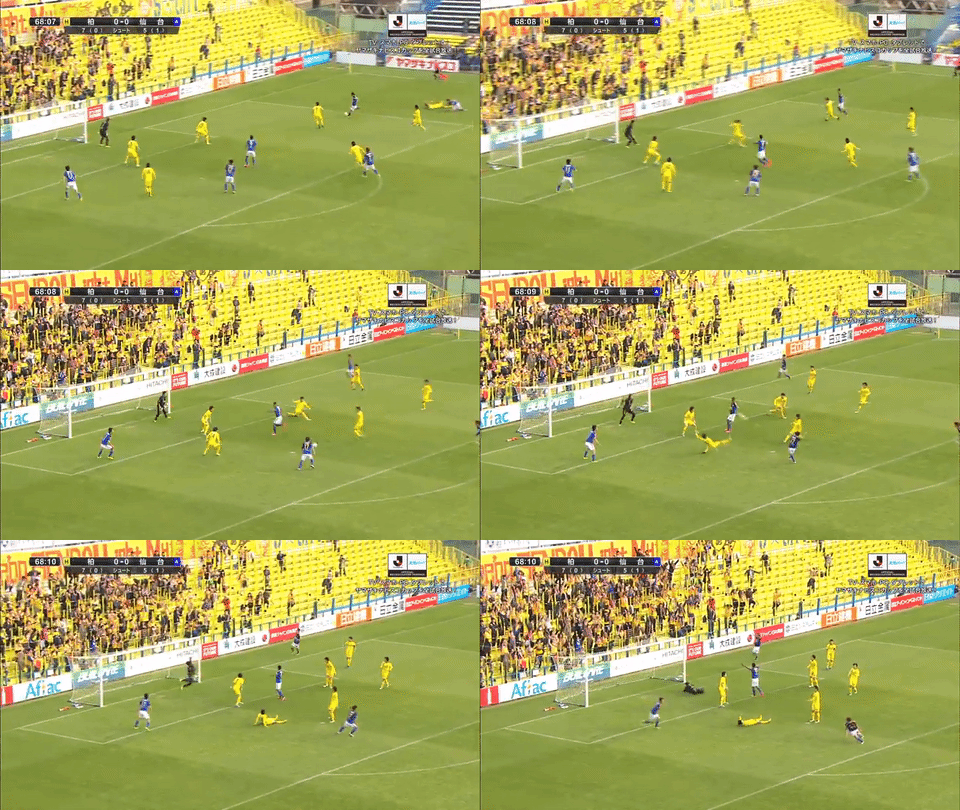
We think here we’re talking of a less-celebrated hero, a true J.Leaguer. Mizumoto didn’t reach the maximum height – he played only seven times with the national team, games in which featured on the span of nine years with five different head coaches –, but he’s played more than 400 J1 games, and in general he’s been involved heavily in every club he’s been with.
Of course, Sanfrecce Hiroshima have been the main club of his career, but he was a part of the two-times J.League Cup winning side from JEF United Chiba, he’s been with Gamba Osaka, he captained Machida Zelvia and SC Sagamihara. He played in all three divisions, and most of all, he’s been a loyal interpreter of a 3-CBs defense. For someone who thought of giving up football after a serious injury in 2011, that’s massive.
- Jong Tae-se (鄭大世)
02/03/1984, 2006-2022 | Kawasaki Frontale, VfL Bochum (GER), 1.FC Köln (GER), Suwon Bluewings (KOR), Shimizu S-Pulse, Albirex Niigata, Machida Zelvia
If he didn’t leave for Europe – he played very well for Bochum and struggled in Köln before returning to Asia –, Jong Tae-se would have been even higher in this special ranking. No doubt that the North Korean forward – mostly known by neutrals because he brought the Chollima team to the 2010 FIFA World Cup – has left his mark on J.League with several teams.
Whether you liked him at Kawasaki Frontale, loved him with a Shimizu S-Pulse shirt, or watched him surprising you with wonder goals at both Albirex Niigata and Machida Zelvia, there’s no doubt that he’ll be remembered. The “Rooney of Asia”, the “Human Bulldozer”, a true character and a wonderful striker. The one who makes you dream every Sunday.
- Hayuma Tanaka (田中 隼磨)
31/07/1982, 2001-2022 | Yokohama F. Marinos, Tokyo Verdy, Nagoya Grampus, Matsumoto Yamaga
He’s been high in this ranking because of his J.League coefficient. He’s been a historic part of Marinos, sharing the locker room with legend Naoki Matsuda, whose no.3 Tanaka took over once he joined Matsumoto Yamaga, coming home (he’s from the city). He won a lot in his career – two J.League titles, one with Marinos and one with Grampus – and he even featured in the national team for one match.
His grit, his dedication to the cause, and his great affection towards Yamaga fans will never be forgotten. Not bad for him, since his father – a great fan of Masumi Kuwata, a pitcher known for his stint with Yomiuri Giants and a passage with the Pittsburgh Pirates in the MLB – hoped Tanaka would have played his baseball. His future? Tough to say, but his experience would be invaluable for Yamaga, especially in such a rough patch like this one.
- Shunsuke Nakamura (中村 俊輔)
24/06/1978, 1997-2022 | Yokohama F. Marinos (x2), Reggina (ITA), Celtic FC (SCO), Espanyol (SPA), Júbilo Iwata, Yokohama FC
His class and his resume would put him probably at the top of retirements in a normal situation, but his J.League stints haven’t been memorable as the ones in Europe with Reggina and Celtic. Secondly, he’s 44 and probably should have called it a day already from 2-3 years, so… that’s why we put him in this position, rather than some places upper in the table.
Nevertheless, you can’t take from him the magic and the flair he gifted the Japanese football movement with his left foot. He’s easily one of the Top 10 Japanese players of all time, despite missing the 2002 FIFA World Cup due to Troussier’s choices and playing a 2010 FIFA World Cup where he wasn’t really involved. Steve Perryman resumed the magic of Nakamura for everyone: “He could open a tin of beans with his left foot”.
A career started in 1997, with six seasons at Marinos, before leaving to Europe and then returning in 2010. He featured for another seven seasons for Yokohama-based club, then moved to Júbilo Iwata, and finally opted to sign for Yokohama FC in 2019. He had a role in getting them promoted to J1 in 2019, but after that his contribution diminished. We probably were not ready – just like him – to see him retiring.
- Jungo Fujimoto (藤本 淳吾)
24/03/1984, 2005-2022 | Shimizu S-Pulse, Nagoya Grampus, Yokohama F. Marinos, Gamba Osaka (U-23), Kyoto Sanga, SC Sagamihara
We’re running into a sort of human contradiction. Jungo Fujimoto has been a great player, but not always. He had the quality to make the difference in Europe and in the national team, but he’s not made the leap and his performances with the Samurai Blue were forgettable (e.g. the final of the 2011 Asian Cup). He should have retired already after Gamba Osaka, but instead he found a way to royally survive with SC Sagamihara.
To us, it’s incredible what he could have been and he’s been not. Looking back at his performances with Shimizu S-Pulse and Nagoya Grampus, you can clearly spot a player who could have dominated the J.League. He’s been “Rookie of the Year” in ’06, featured in the “Best Eleven” twice (2010-11) and played with some of the big clubs in Japan… nevertheless, some regrets still stay with us.
It’s even more surprising how he was a free agent in December 2019 and his career was virtually over at 35. Instead, he signed for SC Sagamihara in August 2020 and he brought them to J2, even having two really solid seasons in both J2 and then J3. The future is already laid out: he’s been announced to become a coach for Marinos Soccer School, coming back to Yokohama (he featured there a couple of seasons).
- Yuichi Komano (駒野 友一)
25/07/1981, 2000-2022 | Sanfrecce Hiroshima, Júbilo Iwata, FC Tokyo (U-23), Avispa Fukuoka, FC Imabari
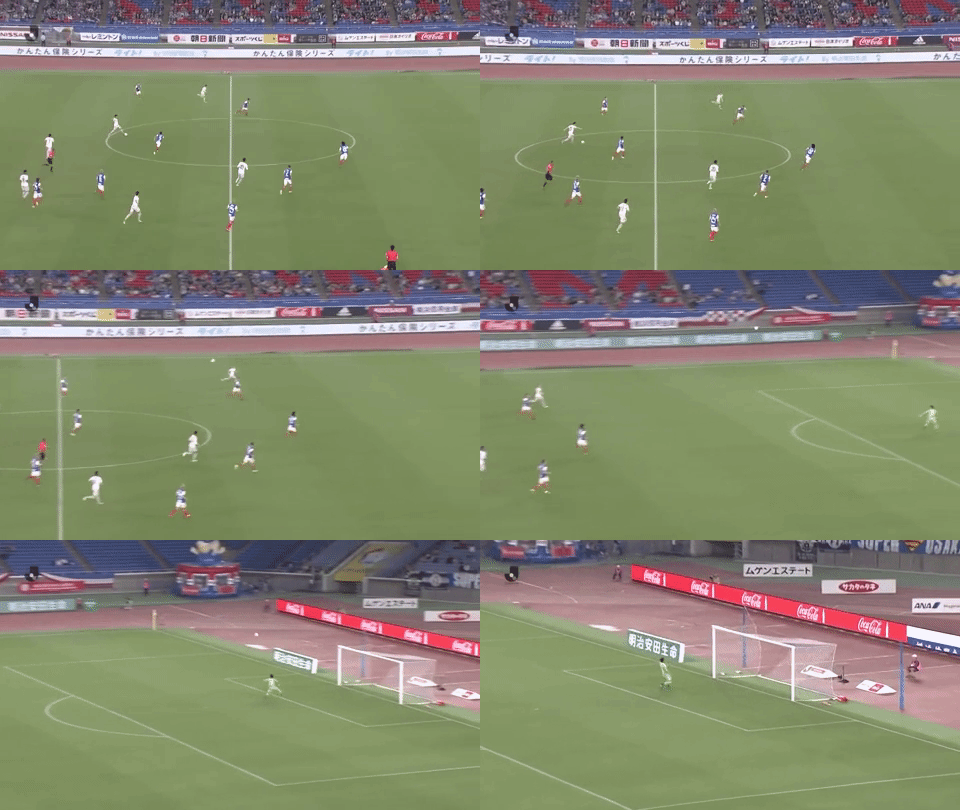
His career will probably be remembered by neutrals because of the missed penalty against Paraguay in the Round of 16 match of the 2010 FIFA World Cup. A crossbar, though, would be ungenerous to define his efforts on the pitch. Komano ran along the flanks of many pitches for 22 years, keeping himself in the conversation with the right approach. Take Yuto Nagatomo, remove the one-man-show attitude, and you’ll get an honorable career.
One of the few footballers to come out of the Wakayama Prefecture – one of the few ones still without a pro-team as we’re speaking –, Komano featured mostly for Sanfrecce Hiroshima and Júbilo Iwata, then moving to FC Tokyo in 2016. Two more years at Avispa Fukuoka before signing for FC Imabari, this ambitious Ehime-based project who back then was just a club in the JFL.
He instead helped bringing them to J3 as a steady presence within the roster, even being nominated within the Top XI of the 2019 season in JFL. He scored another goal in the third tier, and cut for himself a role in the team, who had a wonderful run both in 2020 and in 2022.
- Hidekazu Otani (大谷 秀和)
06/11/1984, 2003-2022 | Kashiwa Reysol
It’s not easy to talk about Hidekazu Otani. To many, he could just appear to be a random holding midfielder who’s been with his childhood club for 22 seasons. But he’s been more than that, because when he joined Kashiwa Reysol in 2003 – in an era where JEF United Chiba were the dominant force in the region –, he wasn’t meant to be the driving force of a change of balance between the two teams.
Instead, Otani – born in Nagareyama, in the Chiba Prefecture – immediately made an impression in the pre-season to Edu Coimbra, who was working back then as an advisor for Zico, who was the head coach of Japan. Despite having played in different positions and being around this long – mostly in J1 –, Otani never featured for the Samurai Blue. He captained Reysol through thick and thin, since 2008 – when he took over from Yuta Minami.
To recap it: Otani has gone through three relegations to J2 (with three immediate returns to the top-flight), 12 head coaches, tons of team mates, and lifted seven trophies under his captaincy from all competitions – including the lone J1 title in the history of the club. Basically, you can’t see a picture of Reysol celebrating a title without Otani. One thing never changed: the yellow heart supporting him all these years.
While announcing his retirement, he said: “I feel sad knowning that I’ll never be able to play again at the Hitachi Stadium… if I was able to compete at this level, despite lacking any special talent, is because of everyone’s support and passion in my regards. I wouldn’t be here without all the friendships I’ve built throughout these years”.
If you want to see the lists of retirements from past years, please go here. To discover the number one, though, you must wait tomorrow for a new article. Stay tuned.
[…] It’s tough that we’ll ever witness another character like Tomoaki Makino, but remember we celebrated as well other retirements from 2022: you can see the full article here. […]
[…] Leaving Fukushima is a strange move – not by any means an improvement –, but the winners of this bargain are surely SC Sagamihara, who changed a lot under the new course of Kazuyuki Toda and need quality after reshuffling the whole squad (especially after losing Jungo Fujimoto last Winter, who retired). […]