It’s fun to look back at certain squads. For Japanese football, the two who faced the 2010 FIFA World Cup and the 2011 AFC Asian Cup in the span of six months should be teams to be framed in the history of this nation’s movement. And if results confirm that place in history – as well some of those profiles –, others have left a huge question mark in our heads. We’re sure we’re not alone in this.
Just to go through a list of some of those players:
- Daisuke Matsui was playing in France, but he never found the same pace after that World Cup, neither in France, nor in Europe in general.
- Kisho Yano would have then signed for Freiburg, only to stay there 18 months before coming back to Japan as a right-back.
- Takayuki Morimoto never lived up to the potential he initially showed in Catania, and he became a journeyman, even playing in the third Greek tier.
- Despite a promising start in Europe and a solid Asian Cup, Masahiko Inoha pulled it through only for six months in Croatia before coming back to Japan.
- Jungo Fujimoto, one of the most prestigious names in J.League, didn’t shine at all in that tournament.
- After deciding the final against Australia, Tadanari Lee joined Southampton for just seven league caps. Once he came back to Japan, he reached double digits of goals just once.
Among those names, there was one missing. He was tipped to be the next big thing for the Japanese defense, especially after Yuki Nakazawa retired from the national team and Marcus Tulio Tanaka wasn’t confirmed. The pair had an excellent tournament in South Africa, and Zaccheroni was maybe hoping he would have been the natural match of Maya Yoshida, back then a promising center-back who just signed for VVV-Venlo in the Netherlands.
The mentioned center-back had already featured at the 2007 FIFA U-20 World Cup, where he played with red-hair to homage Kazuyuki Toda. He showed already his true colors, his strong personality, and debuted with the senior team in January 2010. He didn’t make the cut for the South Africa trip, and an injury kept him out of the national team for the Asian Cup.
Who knows if those two exclusions deprived him of something. Nevertheless, back then in 2011, Tomoaki Makino was already in Europe, having signed for 1.FC Köln. History, though, will prove how things don’t always go your way. Maybe that’s why Makino lived his career with such a hunger, with a drive to prove his value. Naturally, that drive eroded his forces, and brought him to retirement this year.
The Success Arch
Born in May 11, 1987, Makino started his journey from the Nishi ward in Hiroshima. His father liked football; his two older brothers had already started that path. It was natural for Tomoaki to take that leap, and at 13 years old he joined the program of Sanfrecce Hiroshima. Initially playing as forward, but it was coach Toshiaki Tukioka who converted Makino into a full defender.
Once promoted to the first team in 2006, it didn’t take that long for head coach Mihailo Petrović to notice his talent. Sure, the injuries of Dario Dabac and Kohei Morita left the doors open for Makino’s debut, but the young center-back proved to be an asset. Even if the club got relegated to J2 in 2007, Makino stayed in Hiroshima, happy to help in the return to J1. He scored a lot of goals, he had a solid streak of games played – all of these without getting booked once in 2010.
Rightfully, in 2010, Makino featured in the J.League Best XI for the first time. Despite missing the World Cup and the Asian Cup, he felt there was a space to make a leap after five years in Hiroshima. That’s why the Makino went to Germany in December 2010, to understand if there was an opportunity to play in Bundesliga. He had tryouts with Borussia Dortmund and Hoffenheim, but many were skeptical in seeing him in the German championship.
Right when he was coming back to Japan after such attempts, on Dec. 30th, 1.FC Köln made contact and sealed the deal to bring him to Germany. Makino had theoretically one advantage: from April 2011, the head coach was Volker Finke, who managed Urawa Red Diamonds from 2008 to 2010. Folke saw the potential of Makino back in his Japanese adventure, but it didn’t necessarily help.
In the end, even though Makino debuted against St. Pauli on January 29, 2011, the Japanese center-back racked up eight games in Bundesliga over two seasons. He stayed in 1.FC Köln for just 11 months, even featuring in the fourth tier with the reserve team. Makino didn’t dream about this: “I loved the city, it was easy to enjoy life. I thought I would have never come back to Japan, but I needed to regain my confidence”.
Saitama, the Safehouse
That’s when Petrović saved Makino’s career. Back at the time, the Austrian head coach just left Hiroshima to rebuilt Urawa Red Diamonds, who were in big trouble. They just came out of a season where they almost got relegated to J2: can you imagine Mitsubishi-funded powerhouse Urawa Reds risking relegation? Don’t think so. But they needed a character to lead the rebuilding.
Makino has been the engine of a rebirth, which wasn’t granted. When things were not going in Cologne, he thought about it: “Petrović made me an enthusiastic offer. It was a risk, but I had the goal of the World Cup in Brazil. Naturally, cutting short my German stay left me regrets: some of my friends told me to stay in Europe.. but I have that goal, that dream. I have to play more”.
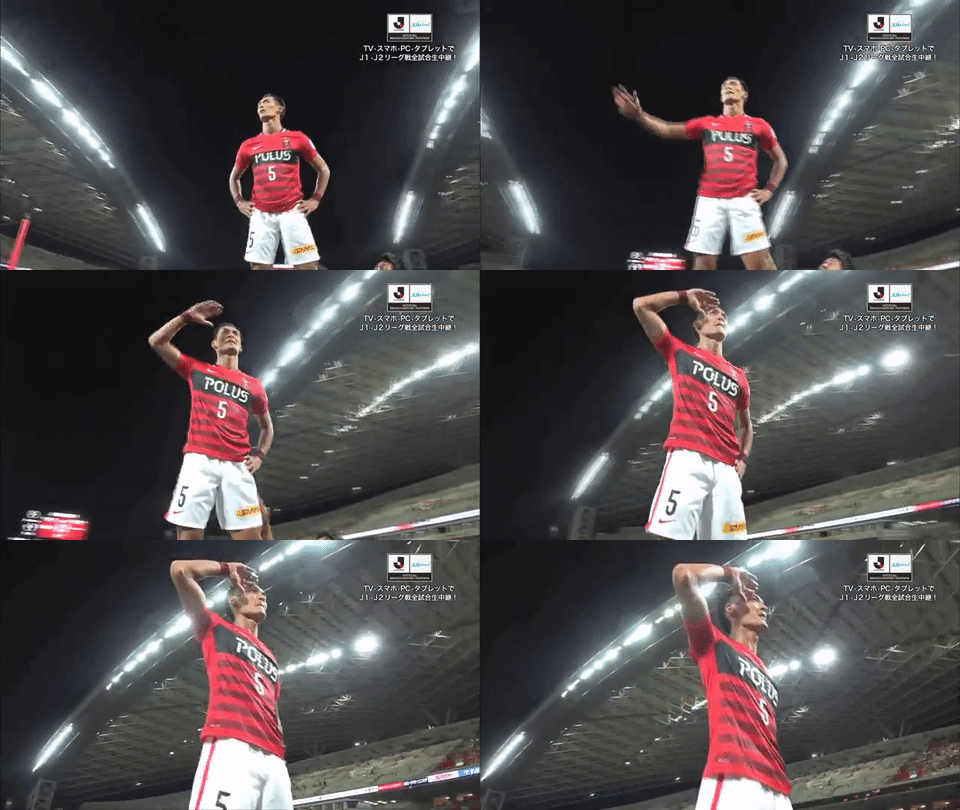
What started as a loan of six months then became a permanent move. Makino retained his no. 5 in Saitama for a decade, reaching heights he lingered at in Hiroshima. He scored 42 goals in 421 games with Urawa Red Diamonds, lifting five different trophies, including the 2017 AFC Champions League and two Emperor’s Cup. And in 2021, he scored the winning goal against Oita Trinita in his last game with the club. Madness.
Makino stayed in Saitama despite good offers from Al-Nassr and Guangzhou Evergrande between 2015 and 2016. He featured twice more in the J.League Best XI, maintaining himself in contention for a spot within the national team. He ended up reaching his dream, although in the moment he probably he expected it the least: Makino did indeed miss the 2014 FIFA World Cup, but he was called up by Akira Nishino to be involved in the 2018 edition.
More Than Just a Player
Yes, we could talk about 2022 and his lone year at Vissel Kobe, but there’s nothing really to talk about it. He reached 400 J1 games and was mostly consumed by injuries. At 35 years old, Makino opted to retire, although he could have continued like others did. He was in good physical condition, although the level wasn’t as high as it used to be. But there are players who got to 38, 39, 40 years old.
Instead, Makino could envision his future in other roles: “I’ve been exploring for a long time what I want to do next. I’d like to be a head coach, to overview the development of football in Japan and promote its culture”. He could soon get the A-level coaching qualification, with the aim of getting the S-class to coach in J.League. With Hajime Moriyasu as his role model (and favorite player ever), who knows what’ll come next.
To be such a warm, light-hearted character, Makino took this decision with a rationality and a clarity in his mind that didn’t resonate with the storytelling we framed him in.
He’s been a unique player, tough to define. He was a defender, but didn’t feel like an absolute gatekeeper. Scored a lot of goals, but he never saw his position change to midfielder. He’s been to Europe, but didn’t succeed enough to stay. He played more than 400 games in J.League, been a symbol for two clubs, and yet we’re wondering if any pundit would put him even in all-time J.League Best XI with Japanese players only.
He’s been a symbol for two clubs who both enjoyed nation-wide recognition, but he never won a J1 League title (he said a few weeks ago: “That’s the only regret of my career”). Actually, Sanfrecce Hiroshima and Urawa Red Diamonds managed to do so when he wasn’t around. He’s been athletic, but not only that. He’s featured at the highest level, but Japan never relied on him as a key-piece of the defense – neither for 2010, nor 2014 FIFA World Cup.
Tomoaki Makino has been a contradiction, a living one. But maybe that’s why we’re fascinated by him. He’s a clear objective in front of him, despite being labelled – and rightfully so – as a larger-than-life character, capable of strange celebrations, taunting habits on the pitch and banter-ish behavior off the pitch, while at the same time featuring in some commercials, comic sketches, and even music videos.
Japan will probably feature better players than him, since the football movement is growing. There will be bigger legends in the history of sakka, but Makino has probably grant himself already a place in this landscape. And we kinda have the feeling he’ll have even a stronger, more significant one in the development of this sport.
It’s tough that we’ll ever witness another character like Tomoaki Makino, but remember we celebrated as well other retirements from 2022: you can see the full article here.

[…] legends – after already saluting many heroes in 2022, including our top pick, Tomoaki Makino and his unique profile, capable of having a blast of a career – between Hiroshima, Saitama, Kobe and even a European […]
[…] already in 2021, when he left Reds to join FC Gifu. It felt like a retirement, just like for Tomoaki Makino. Nonetheless, Ugajin played two years in J3 and, just like Yosuke Kashiwagi, it left a bitter taste […]