Playing 20 years – two full decades – isn’t easy. And it’s even harder if you have to play at certain levels of excellence. A few champions can do it, and the filter becomes even tighter when we’re talking about such a young footballing nation like Japan, at least in professional terms.
Some Japanese players made the headlines for their performances both with the national team and with their clubs, but there are some who didn’t need that kind of recognition. Yet, they’ll be remembered by every fan who truly loves Japanese football for writing some pages of history. Last example in my mind until a few weeks ago was Mitsuo Ogasawara, who neither rose as one of the key stars of JNT nor had a successful stint abroad.
That list must be updated with a name that deserves the utmost respect. A man who came from another continent to conquer Japan, to become a part of this nation, to write history alongside many other characters. In a way, though, he was unique from the start, taking the name from Roman counsel and being born from a mixture of experience (Italian, Japanese and Brazilian) in Palmeira d’Oeste, a small municipality in the state of São Paulo.
This kid – featuring a name inspired by Roman tradition and Cicero – answered to the name Marcus Túlio Lyuji Murzani Tanaka. He’s on his way out after two decades of decorated service to Japanese football and, we’d add, to us fans, who enjoyed this figure throughout 20 years of J. League.
P. I – A beginner
Tulio was born in Brazil, but Japanese culture – about sacrifice and dedication – was always with him, since he moved to Japan at the age of 15. He attended Shibuya Makuhari High School: he fell in love with football, not from the start, because until nine years old, Tulio hadn’t even touched the pitch. He was good at swimming, volleyball, and he even featured in some math competitions in Brazil: that might have been another story to tell.
Instead, his fate changed in Brazil, where he chose a new path. Mirassol Futebol Clube was the first serious club where he was spotted by Shibuya Makuhari High School, which was looking for foreign students to add to its courses. Bear in mind: Tulio didn’t speak Japanese back then, despite being born in a family with Japanese ties. It was hard to adapt to that new reality.
Despite that, though, a strong and relentless figure will find the way. The young Marcus did it by studying Japanese and even finding a new position on the pitch, where he was moved to central defending. Once he graduated from high school, he didn’t attend a university and jumped directly to pro football, where he was picked by Sanfrecce Hiroshima in 2001. Unfortunately, that club changed too many managers and even got relegated.
So Tulio was loaned in 2003 to Mito HollyHock, where he found the first manager to give him some trust: Hideki Maeda. In the first of five years guiding Mito, Maeda was sure about Tulio’s potential, even giving him some offensive licenses. Result? 10 goals for a central defender, with the Japanese defender – yes, he got the citizenship in October of that year – finding a new spotlight.
That spotlight was called Urawa Red Diamonds. Back then, they weren’t the dominant force we all know today, but Tulio helped them change their history.
P. II – A star
Once he got to Saitama, everyone slowly realised how Tulio could become a key piece for Urawa’s future successes. A club which went trophy-less from 1992 to 2003 – in that year, they finally won the J. League Cup – found a new power once all the pieces came together. Youngsters who were ready to become stars (Hasebe, Abe), tensai coming back home (Ono), successful foreign players (Robson Ponte, Washington), and a good coach (Guido Buchwald).
And Tulio, yes. Because without him, Urawa won five trophies in all of their history, the same number of silverwares collected in the six years Tulio was in Saitama. And those trophies were heavyweights: the first (and only) J1 League title in ’06, the AFC Champions League in ’07, two Emperor’s Cups, and a Japanese Super Cup. And you can also add three runners-up spots between ’04 and ’07 (all lost by an inch, otherwise it wouldn’t be Urawa).
This growing feeling of empowerment, the sensation of dominium over others, accompanied Tulio throughout these years in Saitama, especially the central ones. Between 2006 and 2007, the central defender – still sure? Buchwald didn’t mind sending him forward, and he played a little like Lucio, but with less technique and more physical strength – owned the Japanese championship with his complete combination of skills.
Tulio was the MVP in 2006, alongside winning the title for Japanese Footballer of the Year. In those six seasons with Urawa, he was always included in the league’s Best XI. He scored 37 goals in J1, 42 in all competitions, and even scored hat-tricks. He also finally debuted with the Japan national team, although this happened only after Zico left and Ivica Osim took over.
On the other side, being a leader pushes you to take responsibilities and clash with the people assumed not to be working well. Holger Osieck and Volker Finke were targets of his comments, and Tulio openly clashed with the team due to their management. Once Finke opted to get rid of him, Tulio’s contract just expired, and he had even offers from Europe.
Dragan Stojkovic is the man who denied him a European opportunity, but – in good conscience – it was the right choice. The back-then manager of Nagoya Grampus suggested the centre-back to stay in Japan in the year of the World Cup: “You should play here”, said Piksi. And Tulio signed to begin another phase of his development, the ultimate leap to greatness.
Little on the nose about how he lived the JNT-experience. Just like Shunsuke Nakamura in 2002 and Shinji Kagawa in 2010, his exclusion from the Japanese national team for the 2006 FIFA World Cup will be a huge mystery to us. He debuted in August 2006 and played the last game in June 2010, when Japan were knocked out by Paraguay at the Round of 16 in the 2010 World Cup. He even missed the 2007 Asian Cup due to injuries.
Tulio basically featured in just one major international tournament, yet his partnership with Yuji Nakazawa in that competition is still remembered as the best example of how two Japanese central backs should play at their best.
P. III – A leader
Scene 1, Chapter 1. Press conference in Nagoya to introduce Tulio. He starts with a jaw in everyone’s face: “If you can’t win the league, there’s no point in coming here”. Just bear in mind that back then, Grampus came from a contrasting ’09 season: they indeed played the final of the Emperor’s Cup and reached the AFC Champions League semifinals, but in the league, they only came ninth. The title could be one step too far away from reality.
Instead, it worked. Stojkovic made everything right, including proposing Tulio from time to time as a centre-forward, exploiting his past as a “fantasista” when the centre back was younger in Brazil and structuring the whole team around his figure (and leaning on the solid form of their keeper, Seigo Narazaki). In the end, five elements will make the Best XI of the 2010 season.
Nagoya Grampus didn’t have either the best offensive record (that went to Gamba Osaka) nor the best defence (Kashima Antlers were the best around), but they were indubitably the strongest team throughout the season. They had everything: the MVP, the top-scorer, experienced players, class and engines mixed. And they had Tulio, who was back then in his absolute prime.
Hiroshi Nanami once said: “With him, Nagoya can count on 10 points more than their actual potential”. Or take even how Tulio opted to stay committed to Grampus, even when the move to Botafogo was on the cards – twice! – and his family wanted to embrace Brazil again. Tulio couldn’t: the general couldn’t leave his club.
That leader stayed in Nagoya for seven seasons. The club’s form deteriorated pretty quickly once Stojkovic left in 2012. Akira Nishino, eager to start a new experience after the dark parenthesis of Vissel Kobe, didn’t work out, and he just stayed two seasons, not being able to build anything. Most of the heroes of the 2010 title slowly left, and youngsters – Nagoya had (and have) a lot of them – didn’t step up to improve the quality of the squad.
This led to wrong choices, poor managerial picks and – most of all – a deserved relegation. But the story behind that 2016 fall to J2 is that Tulio is somehow a protagonist anyway. He wasn’t actually on the roster, since his contract expired in December 2015 after negotiations fell through due to the club’s request to the centre-back to reduce his wage. Denied, so everyone went their different ways.
But Nagoya suffered a sluggish start to the season under Takafumi Ogura, the former GM of the club. Grampus decided to get rid of him in August 2016 by sacking him and hiring Boško Gjurovski. First thing done by the new head coach? Calling back Tulio, who joined back the team after 293 days out of the pitch.
When the squad finally wins an away game in Niigata against relegation-contender Albirex, his joy is endless. He’s the heart of the team despite not playing with them for the whole season.
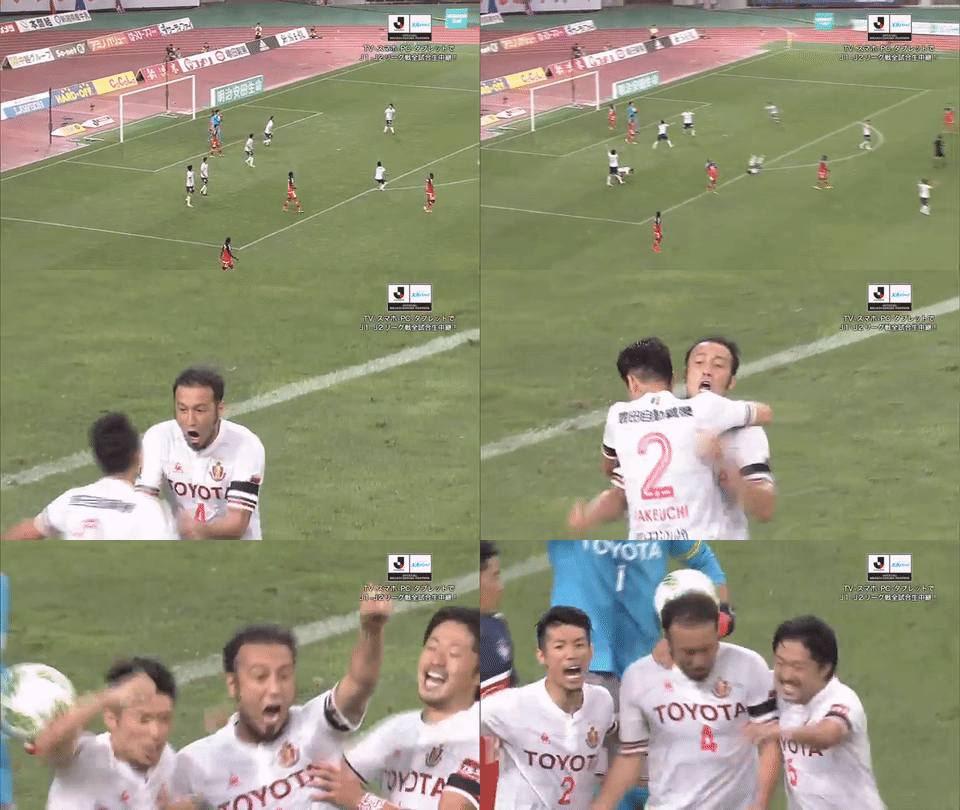
Unfortunately, that effort won’t be enough. Cursed by a terrible start to the season, Grampus will get relegated anyway by losing the crucial match at home 3-1 against already dropped to J2 Shonan Bellmare. Tulio’s efforts – in a narration where he isn’t the star anymore – hadn’t been enough to avoid the unavoidable, despite collecting 10 points in the last seven games of the season.
P. IV – A living legacy
When Tulio and Grampus parted ways for the second time, all thought that may be over for him. This seemed the case, since the player came temporarily back to Brazil, and it was later discovered how he would have renewed with Nagoya, but that wasn’t in the plan of the new manager, Yahiro Kazama (thinking back, how Tulio could have adapted to that kind of football?).
The club offered a position on the staff, but Tulio didn’t want to retire: the centre back was done with J1-football, but he moved to Kyoto Sanga to be a guide for younger players. And his first year was astonishing: at his first experience in the second tier, 14 years after the only one with Mito HollyHock, Tulio channelled his inner striker. His enthusiasm for the game was still there, despite the painful separation from Grampus.
Desperate for some consistency up front, Takanori Nunobe thought of him as a no. 9. It worked: Tulio was fielded from time to time as a striker and even scored a hat-trick against Ehime FC. He scored in all competitions across J1, J2 and J. League Cup, becoming the defender to reach 100 goals in J. League history (although this “defender” label seems too reductive for a player like him).
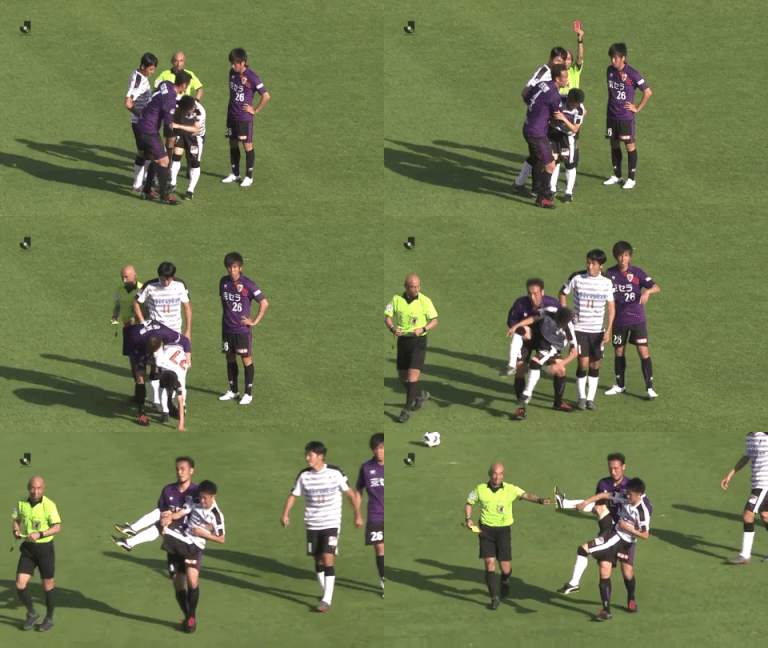
Even when Kyoto were risking relegation – and in mid-2018 we weren’t so far away from that scenario –, Tulio rushed to the side of his club, scoring another four goals to avoid the worst. He even found Gjurovski again, who turned around the ship for Sanga, bringing them to safety with some games to play.
This year, though, was different. Under Ichizo Nakata, no more striker moments for him. With Ichimi and Miyayoshi up front, there wasn’t the need to do that. 2019 was the first full scoreless season for Tulio in his whole career. His last game was the infamous 13-1 defeat that Sanga suffered against Kashiwa Reysol. Case in point: Tulio left the field after just 45 minutes. We’d like to think that’s why the Sanga defence melted in the second half.
One time, Tulio said about Japan: “I want to play soccer for this country and give back to those who helped me”. We all think the profile he created for himself in Japanese soccer has given us back more than we could all possibly imagine. We don’t know if we’ll witness such a unique player, so thank you, Tulio-san.
[…] legend of ours. In 2019, we paid him homage once his retirement was clear after a last run with Kyoto […]
[…] the first was surely Marcus Tulio Tanaka – a national hero because of his value on the pitch (both offensively and defensively), but also because his attitude on the pitch was to win above all. In this imaginary dynasty, we […]