How many times must this happen? An orange crowd in disappointment. Angry players on the bench (yes, we’re talking about Takashi Inui). Not a manager kept for the same year – and it’s been the fourth year in a row, that must be some kind of records. What hurts the most is that Shizuoka Prefecture – that became kinda of their playground from the mid-2000s – now has a J1 team and it’s not them.
Whether we’re talking about Tokyo in 2023 or Sapporo in 2022, Shimizu S-Pulse surely look befuddled. Surprised at how things have declined quickly. Don’t get us wrong – S-Pulse have never been one of the winning teams in Japanese football (they have won a J. League Cup in 1996, a 2000 Asian Cup Winners’ Cup, and the 2001 Emperor’s Cup). But they developed a reputation to be a team that can sail on talents and a fun brand of football.
The tough failures of the last four years proved otherwise. The 2015 relegation and the 2016 core which brought S-Pulse back to J1 was supposed to last. And the eighth place from 2018 seemed to confirm that kind of progress, which was destroyed from changing managers, an unclear plan on the pitch, and eight different head coaches, from five different countries.
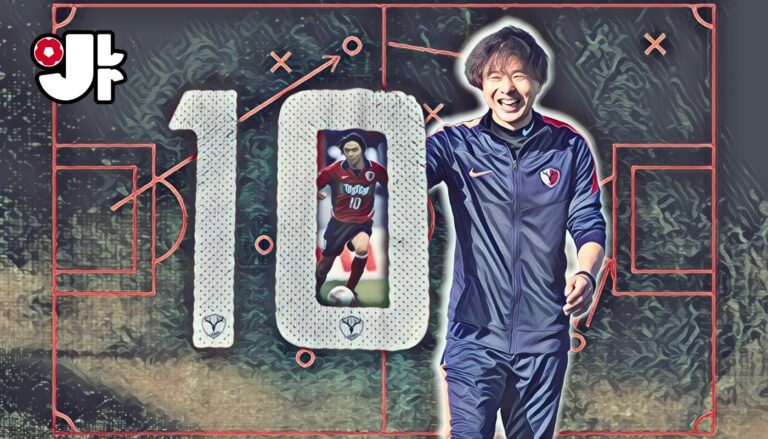
One man’s smile can be the hope though of this club. He wasn’t smiling a couple of months ago in Tokyo, when Verdy scored the decisive PK to equalise in the play-offs final. Nonetheless, Tadahiro Akiba has done his job and now he starts the 2024 season with the hope of rebuilding what was promised: credibility, exploiting a stardom roster, and re-establishing the reputation of one of the “Original Ten” clubs from 1992.
The journeyman, from Chiba to Miami
Tadahiro Akiba is born in 1975 and he’s been a part of the first wave of Japanese players. He was born in Chiba, and he attended Funabashi High School before starting his pro careers. It’s been a career spent in seven different clubs, and mostly in J2 – the place where he left the biggest memory was Niigata, where he also wore the captain’s armband for Albirex. He closed his career in 2010, when he was playing for SC Sagamihara.
Besides his role as the vice-president of the J.League Players Association (2002-07), Akiba had as well a minor stint with Japan. He was indeed called by the U-23 and he was among the players who made possible the “miracle in Miami”, when Japan defeated Brazil 1-0 in the 1996 Olympic Games in Atlanta. But closing his career in a team which was still in the Kanagawa Prefectural League helped him starting as a manager.
In fact, when he was completing his career as a player, he used to be a player-manager for SC Sagamihara in 2009-2010. That was even before SC Sagamihara started the rise towards Kanto Soccer League and then JFL. He then joined Mito HollyHock as one of the assistant coaches under Tetsuji Hashiritani, before leaving after two years, and having his first stint at the helm of a club.

The Holly(Hock) Grail
Akiba went back to a place he knew well – Kusatsu, Gunma. He played there for a couple of seasons in his 30s, and he was ready to take over as a head coach. He kept Gunma relatively safe – 20th in 2013, 18th in 2014 – proving to be ductile. He decided though to resign, in order to join the staff of the national team, where he worked for all youth teams, from U-18 to U-23, first with Makoto Teguramori, then with Masanaga Kageyama.
He opted though to end that experience after four years to back into club’s management, and took over a tough job: replacing Shigetoshi Hasebe at Mito HollyHock was hard. Not because Mito had (or have) particular goals, but they’ve developed into a talents-nurturing factory and keep the circus rolling wasn’t granted. But Akiba managed to do a wonderful job.
Mito HollyHock reached 9th place in 2020, 10th in 2021, and 13th in 2022 – knowning already that Akiba would have left at the end of the year. He fostered several talents – like Niekawa, Boniface, Sumiyoshi, Maejima, Hirano, Ryotaro Ito, Matsuzaki, Kota Yamada, Yamaguchi, Shota Fujio, Kinoshita. It was normal for a bigger clubs to snatch him – and Shimizu S-Pulse managed to do just that.
He’s the man for S-Pulse
But S-Pulse didn’t hire him to be the head coach, but just the assistant coach to Brazilian Zé Ricardo, the one who oversaw the descent of the club into J2. He lasted just seven games, winning none of those. Akiba HAD to take over – and he then spurred S-Pulse into a frenzy made of goals, wins, and positive football. Since he took over, Shimizu made the most points (69, one more than Zelvia), scored the most goals (74), and had the best defence (27 conceded).
The unfortunate coincidence? S-Pulse didn’t win any of the last three games of the season, drawing all three matches. The 1-1 at Mito (ironically) prevented S-Pulse from achieving direct promotion. A 0-0 draw against Yamagata put S-Pulse into the playoffs final, but the 1-1 against Verdy wasn’t enough because of the 4th place in the championship. It was a brutal disappointment for Shimizu.
Should three games change the whole strategy for S-Pulse? Of course not. Sure, there are certain things which were unavoidable after missing promotion – Thiago Santana left for Urawa Red Diamonds, plus Kamiya, Nakayama, Suzuki, and Kishimoto left for good. Akiba cleared some other deadwood – Oh Se-hun on loan to Zelvia, Yago Pikachu back to Brazil, Kokolli back to Switzerland, and Renato Augusto had to leave (his injuries are a big “what if” on S-Pulse’s history).
But the squad looks now less packed and more balanced. Sure, they have to understand who will play in goal between veteran Shuichi Gonda, beloved Togo Umeda, and former Antlers golden boy Yuya Oki, but the rest looks good. Kai Matsuzaki could be a bargain. Shinya Yajima has enough J2 experience. The loans of Lucas Braga, Nakamura, and Sumiyoshi are strategic. Shirasaki and Kitagawa are the old guard still around.
Looking at the roster, the range of options as full-backs is impressive – Yoshida and Yamahara on the left, Hara and Kitazume on the right flank. Kenta Nishizawa is still around (despite he promised way more), Takashi Inui can still have his say at this level. Carlinhos Junior proved to be a factor, while youngsters like Kawamoto, Chiba, and Kato are back to be further options. This could be a generational team – only Akiba will tell if time will make him scream again “This is football”.
J2 previews are still rolling, and S-Pulse are favourites to come back to J1. If you wanna read about another team who has a decent shot, please consider reading over Yokohama FC and their rebuilding year in 2024 (here).

[…] That’s all for J2 League – the pre-season coverage ends here, with two articles still to read about Yokohama FC’s chances in 2024 (here) and Tadahiro Akiba’s cult figure in the league (here). […]
[…] But they needed a stable hand for that, and head coach Tadahiro Akiba proved to be just that. Like we wrote in the pre-season, S-Pulse “could be a generational team – only Akiba will tell if time will make him scream […]
[…] From 2000, Mito have always been there in the second division. They struggled for a decade, having their first breakthrough season back in 2009, when they got eighth in a 18 teams-league. The other highlights were definitely the seasons under Shigetoshi Hasebe – tenth in 2018 and seventh in 2019, when they narrowly missed the playoffs. They did very well with Tadahiro Akiba, who got them ninth in 2020, tenth in 2021, and 13th in 2022. […]