Summer ‘19 has seen a pretty active session of transfers market within Japan. The clubs have done a lot of moves and many of them might be remembered as bargains for 2020 or even further ahead. Usually, Winter is the real deal for J. League clubs, but many of them opted to move and reinforce their rosters in order to achieve their goals for the 2019 season.
In this first part of the analysis, we’ll scour among the transfers to find the more interesting in this Summer market window, between the ones which are promising – even as loans – and the ones which have left us a little befuddled, with moves that are hardly understandable.
- Tatsuya Tanaka: from Gamba Osaka to Oita Trinita
Gamba Osaka opted to revolutionize their roster both in and out: probably they’ve been the most active club in J1, alongside Sagan, Vissel and Marinos. Usami, Ideguchi and Patric are back to revamp a 2014 threepeat-vibe, while Hwang Ui-jo, Meshino and Keito Nakamura are out. A massive transfer market window for all the changes we’ve witnessed.
In the end, though, there’s a minor move that has catched my eye: Tatsuya Tanaka was among the new signings last Winter, but his space in the roster has been limited mostly to J. League Cup appearances. I never got why he was left out, since Miyamoto needed a blistering pace to put his plan on the pitch. Yet, he started only three games in J1 with a Gamba shirt. And despite doing it at the end of his Osaka experience, he left.
Oita Trinita needed another good wing-back and Katanosaka took the chance of signing Tanaka. That’s a master move, since the brand of football by Oita Trinita might not fit Tanaka, but at the same time the Kyushu-based side needed some quickness alongside Rei Matsumoto, Yuta Hoshi and Kaoru Takayama. On the long-term, no one of those players could grow and develop like Tanaka.
Katanosaka confirmed his view, since Tanaka has played all minutes in all the six games he has been fielded. Oita have slipped a little in table, but avoiding relegation seems an almost-accomplished mission. Will he be the man to give Oita a little push for an ACL-spot run?
- Koki Ogawa: from Júbilo Iwata to Mito HollyHock (on loan)
I think I’ll address this problem more ahead in the season, but Júbilo Iwata might face a tough relegation in some weeks, and they’ll have to re-build again, just like they’ve (hardly) done after 2013 relegation. While some clubs took this relegation-chance to erase what was wrong and start again – Gamba Osaka, Shimizu S-Pulse, Cerezo Osaka –, Júbilo just survived. They had a surprising season in 2017, coming sixth. Then they almost got relegated last year.
At this point, I’d say deservedly. The board hardly changed anything from 2018 and this is result. You have 236 J1 goals in your offensive department, but Kengo Kawamata suffered several injuries and Yoshito Okubo – as September 1, 2019 – has still to score in the top tier. So you have to rely on the goals of Masato Nakayama, a really good J2 forward, but not the man you want to uplift your odds against relegation threats.
Yet, Júbilo could have done what their neighbors Shimizu S-Pulse did. They rely on young players since their J2 season – Koya Kitagawa, Ko Matsubara, Shota Kaneko and Genta Miura – and the strategy paid off. Shimizu got promoted in 2016, saved themselves in 2017 and had a great 2018, coming eighth in the table. Where are the youngsters in Júbilo?
They just started playing, while still the club makes incomprehensible moves and signs veterans with no future (sorry, Yasuyuki Konno). They fired Nanami, but the problem wasn’t just him: Koki Ogawa played just 23 games in four seasons with the club; sure, a torn ACL didn’t help, but he has never been developed. Just like Seiya Nakano – another mystery: a gifted kid, but he had to go on loan to Fagiano to play –, Ogawa has left during this Summer.
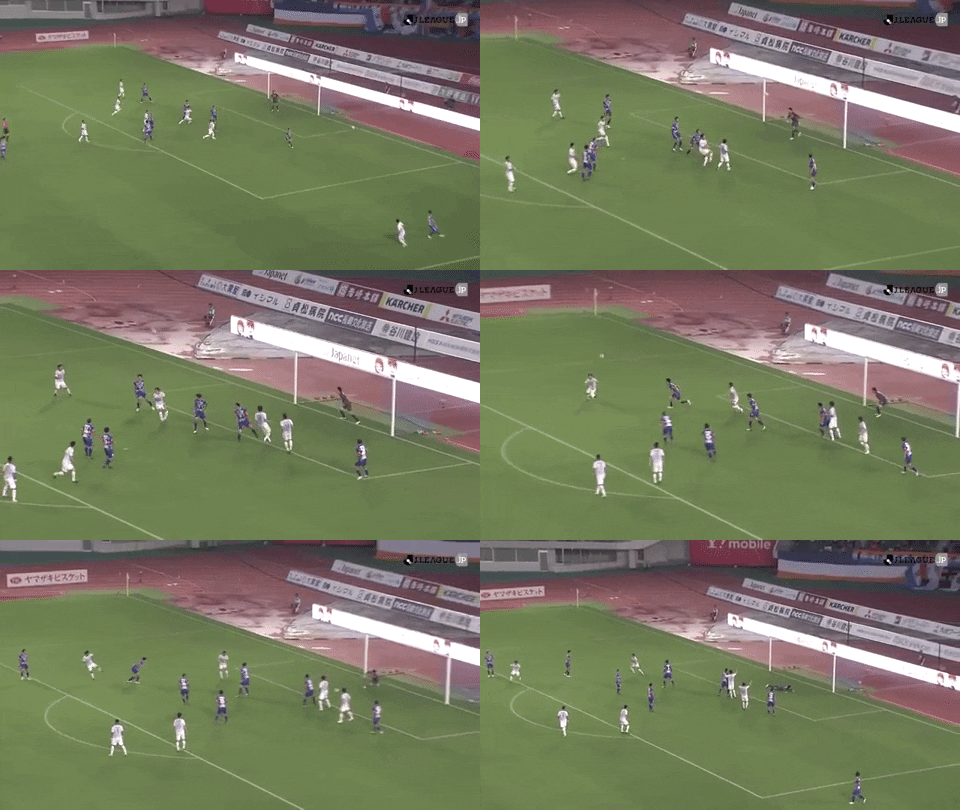
Just as he came in Mito on loan, he immediately scored. Three goals in his first three games, Mito finally have the striker they missed and Ogawa marked the net five times in his first eight appearances, proving he can certainly make the difference in J2. Something that may be useful for Júbilo in the next season.
- Yuki Soma: from Nagoya Grampus to Kashima Antlers (on loan)
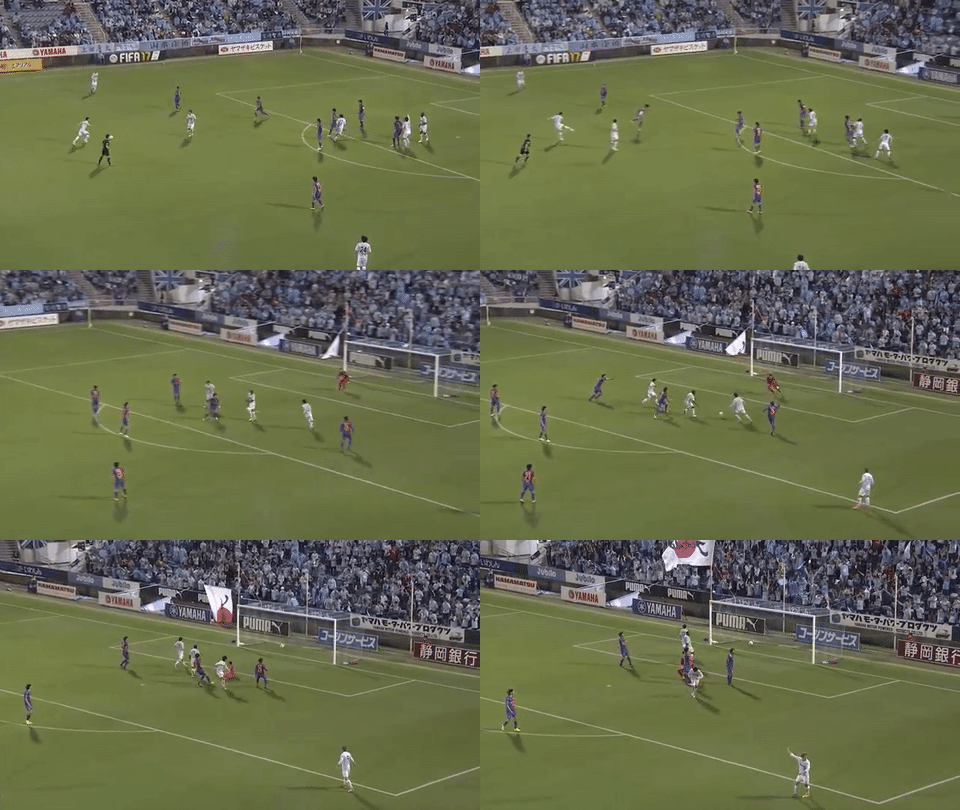
This is a move hard to understand, since Yuki Soma is probably one of the best talents Japan can offer, a sure call for the Tokyo 2020 Olympic Games. He made the difference once he played in Nagoya, but Grampus thought it differently. Both him and Mateus were loaned; but if the Brazilian might be a temporary figure in Yokohama, I think Antlers have strong plans for the former no. 47 of Grampus.
He’s on loan, but Antlers lost a lot of players during the Summer. The arrival of Soma, though, let some breathing space to the Ibaraki-based club, which now can count on a great asset. Soma already scored the winning-goal in Oita with a solo and he can only grow in such a winning environment, especially if Antlers will be able to go through in AFC Champions League (a 0-0 draw in Guangzhou is a decent result, but not the easiest to manage).
With Abe leaving and others who might give it a thought during next Winter (how long European clubs will be able to ignore Kento Misao?), having a kid like Soma is crucial for Kashima and their winning ways. And they’re certainly a good place where to grow a strong mentality. Solid like the metals they produce there.
- Yatsunori Shimaya: from Sagan Tosu to Tokushima Vortis (on loan)
In my eyes, this is a sad story. Yatsunori Shimaya has been the core of the offensive plays in two among the most entertaining teams in Japanese football in the last five years. First the machine of Renofa Yamaguchi, who steamrolled opponents in J3 and gave a good impression also in J2; then Tokushima Vortis, guided by Ricardo Rodriguez and in need of a no. 10 with goals in his pocket.
It worked all just fine. Shimaya was one of the hottest players until Summer 2018, when he opted to leave Vortis to join relegation-contender Sagan Tosu. Back then, Shimaya was having a season made of eight goals and two assists, he was the center of the offensive run by Vortis. Instead, he chose a move to Sagan in the worst time possible with the worst possible coach for him.
Massimo Ficcadenti is known for getting results done, but not for his offensive brand of football. Shimaya didn’t fit in that style and even Kim Myung-hwi hasn’t picked him up for a starter spot; with Torres and Kanazaki coming in, getting picked for the Starting XI was basically impossible. And Sagan still didn’t choose him when they were in need of a creative player, picking instead South Korean An Yong-woo (who has been promising, but inconsistent).
What stays after a whole year in Kyushu? Almost nothing. 46 minutes played in J1 (all against Nagoya Grampus, in two different seasons), 104 minutes in J. League Cup and 88 in the Emperor’s Cup game against Roasso Kumamoto. It’s like Shimaya has thrown away his time in Saga. So when the opportunity presented itself to come back to Tokushima, the midfielder said yes, playing immediately.
It’ll take time to see him back a certain J2-level, but it’s worth the attempt. At 30 years old, there’s still time to come back from this.
- Naoki Yamada: from Urawa Red Diamonds to Shonan Bellmare (on loan)
It’s well-known how Urawa Red Diamonds suffer from a tough compulsive buying disorder on the transfers market. Often they buy players to take them away from other clubs rather than using them for their own purposes. The list is long: Naoki Ishihara, Yoshiaki Kawai, Kosuke Taketomi, Wataru Hashimoto, Toshiyuki Takagi… and you can add Naoki Yamada.
The offensive midfielder found a good omen in Shonan, where he played really well and gained the move to Saitama. It was actually a comeback, because Yamada was raised by Reds in their youth sector and hadn’t so many chances under Mihailo Petrovic. Therefore, being back at the Saitama Stadium with a new manager – Reds just won the ACL with Hori – looked like the perfect chance to leave a mark.
Instead, things went pretty badly: at 28 years old, Yamada wasn’t able to find his spot at Urawa, while the club changed three different managers, with Oswaldo de Oliveira subbing in for Hori and then being released in favor of charismatic Tsuyoshi Otsuki. Eight games played in 2018, just two in 2019: the total is of 579 minutes in 18 months. You can’t stay in a situation like that, despite that environment is home for Yamada.
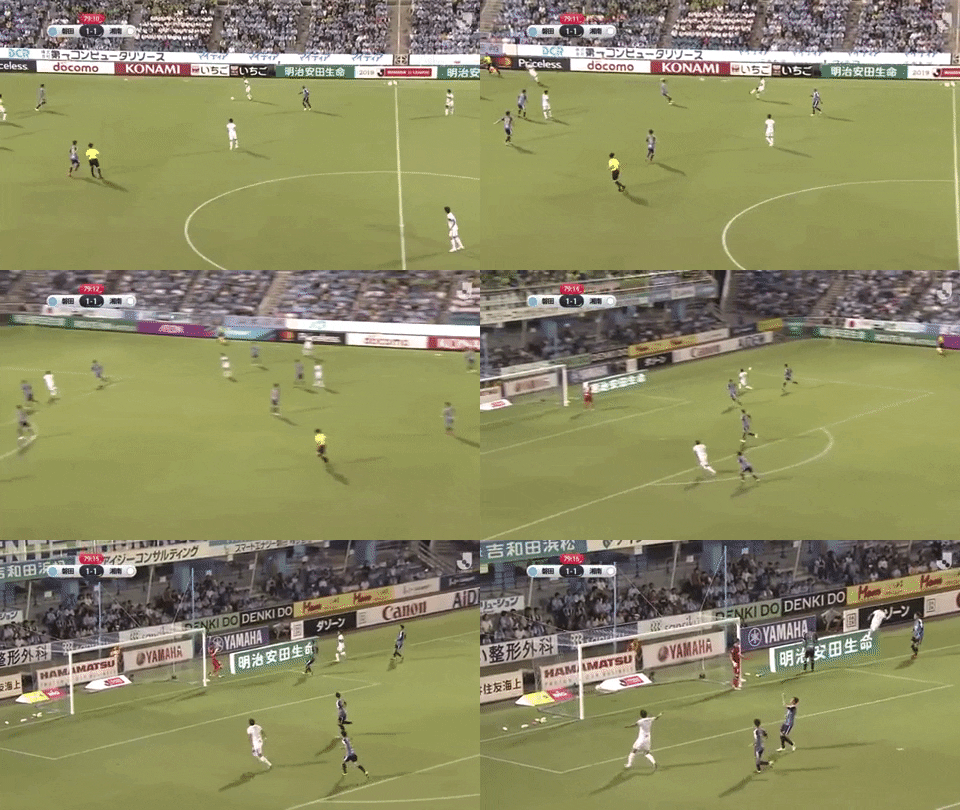
So the player opted for his second home, going back to Shonan Bellmare, even if for now the deal is a simple loan. It doesn’t matter, because he immediately scored a gem and enchanted his old fans with a splendid goal against Júbilo Iwata. Will he back to golden days?
- Kota Watanabe: from Tokyo Verdy to Yokohama F. Marinos
He hasn’t featured that much during the Copa América, but Kota Watanabe was certainly one of the few hidden gems in that roster: he was indeed the only J2 player to be called and one of the two – alongside Ayase Ueda – not to feature in the top tier among the ones coming from the J. League. Despite not playing in Brazil, his potential hasn’t gone unnoticed.
Yokohama F. Marinos picked up him directly from the Summer instead of waiting for the next Winter, when maybe someone would have fought over the precious kid. Despite Tokyo Verdy haven’t been brilliant after Lotina left, Watanabe had the chance of playing under different managers and looked certainly promising for any J1 League club.
Watanabe left Tokyo despite he was just announced as the new captain, picking instead a new challenge to face with the necessary time to settle into the complicated, but fascinating system of Ange Postecoglou. With Amano and Miyoshi leaving, his settlement into the Australian manager’s system might be faster than we all thought.
- João Gabriel: from SC Sagamihara to Tochigi City FC (on loan)
Under the category “sudden and improbable moves”, there’s certainly this move. Yes, Sagamihara aren’t going anywhere, because their push to J2 seems improbable. Yes, João Gabriel could be tired of playing in a J3 mid-table team.
But why Tochigi City FC? They’re not even the most famous club in a small prefecture. I expect indeed to see João Gabriel out of Sagamihara at the end of the year for good, but his 28 goals in J3 were a guarantee to see him somewhere still in this tier, not in fifth division. Who knows what will happen at the end of this season? We just have to wait and see.