The concept of “sensei” and dynastic line is very integrated into Japanese society. You can see it in school, in high school and university teams, even in working environments. And that’s why J.League football makes no exception at all – since the 30 years-history of the championship gifted us those kind of succession lines.
Cerezo Osaka used to have a strict line of dynasty using the iconic no. 8 – iconised first by Hiroaki Morishima, “Mr. Cerezo” – and the no. 13, who felt like the number for the next in line. Shinji Kagawa, Takashi Inui, Hiroshi Kiyotake, and Takumi Minamino used that kind of logic. The same happened last year when Takashi Usami took over the no. 7 at Gamba Osaka after Yasuhito Endo’s retirement, or Hayao Kawabe doing the same at Sanfrecce Hiroshima with the no. 6 left open by Toshihiro Aoyama.
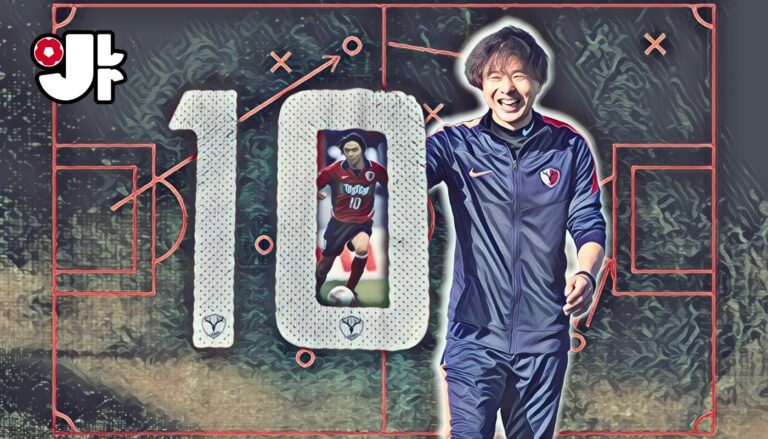
There’s another place where that happened, but it’s been more recent. Once Kengo Nakamura retired – joyfully, at 40 years old and all the trophies he didn’t win in 80% of his career -, the no. 14 seemed a perfect fit for retirement and banners at Kawasaki Frontale. But while us Westerners try to encapsulate moments in history through a number or in a banner in an arena, somewhere else life goes on.
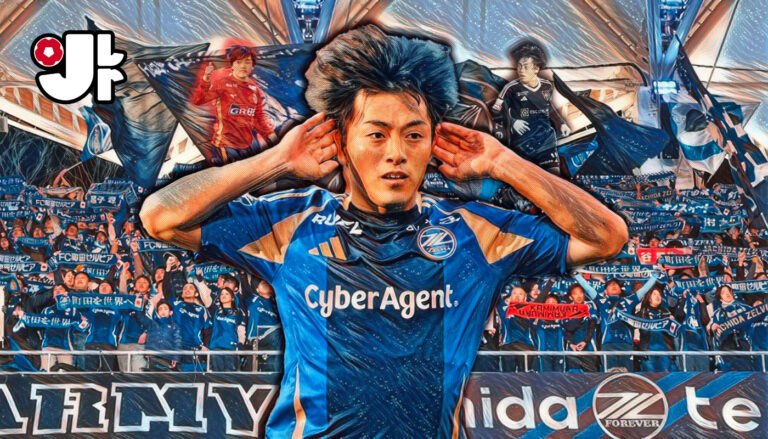
Probably in Japan life is too long, things are too bigger than us to focus on the fact that someone might take the whole legacy of a symbol, even if it’s just a number. And that’s why the no. 14 kept being wore from the player who’s eerily resemblant of Kengo Nakamura for style on the pitch, position and absolute world-class IQ on the field: Yasuto Wakizaka is like the last testament of a dynasty that ended (and a new one that might start).
Baby Steps
Born in Kanagawa – near Yokohama – in 1995, Wakizaka was early associated with the youth ranks of Kawasaki Frontale. As said already for other talents (like Reo Hatate or Kaoru Mitoma), we underlined how good of a job Frontale did in those years to attract and nurture talent. In the end, Wakizaka didn’t get promoted to the top team, and decided to enrolleinto the Hannan University – plus won the 2017 Universiade with some future J.Leaguers.
At the end of those four years, though, Frontale didn’t forget about his potential. They signed him back, and Wakizaka was ready to debut at 23 years old – starting to feature in a few matches of what looked like a rising dynasty under Toru Oniki. Only two matches in 2018, one in the AFC Champions League against Ulsan Hyundai (Ao Tanaka and Hidemasa Morita on the bench – bonkers!), and one in the Emperor’s Cup’s 1st Round against Sony Sendai.
2019 is indeed the year where Wakizaka enters the rotation, with a certain impact – with May being the golden month. Two assists in a home win against Vegalta Sendai, the first league goal away at Shimizu S-Pulse, and a brace against Sydney FC in a dead rubber AFC Champions League match. Oniki gives him more and more minutes, especially once Kengo Nakamura suffers a bad injury, which rules him out for eight months.
And in those 10 months, despite COVID stops football for five of them, Wakizaka becomes a central piece of the squad. So much that Kengo can’t play anymore as a starter with Yasuto doing so well. Once Kengo retires, it’s only a matter of time before Wakizaka does the same trajectory of the Tanaka, Mitoma and Morita of this world, right? Not at all. Actually, Wakizaka will remain the last totem to stand.
Into the Legend
In a legendary season, Frontale somehow tops the incredible 2020 and crushes everyone in 2021. In this scenario, Wakizaka started to increase progressively his numbers. Just take a look at only the league – three goals and four assists in 2021; five goals and 10 assists in 2022; nine goals and six assists in 2023. He gained three “Best XI” nominations in those years, plus being in the “Best Eleven” of the AFC Champions League in 2021.
But it’s strange – despite all the accolades, he’s the only one not leaving. Tanaka goes to Germany, Morita to Portugal, Mitoma signs with Brighton and Hatate joins Celtic. Nothing for him? Apparently not, despite even starting to get called up by the national team – and winning the 2022 EAFF E-1 Championship with a talented squad (just to say a few names: Shuto Machino, Zion Suzuki, Mao Hosoya, Tomoki Iwata, Miki Yamane).
Most of all, when Kengo retired, Wakizaka left the no. 8 and took over immediately the no. 14 – and put up performances that are clearly on par with Nakamura during the same life/career span (26-29 years old). Between 2006 and 2009, Nakamura put together 22 goals in 130 J1 games, Wakizaka racked up 23 goals in 121 league matches. And if Frontale were indeed way better in 2021, the last years have not been the same.
Always for comparison – in the 2006-2009 period, Frontale came second three times (in ’06, ’08 and ’09), while reaching fifth in 2007. Although Wakizaka climbed up the hierarchies, he did it when the golden age of Frontale was finishing – so Kawasaki dominated the league in 2021 and came second in 2022, but they also reached just eighth on the table in the last two seasons. Not exactly top football.
The Captain and the Regret
But no. 14 wasn’t the only thing Wakizaka inherited. Yeah, because not only talents were leaving, but also senators: Shogo Taniguchi, the historical center-back from Frontale, left for Qatar and then Belgium. Kento Tachibanada was supposed to leave for Bundesliga (specifically Mainz), but then decided to stay. And the long serving players like Yu Kobayashi and Jung Sung-ryong stayed, but they’re not captain-material anymore.
So Wakizaka became also the captain of Frontale – although being the leader of a squad who was going under transformation. Actually, despite coming eighth in 2023, he was the only and last member of Kawasaki Frontale to ever being featured in a “Best XI”. He’s been also kinda of the last standing warrior for Kawasaki despite their declining performances. But why is Yasuto Wakizaka special?
It’s strange – in a certain sense, beyond the number 14, the connection with Kengo Nakamura was already there (five years ago, the J.League already produced a shared interview between the two). But Wakizaka reminds also Yasuhito Endo as style of play, plus there’s a bit of a mystic around him. And this rite of passage for the no. 14 was more important than the one happened at Gamba between Endo and Usami, because Kengo left Frontale in excellent terms and still has great words for Wakizaka.
And you know what’s incredible? Japan have so much depth right now in that position that there’s no space for someone like Wakizaka in the national team. The trio of Ao Tanaka, captain Wataru Endo, and Hidemasa Morita are too good. But even on the bench, Reo Hatate is there, plus Takumi Minamino and Daichi Kamada are playing as a CM. It’s a bummer to know that the heir to the sacred no. 14 at Frontale won’t see any recognition beyond Japan.