J2 League is usually the fun side of the J. League. It’s the place where “Chaos and Energy” version of the league becomes reality. For the fourth year in a row (solidifying this tradition for our readers), J. League Regista assigned its awards. To do that, we summed up a small panel to pick the possible options, then saw the votes coming through polls by our readers and followers:
With Ventforet Kofu making even more headlines by winning the 2022 Emperor’s Cup (and then qualifying for the 2023-24 AFC Champions League), J2 League caught a lot of attention, although most of the things didn’t go to the wire like it used to. Therefore, we can roll on with the winners!
Best Team | Roasso Kumamoto (62,1%)
J3 champions rarely make the headlines. Surely, they rarely get relegated – Iwate Grulla Morioka has been an exception this year (following the example of Kagoshima United in 2019 and SC Sagamihara in 2021) –, but they tend to live through quiet seasons. Zweigen fought for promotion in 2015 but then declined. Renofa, Machida, Oita, Tochigi, Ryukyu, Giravanz, Thespa, and Blaublitz all survived in a dignified manner.
It’s another matter to make it to the playoffs and do that in such a style. That’s what happened indeed to Roasso Kumamoto, who overcame Machida Zelvia – who ended up seventh in 2016 – and Giravanz Kitakyushu – who made it theoretically in 2020 (coming fifth), but there were no playoffs. They had an excellent season with this strange 3-3-1-3, developing interesting players like So Kawahara, Toshiki Takahashi, and Naohiro Sugiyama.
Flop Team | V-Varen Nagasaki (66,7%)
At the beginning of the year, we were pretty sure V-Varen would have been in the mix for direct promotion. A shot at Top 2 wasn’t impossible with the roster they had, and the addition of Cristiano made it even closer than 2021. Instead, they flamed out spectacularly throughout the season, even sacking Hiroshi Matsuda (who’s now trying to not cross them again with Gamba Osaka in J2 next season).
Finishing eleventh with just 56 points – the same as Blaublitz Akita, just to make a comparison – was tough. Playoffs weren’t even that far: Montedio clinched sixth place with 64 points. Fun paradox: when Matsuda was sacked, V-Varen were sixth. With Fabio Carille – the new manager hired from Athletico Paranaense and already confirmed for 2023 – they dropped out of the playoffs zone on Matchday 33 and never came back.
MVP | Koki Ogawa, Yokohama FC (46,7%)
Just like last year, the top scorer takes the glory. Which was predictable, since Koki Ogawa was a real factor in Yokohama FC’s return to J1. Here we wrote about his importance within Yomoda’s system this season.
Best Goalkeeper | José Aurelio Suárez, Tokushima Vortis (55,6%)
Last year, Tokushima Vortis got relegated not just because the squad wasn’t up to the level of J1 or because they lost Ricardo Rodriguez all of the sudden. It was a matter as well of the keeper: Naoki Kamifukumoto is a beloved J.Leaguer, but he wasn’t at the level of Tokyo Verdy and only this year, with Sanga, he was one of the most apparent keepers in J1. So, they had to replace him.
Initially, Dani Poyatos – the confirmed head coach – relied on veteran Toru Hasegawa and Koki Matsuzawa to juggle J2 League and the J. League Cup. Then José Aurelio Suárez – who signed from Alcorcon last Winter – found his way into the team. It was a revelation: despite Yamagata’s Masaaki Goto and Yamaguchi’s Kentaro Seki having an excellent season (we would have added Sendai’s Yuma Obata), no match for the Spanish keeper.
If Vortis ended up being the best defense of the league (tied with Albirex Niigata, only 35 goals conceded), Suárez has most of the credit. Among keepers who featured at least 10 times in this year’s J2 League, the Spanish keeper has a 39,4% of clean sheets. Not bad for the first year outside of his own country.
MIP | Koki Ogawa, Yokohama FC (67,9%)
One number is probably enough: last year, Koki Ogawa scored just one goal in 26 matches with Jubilo Iwata. In 2022, he rose up to 26 in 41 games, with seven braces. That’ll do (although Shunsuke Mito was the favorite in our opinion).
Best Rookie | Yota Komi, Albirex Niigata (53,8%)
As we wrote last June, Albirex Niigata were barely legal for J2. Their offensive force was the one fit for a mid-table team in the top-flight. Shion Homma, Koji Suzuki, Yoshiaki Takagi, Ryotaro Ito, Alexandre Guedes, Eitaro Matsuda, Ippei Shinozuka, Shunsuke Mito, Ken Yamura… it’s even too much! But there was a particular player who stood out for his young age.
Yota Komi played just a handful of small parts of matches in 2021. But with his skills and looks – he reminds us of a mix between Kazuhisa Kawahara and Kengo Kawamata, both former Albirex players –, he found a space within the rotation of Matsuhashi. In the first part of 2022, he didn’t play that much. Once Homma went to Belgium and Takagi got injured, though, he became more important.
In the final third of the season, he even started a few games. His performances were fundamental, like when he scored a brace at home Yokohama FC or his goals to win both against Roasso and Ventforet. Crucial points, and next year he’ll surely find space as a fourth option in the offensive midfielders’ department since J.League Cup will provide more matches to show off.
Best Signing | Ryotaro Ito, Urawa Red Diamonds » Albirex Niigata (55,2%)
And about Albirex Niigata… they won again in this category. Last year, it was Kaito Taniguchi to shine; this year, it was up to Ryotaro Ito. The midfielder physically brought Niigata back to J1: we explain why here.
Best Wish | Akira Silvano Disaro, Shimizu S-Pulse » Montedio Yamagata (48,0%)
Incredibly, we have a bis here as well. Akira Disaro was the exciting forward that had amazing performances both in 2019 (in J3) and in 2020 (in J2) with Giravanz Kitakyushu. The trio with Daigo Takahashi and Shuto Machino produced 56 goals and 26 assists in the two years they played together. Nevertheless, unlike Machino (who joined Shonan and is ready for a European leap), Disaro’s career took the turn of Takahashi’s.
While Takahashi stayed an extra year on loan to Giravanz, Disaro joined his club, Shimizu S-Pulse, in Winter 2020-21. The idea was good: the new manager, Miguel Angel Lotina, loves strikers capable of pressing and counterattacking quickly. Unfortunately, Disaro never found real space in Shizuoka: in 18 months, he played 40 games to score just 5 goals (three of them in the Emperor’s Cup against Shunan University). He wasn’t a striker anymore.
And that’s where Montedio Yamagata come into the scene. They didn’t really need another forward – Dellatorre and Yoshiki Fujimoto were doing the job –, but the idea of revitalizing another talent tickled Peter Cklamovski’s appetite. Therefore, Disaro joined on loan and scored eight goals in 17 matches, bringing Montedio to the playoffs. He could go back to J1 with Yamagata or stay with them in J2, maybe facing even S-Pulse. We’ll see.
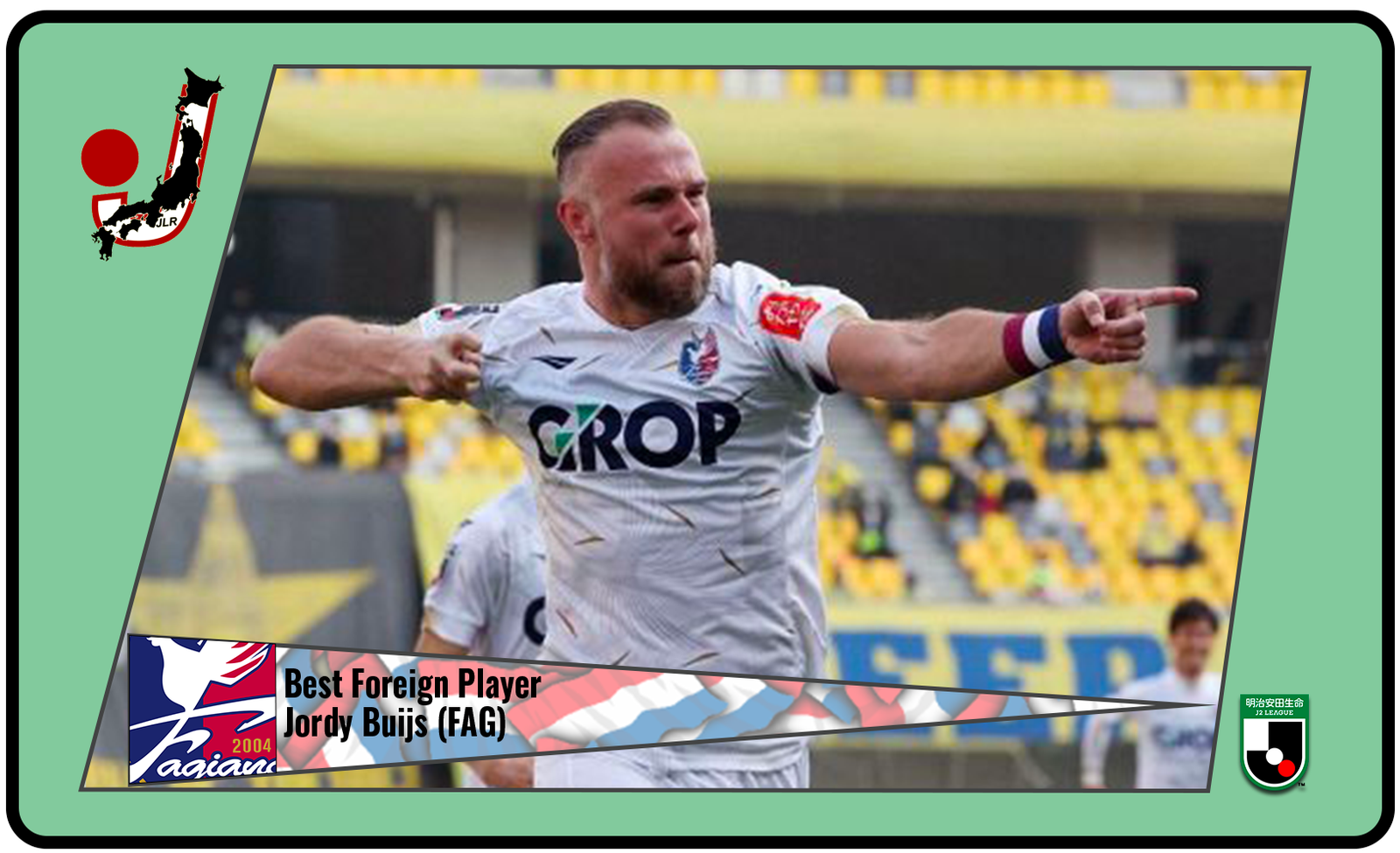
Best Foreign Player | Jordy Buijs, Fagiano Okayama (48,0%)
Looking at the playoffs this weekend, Fagiano Okayama brought home already two accolades. The first one is about the Best Foreign Player, where Okayama could actually count on two nominations, but one resulted stronger than the other: the leadership brought by Jordy Buijs stayed unmatched.
After Nagasaki, Tokushima, and Kyoto, the Dutch center-back left Sanga to find new challenges, and Fagiano were already rumored to be a playoffs contender with him on the line-up. But the pairing with Yasutaka Yanagi – another excellent center-back, another goal-getter in the penalty box – helped Okayama progress to their best season ever.
Best Goal | Tiago Alves, Fagiano Okayama-Ventforet Kofu (MD1, 44,0%)
JLR won’t hide. We were rooting for Kazuma Yamaguchi’s rocket to win. But Tiago Alves used this goal as a statement. After a few years in J1 wandering between squads – he played for Shimizu S-Pulse and Sagan Tosu, before ending up at Gamba Osaka in 2021 –, the Brazilian needed a place where to be a protagonist.
Although he was nominated for Best Foreign Player, his contribution seemed more fitted for Best Goal. His half-line screamer on the first matchday against Ventforet Kofu set the tone for the season, also scoring a brace in the process and closing a mesmerizing afternoon for him. Whether Fagiano go up or not, they surely found a new hero to rely on.

Best Manager | Takeshi Oki, Roasso Kumamoto (55,9%)
Takashi Kiyama has done his job at Fagiano Okayama. Rihito Matsuhahshi has brought Albirex back to J1, in a process that reminded us of Oniki taking over Kazama at Frontale. Surely other managers deserved a shout, like Ken Yoshida’s work at Blaublitz Akita and Takahiro Shimotaira’s work in Oita.
But there was no match for Takeshi Oki. At the end of 2020, after a failing season, he seemed done. His football wasn’t working in Kumamoto. But with the right players, he built up something even bigger: he’ll give the playoffs another try, after three missed chances in a row with Kyoto Sanga between 2012 and 2014. Here we wrote last June why he did such an amazing job.
2022 has been a hectic season, and the Regista Awards will cover them in its entirety. Keep your attention on these channels: soon the Regista Awards for J1 and J3 will be here…

[…] is going longer this season. If you want to catch up with the J2 League, you can read the awards here. Thanks for reading and following our activity throughout the whole […]
[…] featuring here, we can’t wait to see them again in action for 2023. You can recover J1 League and J2 League awards at the links reported. It’s been a blast to have another year of the Regista Awards: thank […]