Among the 18 teams, what’s the most surprising to still see around in the top flight? The easy answer probably comes fast to your mind: Sagan Tosu. Promoted in 2011, almost capable of reaching ACL spots in their debut season, Sagan have been able to retain their spot in J1, even in seasons when their performance couldn’t have granted survival. Think especially about 2018 and 2019, when Kim Myung-hwi made a miracle in keep them around.
Nevertheless, Sagan went through a rough patch when Fernando Torres retired and everyone quickly realized the club was in financial shambles. Furthermore, despite good performances in 2020 and 2021 – throughout COVID-19 clusters and wrecked schedules –, another scandal rocked the club, with power harassment accusations towards Kim Myung-hwi, who had to resign. And so Sagan needed to find another coach able to pull it off.
Tosu have been able to built some characters within the league: beyond Kim Myung-hwi, we had Yoon Jung-hwan and Massimo Ficcadenti. But they probably needed a different guy, someone more sympathetic and less authoritarian. And we actually a nice picture of him by an out-of-the-blue character in this story: Sisinio, the Spanish midfielder who played in J2 for FC Gifu, Tokushima Vortis, and Ehime FC. Yes, Ehime, because the protagonist of this story is Kenta Kawai.
Sisinio had a tough season in Ehime, fighting against injury and living through the first year of the pandemic on the side lines. It was hard to manage all of these feelings, between a possible retirement and the will to integrate in Japan (even learning the language). Kawai was fundamental in all of this, since he had maximum trust in the Spanish midfielder, and waited for him. Always checking his progress, Kawai comes through as a gentle guy, very careful at the mental condition of his players.
The Ehime-an
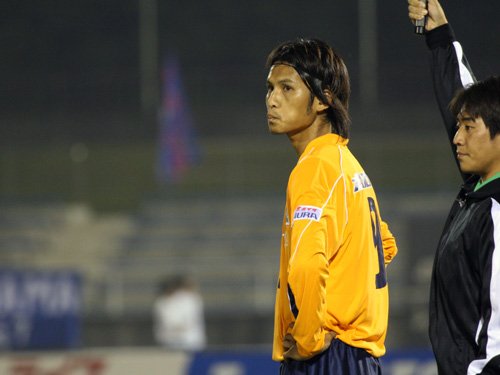
Kawai’s career was really brief. Born in Uwajima City – in the Ehime Prefecture – in 1981, Kawai stayed at home his career, minus a stint at the Momoyama Gakuin University in Osaka. Once he ended his stay in university, the young Kenta came back and joined Ehime FC in 2004. And don’t think about current Ehime, who played for 15 seasons in J2 League, and are still relevant in J3. We’re talking of Japan Football League times, a decade before J3 was even born.
In 2005, Ehime got promoted to J2 from JFL. Kawai didn’t play at all that year, but in his rookie season in 2004 he actually scored six goals in 22 caps, showing some potential. When they got to J2, the striker featured just twice in Ehime’s maiden season in the second tier – actually, his debut came against… Sagan Tosu! Then two minutes against Shonan Bellmare on Matchday 3… and that’s it. He retired at the end of the year, being just 25 years old.
Kawai built then himself a role within women’s football. He was involved for a decade with the Pacific Junior Rim College as a coach of the women’s team, and he also stayed five years within the staff of Ehime FC Ladies. He did a good job with them, since he brought the team from the third to the second division, and his work lasted longer than his stay. Now Ehime are playing the Nadeshiko League, the top flight in WE League.
Bursting Into the Scene
Kawai was then promoted in 2018 to the U-18 side of the men’s team, managing them for the rest of the year. At that time, Ehime were mainly trying to stay afloat. To do so, they picked Shuichi Mase as the head coach, who had a decent stint with Blaublitz Akita. Unfortunately, the fit wasn’t there and, to avoid relegation, the club changed the manager, offering the job to Kawai. It seemed a long shot, but in the end it actually worked.
Kawai stayed in the dugout for two and a half years. He managed to achieve two excellent years in 2018 and 2019, ending 18th and 19th on the table. Putting Ehime outside of the danger zone was a massive achievement, with historical games involved – including four consecutive wins in July 2018, or wins against Oita Trinita, Albirex Niigata and thumping Omiya Ardija at home. Unfortunately, the spell broke in 2020, when Ehime theoretically got relegated but no relegations were in place (they ended 21st).
To keep learning after his Ehime adventure, Kawai actually left the Prefecture for the first time in 17 years to join Montedio Yamagata as an assistant coach under Pete Cklamovski in April 2021. He stayed there for the remainder of the season, absorbing even more from the Australian head coach. Kawai announced his departure in December 2021, because he was picked to be in charge again. This time, with the big boys in J1, for Sagan Tosu.
Showtime
Many feared that losing Kim Myung-hwi would have broken the system. It didn’t happen. Kawai was spot on in his first words as a head coach of the club: “I’d like to see Sagan grow together with the region and the supporters. We want to bring excitement to everyone”. The idea was to play a certain brand of football, the one already showed at Ehime – although with limited resources – and cemented in his assistant coach stint in Yamagata.
Sagan surprised everyone for their defensive stability. In the first 12 matches of the 2022 J1 League, they conceded just seven times – and three of those came in a loss away in Kyoto. They were part of one of the craziest matches we’ve ever seen – the 4-4 draw against Kashima – and they generally took some good results from this season. Winning 5-0 at home against FC Tokyo, or staying unbeaten against J1 champions Marinos (two draws) and Sanfrecce Hiroshima.
In the end, the home performances made the difference: 24 of those 42 points came in Sagan’s stadium. They found goals from basically anyone – Sagan Tosu had 17 different scorers in 2022, with Taisei Miyashiro being the main one with eight. Sure, Tosu lost Miyashiro and Kakita, but they have a wonderful youth sector and they’ve been able before to resuscitate careers: could you imagine Yuki Horigome or Yuto Iwasaki being relevant in J1 in 2022? No? That’s why Kenta Kawai is magic.
[…] Kawai, the head coach who led Sagan Tosu in the last 2.5 years before being sacked last August. He was really a solid, steady hand to coach Sagan, but Tosu entered the relegation zone on Matchday 6, left it for a couple of months, and then […]
[…] There were surely some differences, although I worked mostly with the goalkeepers and the academy, but surely there were diverse one from each other. I noticed more of a difference with my second stint at Sagan Tosu, because some of the Japanese players who were playing at Sagan entered the technical staff. So it wasn’t so much a question of having a Japanese head coach or not (for example, Kenta Kawai was a very thoughtful individual). […]