One-hit wonders. A light in a strange career, which wasn’t made of sparks and constant success. A sudden corner of attention in an otherwise normal trajectory. There are seasons or years like these, with players capable of rising to the occasion when it’s needed the most. Just think of sudden protagonists, who made the front cover for a certain period, without repeating themselves after that season.
“Lost Treasures” is a column that featured six episodes until now, all talking about these kinds of players in the history of J. League. To pick whom to feature in this column, we looked at all the Best XIs composed by the J. League committee at the end of every season and chose four players who made an enormous leap, just to rarely or not repeat themselves in the successive seasons.
Another specific detail: we picked just J. Leaguers, who enjoyed most of their career in the Japanese championship, albeit there have been two exceptions. It’s been some time since the last piece in this column. We enjoyed a trip on Memory Lane with Manabu Saito, who could have been one of the brightest talents in Japan in the 2010s, and then got lost along the way (now he’s playing for Azul Claro Numazu in the J3 League).
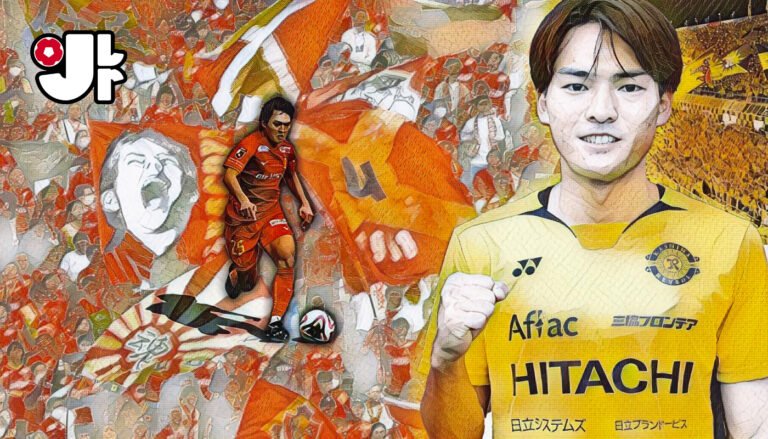
And today we’re gonna move to another no. 10, who once broke through in the J.League without making a fuss. His class was well-renowned, although he never left a mark outside of Japan. For his technique, he could have been a Europe-bound player, but instead, by 33 years old, he was already out of the spotlight. That’s Yoshizumi Ogawa, the no. 10 of Nagoya Grampus and the heir of a very heavy jersey to wear.
The Beginnings
Born in 1984 in Sunigami, Tokyo – one of the most liberal areas of the city, the one where a woman (Satoko Kishimoto) has been elected as mayor of the ward -, Ogawa could have joined Verdy’s youth ranks, but he didn’t go through the next stage and stayed put with Mitsubishi Yowa SC. Nonetheless, Ogawa became a national sensation due to his performances in major tournaments.
The young kid was very successful with the youth tournaments. He won the national championship in 2003 with Funabashi High School, scoring the goal to win it all in the final against Nagasaki Prefectural Kunimi High School. In that team, Ogawa played with many future J.Leaguers, such as Kazuki Hara, Tatsuya Masushima, Robert Cullen, Ryota Aoki, and Yuya Sato.
It didn’t go any differently with Meiji University, where Ogawa enrolled himself from 2003 to 2006. He remembers how important it was to live the university experience: “I think it was important to be able to grow as a human being when I was in college. I wasn’t there just to be a decent football player, but also to become a good human being, a functioning one for society. I grew up a lot in those times”.
After being selected for the Kanto representatives, Ogawa had two chances to become a pro. The first one was Nag.. no, Sagan Tosu. They invited Ogawa to a practice session but then passed on him. For Sagan Tosu – a small J2 club back in 2006 – it was a major oversight. Then Nagoya Grampus – who had already a first training session with Ogawa – gave the kid a second chance and signed the kid, especially because he resembled a lot someone else.
The Manifestation
Ogawa debuted in ’07 wearing the no. 29, under a team that was mid-table at best and with a foreign coach in the dugout – the Dutch Sef Vergoossen. The trainer, though, lasted just one year, and then Grampus took the chance of hiring a former player, a legend, maybe one of the greatest foreign players that the J.League ever featured: Dragan Stojković was back.
Stojković retired in ’01 as a Nagoya player, at the age of 36 years old. And he didn’t coach until that moment back then – he was first elected as the president of the Serbian Football Association from 2001 to 2005, and then as the president of Red Star Belgrade from 2005 to 2007. It could have been a disaster, but the whole environment wholeheartedly took Stojković back.
And the Serbian head coach saw in Ogawa a sort of heir. And he was right: after playing just 15 times in all competitions in his rookie year, Ogawa took over the right midfielder position and, as a sophomore, put together 45 games and 13 goals (11 of those came in the J.League). Not just that – Ogawa entered the “Best XI” at the end of that year and, looking back, Ogawa knows how much Stojković has been important for his career.
“Without him, I don’t have any doubt: I wouldn’t be here. When Stojković took over, he immediately told us he wanted to win a title. He kept encouraging us, to never give up, planting that mentality in the team. I saw him furious sometimes on the bench, but I understood his obsession with beautiful football as a goal”. To this day, Ogawa is still the most used player ever by Stojković in his coaching days.
The Institution
The problem is that when you set yourself that high – very few rookies immediately reached the Best XI – to top that is hard. And Ogawa felt that throughout his career, because he didn’t save the best for last. The midfielder took over the no. 10 in 2009, and immediately helped Nagoya Grampus reach the J1 title in 2010. That was followed right away by the win in the 2011 Japanese Super Cup, plus three AFC Champions League participations.
Unfortunately, Grampus stalled after that. Despite Ogawa having other solid seasons (like 2013: 38 games and 9 goals), it was impossible to reach those heights again. Furthermore, he attended some training camps from Japan, being called up by Takeshi Okada, but he never featured for the national team (despite other coaches advocating for that – like Nobuhiro Ishizaki after a Nagoya-Kashiwa in 2008).
In 2016, with Grampus going down, Ogawa left and joined Sagan Tosu – in a strange joke from destiny, he joined the team who passed on the chance of signing him. It lasted only six months, before joining Albirex Niigata on their way to J2. He even became the captain of Niigata, only to retire at the end of the 2019 season. And when it came down to what to do next, Ogawa had a desire.
Already in 2017, Ogawa was impressed by what Pep Guardiola in Europe and Ange Postecoglou in Japan were doing. The former Nagoya no. 10 started to take note and the post-retirement scenario took shape – being a head coach: “Of course, I knew it wasn’t going to be easy, but I didn’t want to do step-by-step by starting from a youth coaching position. I wanted to become a head coach right away given I just stopped playing”.
The Present
So it felt natural for Ogawa, back in 2019, to take immediately over the coaching way by signing for Kansai-bound side FC TiAmo Hirataka and being their manager for three seasons. At that time, the Osaka-based club started in the Kansai Soccer League, but Ogawa brought the club immediately to the Japan Football League. He stayed there until September 2022, when he was dismissed.
To proceed with his coaching development, Ogawa chose to come back to Sagan Tosu and join again the club, this time in an assistant coach position, which he held for two seasons – the last of Sagan Tosu in J1. The most recent news is that Ogawa opted for another return, this time to a place he attended before his pro-career. He’s been hired as the new head coach for the football program at Meiji University.
Ogawa is just 40 years old, but so much has been going on for him. The biggest legacy? Probably being the real heir of Dragan Stojković – although Ogawa has always tried to shy away from this comparison: “We have different styles of playing”. But in the end, Ogawa won even more for Grampus compared to Piksi, although Stojković has left the biggest mark on both J.League and world football.
Whether Ogawa will become a head coach with a certain career in the J.League-sphere, only time will tell. Surely he’s been a joy to the eyes while wearing that no. 10 for Nagoya Grampus.


[…] Another specific detail: we picked just J. Leaguers, who enjoyed most of their career in the Japanese championship, albeit there have been two exceptions. It’s been some time since the last piece in this column. We enjoyed a trip to Memory Lane with Yoshizumi Ogawa, the man who inherited the legacy and the number of Dragan Stojkovic at Nagoya Grampus – and won it all. […]