There’s no doubt that the J.League is growing a lot, and there are several indicators for it. My favourite one is average attendance, but there’s no denying that you can witness that growth as well somewhere: for example, the transfer market – how many Japanese players are leaving the country each market session? Many players are trying their luck in Europe, but given the level of talent provided by the J.League, some of them are also coming back pretty early.
We’ve already written about it a few months ago, and you can easily put up a line-up that could fight for a Top 5 finish in the J.League with the “returnees”. Furthermore, the concept of “returning to your league” has changed; 10 years ago, that would have been the sign of a failure (e.g. Hotaru Yamaguchi, Yoichiro Kakitani, etc.). Today it’s either a way to find back their mojo (e.g. Tomoki Takamine) or prepare yourself again for another European shot (e.g. Satoshi Tanaka).
But the “one-and-gone” category is filling up with several players, especially in the last years. Just to give you a few more names who are doing very well since their returns:
- Yosuke Ideugchi (Vissel Kobe)
- Kyosuke Tagawa (Kashima Antlers)
- Sei Muroya (FC Tokyo)
- Shuto Abe (Gamba Osaka)
- Ryotaro Tsunoda (Yokohama F. Marinos)
But none of them is more representative of that case than a speedy winger, who used to be a fan favourite in Nagoya and then moved to Europe, coming back after 18 months and a strange ending of his Portuguese experience. At that time, who would have thought that Yuki Soma would have light up the league? Nonetheless, his last months with Machida Zelvia have been a statement form, week in and week out.
Ready for the Leap
Class ’97 born in Tokyo and a great-great-grandson of Nakamuraya’s founders, Soma joined first Mitsubishi Yowa, then enrolled at the Waseda University, and he created a bit of legend around his character. Soma was indeed one of the few top athletes to have properly balanced his success on the pitch with an academic preparation, studying psychology and kinesiology. His aim? “I wanted to understand football almost scientifically”.
Soma joined Nagoya Grampus in 2018, and it was a strange time. Yahiro Kazama was still the head coach back then, and Grampus were very entertaining to watch, but not for the right results. Their results were very moody, and Kazama had probably some doubts about him. Despite showing some glimpses of potential, Soma didn’t stay until Kazama was there, ending up on loan for six months to Kashima Antlers in 2019.
Once he returned from the loan in Ibaraki, Soma became a key player for Nagoya, one of the stars under the management of Massimo Ficcadenti. He won a J.League Cup in 2021, and played all but one match in two consecutive J.League seasons. Not just that, because he also debuted with Japan, and actually won the MVP and top-scoring title at the 2022 EAFF E-1 Championship. It seemed that a European opportunity would have come soon.
Soma even got a call-up for the 2022 FIFA World Cup, being one of the few Japanese players featuring from the J.League and playing for 82 minutes in a dreadful game loss against Costa Rica. And once the adventure in Qatar was over, Portugal knocked at his door for a shot. Soma took it, but he didn’t know what to expect.
Europe and Back
Soma moved to Casa Pia, a small team in top-flight of Portugal. He moved there in January 2023, and actually Casa Pia is based in Lisbon, so it was a decent move for the winger; furthermore, when he arrived, Soma joined another Japanese player in the roster, Takahiro Kunimoto. But Soma’s whole adventure is strange and representative of a new tendency: sometimes numbers are not enough to keep you around in Europe.
In fact, Soma had a wonderful debut in Portugal. After a first appearance, in his second match in Portugal, he needed just 28 minutes to assist one and scored the winner in a home game against Santa Clara. He scored two in 18 games in 2022-23, raising the bar to five goals in 30 games in the successive season. And yet, his loan to Casa Pia was never transformed into a permanent move, so he left Portugal in June 2024.
To where? Well, to come back to Nagoya Grampus, where things radically changed. Ficcadenti wasn’t there anymore and Kenta Hasegawa’s reign of terror wasn’t exactly thriving (despite Grampus were on their path to win the J.League Cup that year). Soma stayed just one month in Nagoya, the time to actually play 78 minutes in a home match against Kashiwa Reysol and score his last goal with the jersey of Grampus.
In August, with a bit of surprise, Soma left Nagoya and moved to newly-promoted Machida Zelvia. A move that made everyone happy: Zelvia heavily strengthened their team in the Summer and Soma could finally play in his hometown (he’s from Chofu, a municipality of Tokyo).
A King in Machida
What we didn’t expect was HOW impacting Soma’s arrival would have been in Machida. He didn’t just make the starting line-up; in these 18 months, he’s been the offensive engine behind Zelvia’s results. And if his 2024 with Zelvia was a notch down compared to what he had done in Nagoya (scoring just once, although in the derby against FC Tokyo and with an olimpico!), 2025 was mesmerizing from his side.
Soma got a spot into the “Best XI” from last season (first player from Zelvia to do so), after scoring nine goals and providing nine assists in 34 games, with Zelvia ending their campaign on sixth place. He scored two more in the Emperor’s Cup, including one in the final against Vissel Kobe, to clinch the trophy with Zelvia. And he had a wonderful run as well in the 2025-26 AFC Champions League, scoring three times in the 10 games he featured in the competition.
Soma even got again called up by Japan, although it was just for the 2025 EAFF E-1 Championship, but as a vice-captain. He now holds a particular record for any Japanese player: he featured in three different editions (2019, 2022, 2025), winning two of those. Then Soma played as well some minutes in the friendly games against Paraguay and Brazil in October. We seriously doubt he’ll be in contention for a spot for the 2026 FIFA World Cup, but… he’s been around in the last months.
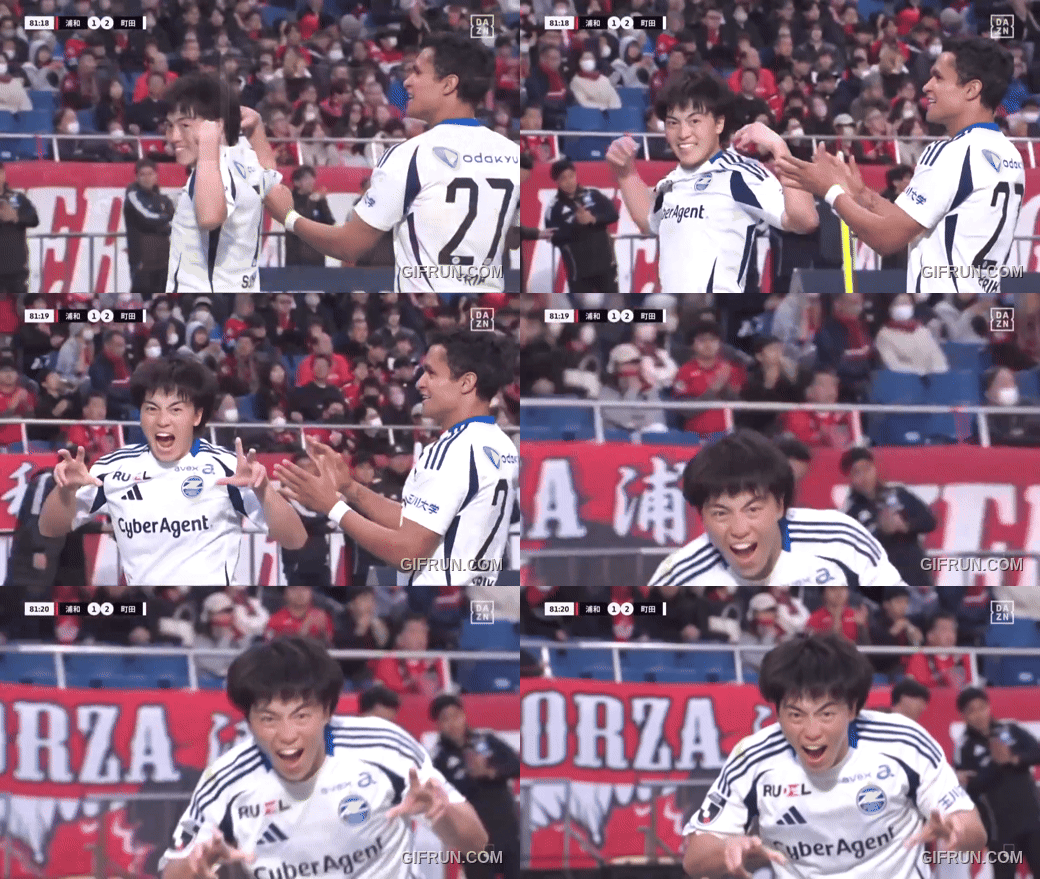
The no. 7 didn’t lose any time in the “100-Year Vision League”, scoring already four times in just six games – including a winner in Saitama last week. He’s already scored more goals with Machida Zelvia than into his whole career in Nagoya (but with almost 50% less games). And it’s not an accident if he won the monthly MVP award for February. Soma is an interesting case; I wonder if we’ll see more of those in the J.League in the next seasons. Meanwhile, let’s enjoy him.



[…] we talked about how Yuki Soma became a star of the league with Machida Zelvia after a solid stint in Portugal. We could name many players (and we have done that!) who returned […]