It’s not easy to sell your brand overseas, especially if you’re a football league. Of course, there have been leagues which are working extremely well, whether because of their structures (look at Bundesliga) or due to their stardom and tradition all over the world (LaLiga has been expanding a lot in the last years, given the results of Spanish teams in the continental stage and its ties to Asia).
There have also been different examples. Premier League is certainly the most lucrative league for now, but their peak seems behind their shoulder and finding another land to “evangelize” isn’t exactly easy. This happens while Ligue 1 overvalue its own product and Serie A… well, it’s going to Serie A-ing, asking a lot of money for TV rights, but featuring this Twitter coverage for the Italian Cup final or a terrible managing of their YouTube channel.
Then you have “second-tier leagues”, which divide into between the ones which can’t grow anymore, but they have their potential (Eredivisie, Championship, Portuguese Liga, Série A), and the rising leagues, although you can easily spot the differences among them. In this last category, alongside Chinese Super League and MLS, you can find J. League, which isn’t flawless, but they’re putting some effort in the last two-three years.
The arrival of DAZN gave a big push, but some work has been done even before, when the league wasn’t exactly healthy and you needed the help of rock-hard fans to keep the conversation going. In this scenario, you have a podcast, which even went on hiatus at the end of 2016 and came back in its original format at the beginning of 2018. We’re talking of a real institution for foreign fans of J. League, whether they’re living in Japan or not.
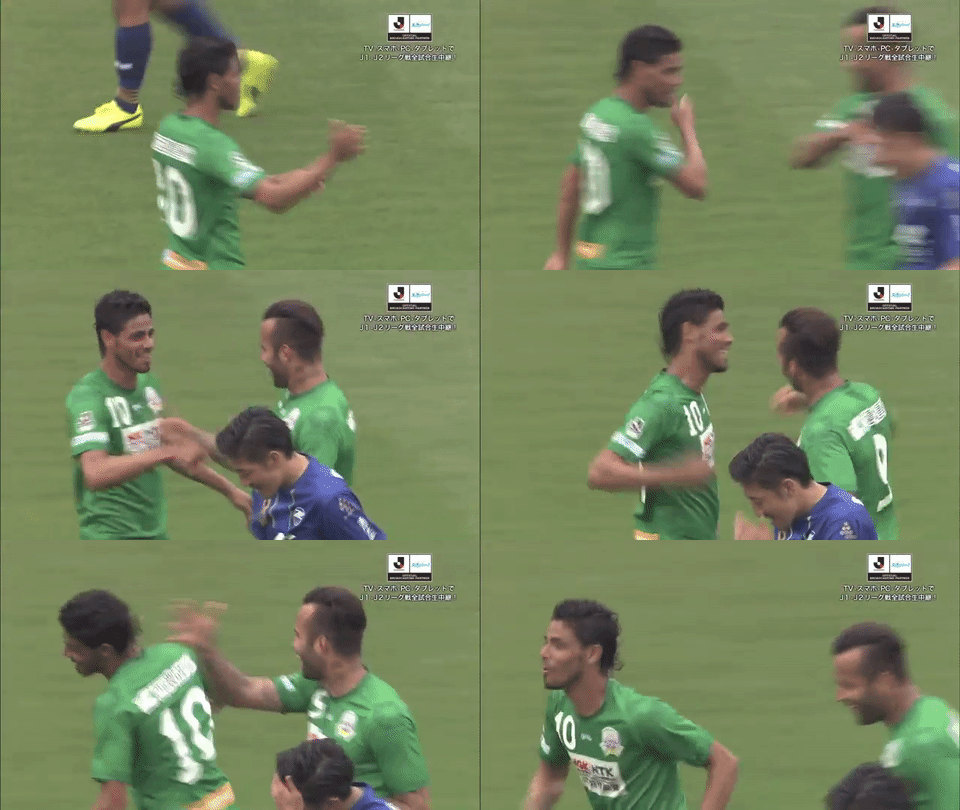
We’re talking of “The J-Talk Podcast”, launched on March 8th, 2012 by an Australian fan living in Japan (who already had a pod, but about his beloved FC Tokyo). It was a first experiment, featuring Sean Carroll. Little did Mr. Ben Maxwell know about the importance that JTP would have for fans, but now that this podcast has become a recurring appointment for every J. League fan, you can see the success.
We decided to talk to Ben to understand better how the process worked throughout these seven years and how the idea of a podcast started in the first place. We hope you’ll enjoy this interview!
Ben Maxwell, a name tied to the J-Talk Pod. But who’s the man behind this project? Why and when you opted to move to Japan?
I’m just another English teacher in Japan! I moved here (initially for a year, or so I thought) in 2000, on the recommendation of a close friend I grew up with in a small town in Victoria, Australia. I had spent some time playing cricket over in the north-west of England, and in my second stint, in 1999, my friend moved to Osaka; he gradually sold me on Japan being an interesting place to live and work. I didn’t want to go back to small town life, so I thought I’d give it a go… and 19 years later, I’m still here.
How it was the passage from European football to live Japanese football in person? And how’s your relationship towards your favorite team, FC Tokyo?
Where I’m from in Australia, cricket and Aussie Rules football were my main passions growing up, but my two summers living in England really opened my eyes to the religion that is football. Whenever we were rained out at cricket (which happened quite often), some of us from the club would go to watch Macclesfield Town if they were at home and I was also lucky enough to attend a game at Anfield (Liverpool 3-1 Bradford, ‘99). I loved the atmosphere inside the stadiums.
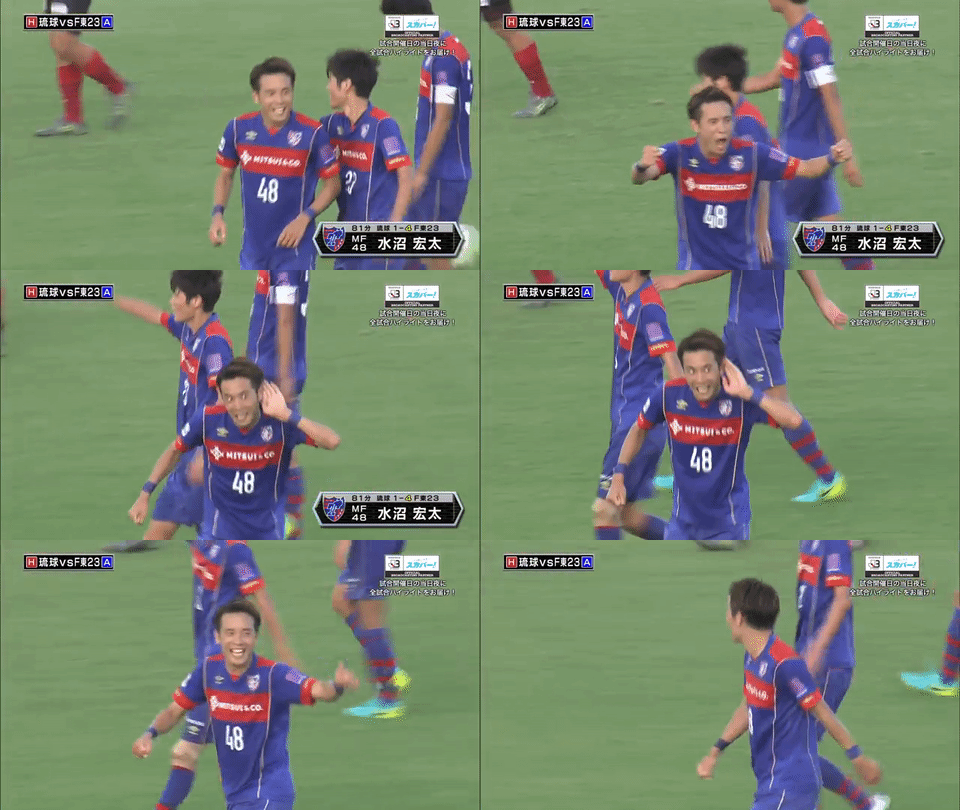
When I arrived in Japan, I knew I had to choose a club to support, I saw an FC Tokyo “Sexy Football” poster in the window of my local am/pm convenience store, and that was me sold. Ajinomoto Stadium is certainly not the most atmospheric of J. League grounds, but I love the days out, and the constant singing from the supporters – while taking a bit of getting used to at first (hang on, the other team just scored, why are you still jumping up and down?!) – certainly adds to the occasion.
I’m not as passionate about Tokyo as four or five years ago and had to give up my season ticket as our family grew and we moved further away, but the defeats still sting and I still have the same complaints about the way the club is run… so I know the fire is still there deep down.
J. League has more than a quarter of century behind it. The growth is there, even if it wasn’t all granted. JFA even tried to sabotage itself with some strange moves (e.g. the return of two stage-championship in 2014 or the existence of U-23 teams in J3), but still the unique identity of Japan is providing the possibility of distinguishing the league from many others all over the world. What’s the beauty of J. League for you, even in lower divisions?
A lot of it is about that atmosphere inside the stadiums. J. League can’t stay out of their own way with some of their ridiculous decisions (the two you mention being prime examples), but at the end of the day it’s a simple game that stirs passions in people of all ages, and the game is very inclusive here, which adds to its appeal.
When the camera pans around the crowd at a European stadium you’ll mostly see 30-60 years old-men, but here there are an almost equal sprinkling of men, women and children; that diversity in ages and family atmosphere makes attending a J. League game anywhere across the country a unique experience.

You’ve built so many relationships through this podcast: do you think that’s the most precious outcome from this adventure? Or would you choose also other possible memories, like a particular moment through J. League history?
Yes, we are so lucky in our little J. League English-speaking community to have so many sincere, passionate individuals: personally, I’m lucky as host that so many of them are willing to give up their time, work around my schedule (can we record at 10pm, after my kids are in bed?), and share their views on things. Over 40 guests in six-plus years, from all across the globe. It’s been wonderful.
J. League is now experiencing a new phase of stardom with Torres, Podolski, Villa, Jo and Leandro Damiao. But I think the progress and the growth of J. League passes through less known stars and aspects. Do you think the Japanese championship could grow more and more in the next decade, maybe even reaching a Top 10 status among national tournaments?
It’s a tricky balance. I hope the league continues to improve, but it needs to be driven on a basic level by the standard of domestic players, rather than a reliance on foreign imports, who will always arrive in different stages of their careers with varying levels of motivation.
We saw the explosion of money and big names in China, but that hasn’t impacted the national team there at all, and while I’m glad to see names like Torres and Iniesta here, I hope we don’t see a development like that in the J.League (and don’t think we will).
Naturally though, the best of those domestic players will be drawn to Europe and I think we’re a long way off the standard being high enough that the next Keisuke Honda or Takefusa Kubo will think it better for their career to stay at home rather that test themselves on the European stage. For now, good performances in the ACL – following on from the titles won by Urawa and Kashima – will have to be the best guide as to the level of the league.
In late 2016, you announced how you were going to take a break due to family commitments. Of course life has tougher challenges for us, but it was hard to give a momentaneous goodbye to something you built from scratch?
Yes, I missed doing the pod, as it was a huge part of my weekly routine, but family comes first and my wife had supported me taking time out for so long to do the pod, I had to do my bit after our second child was born. Then at the start of last season when I wondered if I should get back on the horse; she knew how much I had enjoyed doing the show, so encouraged me to start doing it again. And I’m glad I did!
In the last 12 months, the podcast joined Football Nation Radio, had the chance of featuring for the Totally Football Show of James Richardson during World Cup and grew massively.
Do you think there’s space for further improvement? And how much would you like that to happen, especially on the int’l narrative about the league?
Both the league and the national football federation can and must improve on this, as you’ve underlined several times.
I probably could do more to get the pod ‘out there’, but at the same time I know it is very niche and I’m thankful for any opportunities I get in other places like The Totally Show and Football Nation Radio. I’m not one for sweeping changes, as regular listeners will know: the format of the show has basically been the same from the start, but there is always room for new voices on J-Talk and I hope we can keep moving forward in the years ahead, spreading the word about the game we all love here in Japan.
Well, thanking Ben wouldn’t be enough. Mr. Maxwell lighted up a spark for all J. League followers to come together from all over the world together in one community, all in love with this country and its league. I could mention other pioneers in this important function (from Ken Matsushima to Cesare Polenghi, passing through Alan Gibson and Dan Orlowitz, and I’m surely forgetting someone: sorry!), but the J-Talk Pod is an institution.
Long live the J. League, long live the pod.