It’s not easy to impose yourself as a relevant club in the Japanese football scenario if you’re from one of the most famous regions of the country. If you’re from Kansai or Kanto, you might struggle to find your space, especially if you think that even clubs from other regions – Hiroshima, Ibaraki, even Miyagi – caught the spotlight in the last decade.
So there’s no surprise in learning that a club from Fujieda – Shizuoka Prefecture, just near Jubilo Iwata and Shimizu S-Pulse, the leaders in that zone – might not be so relevant at all. Fujieda MYFC are mostly famous for being one of the founding members of the J3 League, which was launched in 2014 and saw MYFC among the early adopters of that category.
But even then, you wouldn’t expect that much from such a small club. Their highlights in these years? A superb run in the 2015 Emperor’s Cup and their credit in giving Tsugutoshi Oishi a chance to become the J3 all-time top-scorer. Apart from those facts, nothing to report.
Yet, today Fujieda MYFC lead the table in the 2019 J3 League. Many didn’t see that coming, but it happened. And there are a couple of reasons why we’re witnessing another strange run at the title in the third division (other than, you know, J3 being even more mental than J2).
The club
J3 League welcomed Fujieda MYFC, which isn’t actually that old. The club was founded in 2010 after a merger between Fujieda Nelson and My Football Club. The latter, back then, represented a project launched by several fans all over the world, who wanted to fund their own clubs, acting not only as supporters, but also as shareholders. This also took place in Japan with MYFC.
Originally, MYFC acquired the sporting asset from Shizuoka FC, which was competing in regional football during the 2000s. They won the Tokai Soccer League several times but never successfully advanced to the JFL. To grant the sportive success of the project, Toshihide Saito – former Shimizu S-Pulse and Japan NT member – was installed as captain and manager of the club.
It took time, but the club reached the Japan Football League. After being knocked out in the first round of the Regional League promotion series in 2010, the successive year was the right one to seal the deal: a decisive PK-lottery win against YSCC gifted the club the promotion to the back-then third division.
Once in JFL, the squad changed the name to their current denomination, Fujieda MYFC. But their first two seasons in Japan Football League weren’t exactly exciting: average attendance under 1,000, no particular player shining there (if you exclude Kerlon’s mad journey or Daisuke Ichikawa closing his career), no results to be joyful for. Fujieda came 11th and 13th in two seasons, but they found a way to be admitted to J3 in late 2013.
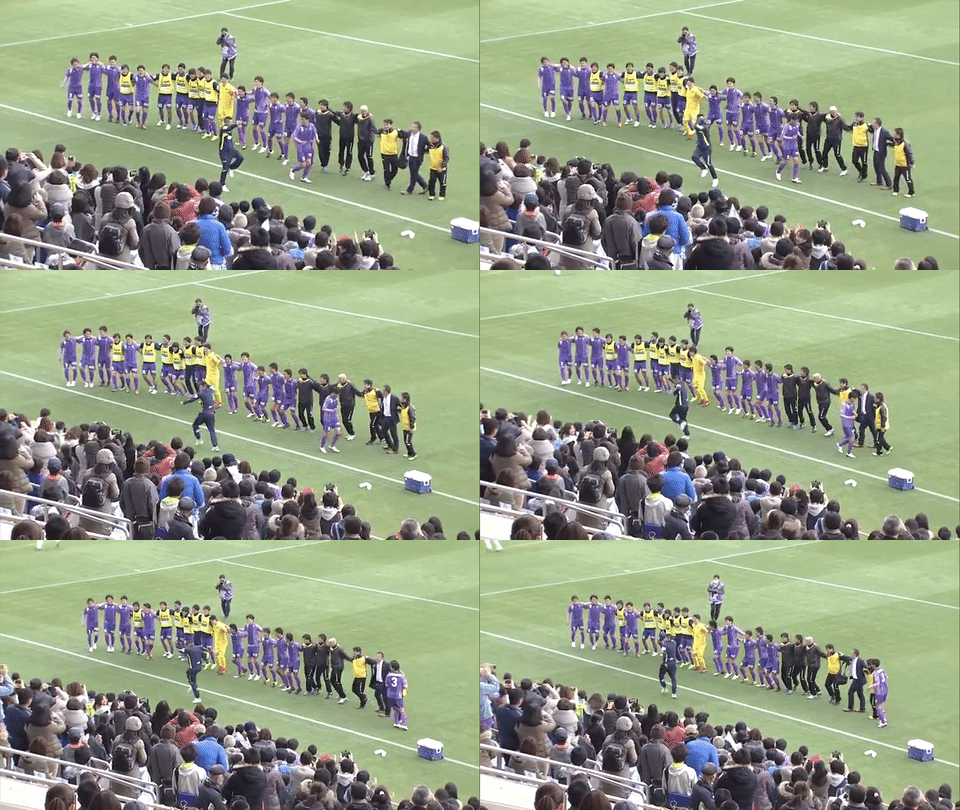
Once they joined the newly-born division, MYFC found their spot in the league. They weren’t brilliant, but they weren’t terrible either: that was already a success in a league where some teams were pushing to grow or even going up. Credits has to be assigned to Atsuto Oishi – now manager of Vanraure Hachinhohe –, who kept MYFC in a solid run before resigning in the middle of 2018 season.
Why leaving though? Because results dropped massively: after two seventh-placed finishes in 2016 and 2017, with MYFC ending second to bottom in 2018. But even if they didn’t know back then, their managerial change might have been the first step to restart for this 2019 season.
The manager
The resignation of Atsuto Oishi wasn’t easy for MYFC. Yet, just like in other cases – such as Moriyasu in Summer 2017 with Sanfrecce Hiroshima, for example –cycles just end. You can’t do anything about it; sometimes it just happens. What you can do, instead, is try to move forward with a good manager. And that’s exactly what happened in Fujieda last Summer.
Nobuhiro Ishizaki is probably one of the most underrated profiles in the history of professional Japanese football (I’d put Nobuhiro Ueno in that list as well). Ishizaki has a long history of success not in terms of general silverware, but in making his teams better than they actually were. He’s a developer, like Steve Ballmer would like to scream at you.
Kashiwa Reysol, Consadole Sapporo, Montedio Yamagata and lastly Tegevajaro Miyazaki: all squads living a promotion under the steady hand of Ishizaki. With the Kyushu side, the journey ended last Summer, just like the honeymoon between Oishi and MYFC. When Ishizaki joined the Fujieda side, it didn’t start well, but MYFC planned the season differently for 2019.
During last Winter, Fujieda MYFC signed some solid players, like Junya Suzuki (coming back from Germany), Nobuyuki Kawashima (who already has played in Fujieda), Ryosuke Matsuoka (a J2 veteran), Tatsuya Yazawa (still a useful player for this category), Naoto Ando and Sho Maruoka. To those ones, you have to add Daiki Asada, Takashi Akiyama, Ryota Iwabuchi, Kenzo Taniguchi, Ryuto Otake: all expert figures in the third division.
The results are in front of everyone’s eyes: beside being trashed in Osaka twice by both U-23 sides, Fujieda are thriving. They’ve a solid defense – guided by J3 senator and keeper, Daichi Sugimoto – and they found 10 clean sheets out of 18 games played in this championship. And among the signings of last Winter, there’s one more important than others.
The player
For some reasons – to me honestly unknown –, the career of Yasuhito Morishima seemed over two years ago. His downfall was massive, so huge that I couldn’t explain it to myself. Raised by Cerezo Osaka youth sector, he didn’t find the right space alongside Takashi Inui and Shinji Kagawa in mid-2000s. So he left Osaka to join Oita Trinita, who faced a tough time after relegation in ’09.
Despite that, Morishima needed time: he had his first double digits-season in 2011, but he repeated that form even in 2012, probably reaching the pinnacle of his form. Oita reached sixth place and faced Kyoto Sanga in the play-offs semi-final: Morishima scored four goals to lead Trinita to a stunning 4-0 win. In the final, a goal by Takenori Hayashi pushed the club back to J1.
Their J1 season in 2013 was dreadful. They got relegated with a lot of games to play, but Morishima had a good run: 11 goals in all competitions, seven in the championship. It was natural to see him progress with his career rather than going back to J2 and that’s why he was picked up by Kawasaki Frontale, who just came back from a promising 2013 season.
Unfortunately, it wasn’t the right choice. Morishima had to compete with Yoshito Okubo and Yu Kobayashi for the spot of main striker. It was an impossible task, also because his way of playing football didn’t fit in Yahiro Kazama’s system. Despite scoring in three different competitions, he was loaned out to Jubilo Iwata. But even then, troubles came on his way.
Jay Bothroyd was rightfully preferred as the main option by Hiroshi Nanami, and Morishima failed to score even in J2, his old home. When the club came back to J1, there wasn’t any space left for him, since Kazuki Saito and youngster Koki Ogawa were eager to eat some of his minutes. At 29 years old, Morishima made a big drop, signing for Tegevajaro Miyazaki for the 2017 season.
From J1 League to Kyushu Football League: a jump back of four divisions. It seemed some strange, but probably Morishima needed to re-build himself from scratch. In the last two seasons, the striker featured in the fifth tier: first he scored 19 goals in 17 games to push Tegevajaro to JFL, then he tried the same number with Tochigi UVA FC (17 goals in 18 games in the Kanto Soccer League), but the club didn’t reach the fourth division.
After those two regional experiences, Morishima opted to join Fujieda MYFC last Winter, reuniting with Nobuhiro Ishizaki, who took him in Miyazaki when he was coaching Tegevajaro.
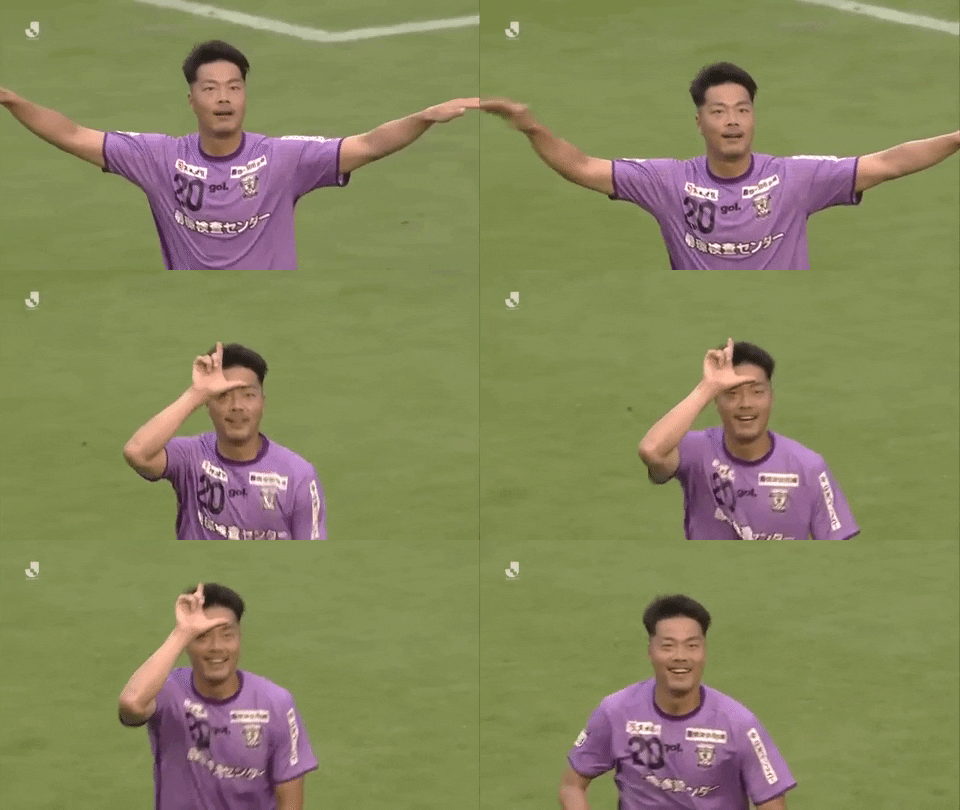
Seeing him coming back to professional football after this fall isn’t that surprising, given the value of the player. What strikes the most is how he’s performing after such letdown: Morishima scored 12 goals and we’re only half-season, pushing Fujieda MYFC for the first time to the top of J3 League, thanks also to his hat-trick against FC Tokyo U-23.
Not only that, because he won the Monthly MVP Award in April.
What now?
It’s tough to see if we’re seeing a Blaublitz-case, like in 2017. Certainly, Fujieda don’t hold a J2 license and I don’t think they’ll obtain one in Autumn 2019. Still, Morishima’s form, the experience of many senators and the uncertainty in J3 could push the club towards unimaginable scenarios.
It wouldn’t be the first time J3 is stunned by a single season of fire: Zweigen Kanazawa are now a solid force in the second tier, but we were expecting Nagano Parceiro to win it all in 2014. Oita Trinita came back from J3, but they had to suffer, just like Tochigi in 2017. Renofa Yamaguchi stormed the league, but then almost slipped on the finish line. And what about FC Ryukyu last year?
J3 League is a wonderful league BECAUSE of its surprises and breakthroughs, so it’d be nice to watch another pleasant cliffhanger by an outsider, even if – just like Blaublitz Akita, champions in 2017 – won’t mean automatic promotion. Why ruining a nice story with the truth?
[…] playing in the ACL to featuring in the Kyushu Soccer League three years later in Miyazaki. He then re-emerged with Fujieda MYFC, having a beautiful debut season in 2019, only to miss continuity before retiring. It’s been […]
[…] where Fujieda MYFC were waiting for him. They closed the year terribly, but 2019 was a success: we indeed talked about their season, and highlighted how Fujieda were really good offensively to be a team led by Ishizaki. They […]