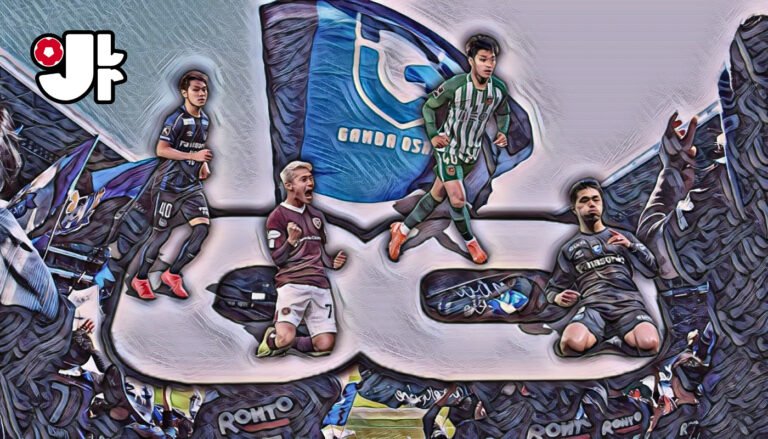
AFC Asian Cup hasn’t been great for Japan, but there was a team which left a positive mark on the tournament. Two of the (few) positive notes were Ritsu Doan and Keito Nakamura, who had a decent performance level. Both came out from the Gamba Osaka youth ranks, both have debuted in J3 with the reserves team, and they’re not the only products who have been given a shot under Hajime Moriyasu.
Kosei Tani has been ingurgitated and then swallowed back by his European adventure, but until 12 months ago he was one to watch (and he still is to us) for the national team. Before rupturing his ACL, Yosuke Ideguchi was supposed to be in the backbone of Japan in Russia for the 2018 World Cup. And many more could have been part of a squad basically done only with home-grown players.
While FC Tokyo and Cerezo Osaka’s U-23 teams haven’t been memorable in J3, Gamba Osaka had so much talent that we envisioned them taking J1 by storm. Besides 2020, though – when the club reached second on the table -, that never materialised. And if we look back at some of those players, surely some of them have fulfilled their potential, but mostly left a sour taste into the fans’ mouth.
That’s why we teamed up with Jonny Nicol (@BlogGamba on Twitter) to talk about certain names (mostly raised by Gamba, but who featured in their U-23). Some of them still gravitating in Osaka, and we divided them into three tiers:
- The Shoki Hirai tier – the ones who have potential for J1 for a short period of time.
- The Takahiro Futagawa tier – The ones who can be excellent J1 players.
- The Ritsu Doan or Takashi Usami tier – The ones who could even play in Europe.
The Hirai tier
When it came down to divide some names into these tiers, Jonny put in here the ones who probably are up for J1 time, but not as protagonists or game changers. Starting from someone who just came back to J1, since Hiroki Noda (class 1997) has just joined Kashiwa Reysol from Montedio Yamagata. His journey started in North four years ago, and Gamba barely used him – now it’s up to him to prove his value.
Alongside him, we have another defender – that Riku Matsuda (1999) who was supposed to become more than a J2 player. Just like Noda, he barely featured with the first team at Gamba, before going on loan two years at Zweigen Kanazawa. He did well in there, but he played way less last year at JEF United Chiba. Another one who got lost is Dai Tsukamoto (2001), who just left Gamba for good, signing for Zweigen Kanazawa. Haruto Shirai (1999) gave some rebirth signals, starting in Okinawa and having a decent year with FC Ryukyu (goal of the year in J3).
Among these ones, Kazunari Ichimi (1997) has been the biggest letdown. He scored a lot of goals in J3, then had a 17 goals-season in 2019 with Kyoto Sanga… only to end up playing for four different teams in the four seasons after (Yokohama FC, Gamba Osaka, Tokushima Vortis, and again Kyoto Sanga) and scoring LESS goals in these four years than in 2019 (16, just one in 2023).
The Futagawa tier
Different tier here, for which Jonny has told us about players who could have still a solid career in J1. We hope Hiroto Goya (1994) is gonna be in time, although his last season with JEF United Chiba was a letdown and his 22 goals-season with V-Varen Nagasaki was in 2019. Same goes for another 30 years-old, Shinya Yajima (1994)- a favourite of the author writing this article and a class player, but he still lies in J2, although with S-Pulse.
Leo Takae (1998) seemed to have found a nice environment in Machida, until he was sold to Montedio Yamagata mid-season in 2023. Isa Sakamoto (2003) is incredibly young, but he’s now back at Gamba – and it won’t be easy to find some space after a normal season with Fagiano Okayama. Instead, against all odds, Ryo Hatsuse (1997) is today a J1 champion, and a pillar for Vissel Kobe.
But to us, though, the two most curious cases from this tier are two current Gamba players. Do you remember when Ryotaro Meshino (1998) moved mountains with his goals? He went to Europe waiting for the impossible… and then it just didn’t work out. Whether it was Scotland or Portugal, it just didn’t. He came back to Gamba and Poyatos turned him into a central midfielder – which might be a strange development for him.
But if Meshino is still young and he’s got already experience under his belt, the story of Shoji Toyama (2002) is even weirder. When he scored multiple goals in J3 for the U-23 team of Gamba, we expected him to reach J1 in no time. Instead, he struggled massively in J2 – one goal with Ehime, six with Mito in 18 months. He’s been brought back mid-2023, but it’s hard to say if he might be ready for this level (the poacher instinct is there).
The Doan/Usami tier
Jonny put just five names here – one has been already in our thoughts: we talked over Kosei Tani (2000) a bit more than two years ago. Different focus for Shuhei Kawasaki (2001), who showed a lot of potential. Nevertheless, his stint at Portimonense has a big question mark all over it – and not even six months on loan at Vissel Kobe shook that feeling. And then there are three more players to talk about.
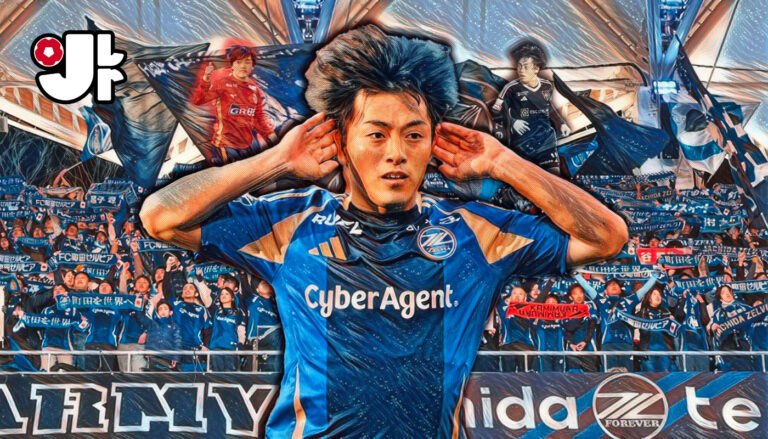
The one who got away, the one who’s on the verge of breaking through, and the one with a range going from “what if” to “national team member”. Let’s start with the first: Takahiro Ko. Back in 2019, when Miyamoto promoted him into the starting eleven, he seemed destined to big things. Those arrived in the end, but not in Osaka: he moved to Albirex Niigata, becoming a key-player, and now moved to FC Tokyo.
Different story for Yuya Fukuda (1999), who seemed on the verge to leave. Back in 2021, we underlined the importance for him to get a loan and some playing time. Tsuneyasu Miyamoto gave him matches and minutes, and after three shaky years (with no more than 15 caps in J1), Fukuda must give a signal that he’s ready for the next step. He’s ductile, he’s still young, and he doesn’t lack any class – but the competition is a lot.
Last but not least, the only player who looked a lot like Takefusa Kubo – Jiro Nakamura (2003). When he debuted with Gamba Osaka U-23 in J3, just like Toyama, many were eager to see where he’d arrive. As today, despite precocious attention, Nakamura has played in J1 only 11 times in four years. In 2023, he featured only once in J.League Cup, and now he’s been under surgery twice. Future is his, potential-wise; he must be lucky as well.
Gamba Osaka’s talent factory has to recover some steps, but we’ve already mention another J1 team – Tokyo will live through a special season, with three teams in the top-flight, and hierarchies to rewrite.
[…] Takahiro Ko absorbed the disappointment of being rejected by Gamba Osaka and rebuilt his career at Albirex Niigata. He became an anchor in the midfield, he was fundamental […]