At the start of this J1 League season, the confirmed managers were only 10 out of 18. Therefore, half the league thought changing was necessary or at least positive. Among the 10 confirmed managers, half of those ones came to manage their clubs only in 2017. Among the remaining five were Hiroshi Nanami (Jubilo Iwata), Susumu Watanabe (Vegalta Sendai), Takahiro Shimotaira (Kashiwa Reysol) and Takuya Takagi (V-Varen Nagasaki).
But there’s one remaining, who’s in fact the one with the longest-serving time at his club. He came in difficult times, but he has brought his squad to heights never touched before. Three promotions, two J2 League titles (one, in 2014, won in a landslide, achieving 100+ points); a 8th-place in 2015, several players launched into the Japanese football world and now the chance of even winning a cup.
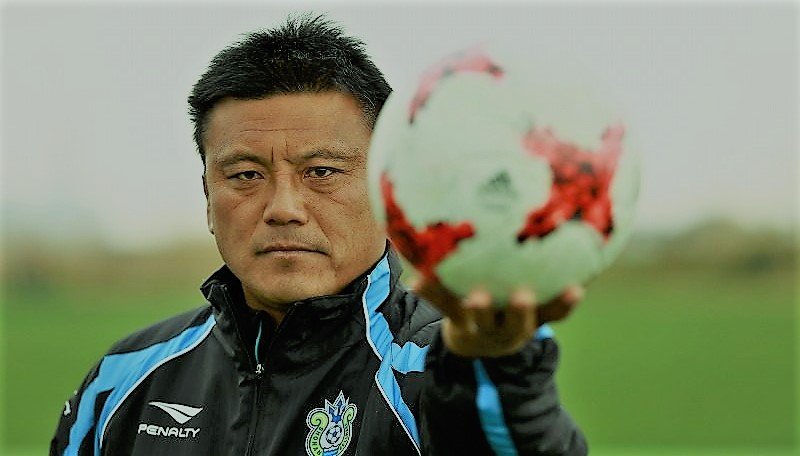
That man is Cho Kwi-jea, who never left Shonan Bellmare from his arrival in 2012 and has achieved more than many fans probably would have imagined six years ago.
Before the storm
You have to remember though, that Cho isn’t only a manager. Of South-Korean nationality, he’s born in Sakyō-ku (one of the 11 wards in Kyoto) and has played at the beginnings of J. League as the massive pro-league we know today. He has been a member of Hitachi’s football squad since 1991, which then became today’s Kashiwa Reysol. After those three years, he also played with Urawa Red Diamonds and Vissel Kobe, retiring at only 28 years old.
Then, though, Cho opted to study and add depth to his football knowledge. Immediately after his retirement, he went to Germany – precisely to the German Sport University in Cologne – and then he came back to Japan, becoming an assistant coach for Kawasaki Frontale. After another two years at the same club as Youth Football director and a stint at Cerezo Osaka as an assistant, he joined Shonan Bellmare.
It’s since 2005 that his life and the club’s destiny are somehow intertwined together. At that time, Shonan played some seasons in J1 League, but they would have faced a decade without J1-football and their name was mainly tied to the legend of Hidetoshi Nakata, who has played in Japan when the club was still under the denomination “Bellmare Hiratsuka”.
Cho has worked again with youth ranks until 2008, before finally acquiring the license to coach and then joining the top team coaching staff, where he was the main assistant for Yasuharu Sorimachi. When the current manager of Matsumoto Yamaga failed to bring Shonan back to J1 in 2011 (with a terrible season, coming only 14th in J2), the board opted to work with Cho as the new head coach.
They didn’t know what treasure they had in their hands.
Shonan, Step 1: Surviving
After such a horrible season, the first step was just to come back on their feet. But Cho did something even greater: he revolutionized the squad to add new blood to the team. He lost some players, but he acquired Kenji Baba, Kazunari Ono and Tatsuya Furuhashi, adding also young uni-guns like Masashi Kamekawa and Shuhei Otsuki. Some players grew in that season, like Kaoru Takayama, Daisuke Kikuchi or Ryota Nagaki.
While Ventforet Kofu got promoted with some games to play, Shonan Bellmare won a tight race against Kyoto Sanga, Yokohama FC, JEF United Chiba and Oita Trinita – all separated between each other by just one point – to lock a J1-ticket for 2013. None of Shonan players had double-digits of goals and they also lost crowd from the year before (-1,3%, 8th in the league). Yet, Cho brought his guys to a deserved promotion by snatching 2nd-place in the last game, after a 3-0 away victory at Machida Zelvia.
Unfortunately, it wasn’t the right time. During 2013 J1 League, Shonan struggled a lot to find some goals and there wasn’t enough experience to cope with a higher level of football. In fact, Shonan were never out of relegation zone: they’ve been there for 31 of the 34 matchdays of that season. And with a high margin, since 15th-placed Ventforet Kofu ended the year with a 12 points-advantage to comfortably retain their J1 spot.
Yet, the path was written. Cho learned from his mistakes and the club kept him at the helm of Shonan Bellmare. It was a wise choice, because 2014 was going to be a massive season for the Kanagawa-based club: 101 points, a string of 14 consecutive wins before losing in Ehime and other heroes for the squad, like a young Yuto Misao, Shunsuke Kikuchi, Yuichi Maruyama and Shohei Okada.
It was only the appetizer, because I don’t think I was the only one thinking in 2015 pre-season that Shonan couldn’t only survive, but actually shine. Despite another shuffle in the transfer market (with 20+ players leaving Bellmare in the winter of 2014-15), Cho did the right moves in signing André Bahia, Kaoru Takayama (back after a brief stint at Reysol), expert Keisuke Tsuboi and taking on loan Naoki Yamada. These adds – alongside the core, formed by Wataru Endo, Akimoto, Nagaki, Kobayashi – brought Shonan to a wonderful result.
2015 J1 League saw Shonan ending 8th on the table, ahead of Nagoya Grampus, Kashiwa Reysol and Vissel Kobe. This happened despite the top-scorer of the squad was Takayama with 8 goals, followed by Endo and Fujita at 5. The collective effort and the 3-4-3 formation were way more important to seal an incredible year: especially in the 2nd stage of that season, Shonan were always between 7th and 10th. They took six points from Kashima Antlers, they had the 2nd-best defence of the tournament and all seemed possible.
But I think the best was yet to come.
Shonan, Step 2: To the stars
And how can you top such heights? Simple: if achieving an exploit is easy, repeating themselves is way harder. In fact, it’s even more difficult when your key-players leave. That’s what happened for 2016 season: Wataru Endo moved to Urawa Red Diamonds, Akimoto chose FC Tokyo, Kobayashi went to Nagoya, Nagaki opted for Kashima Antlers. All dreadful departures for Shonan’s football system, which weren’t well-replaced. Beside Paulinho and Shimoda, no one exactly shone. Yet, despite a tough string of 10 defeats in a row and 13 games without a win, the board didn’t change the manager.
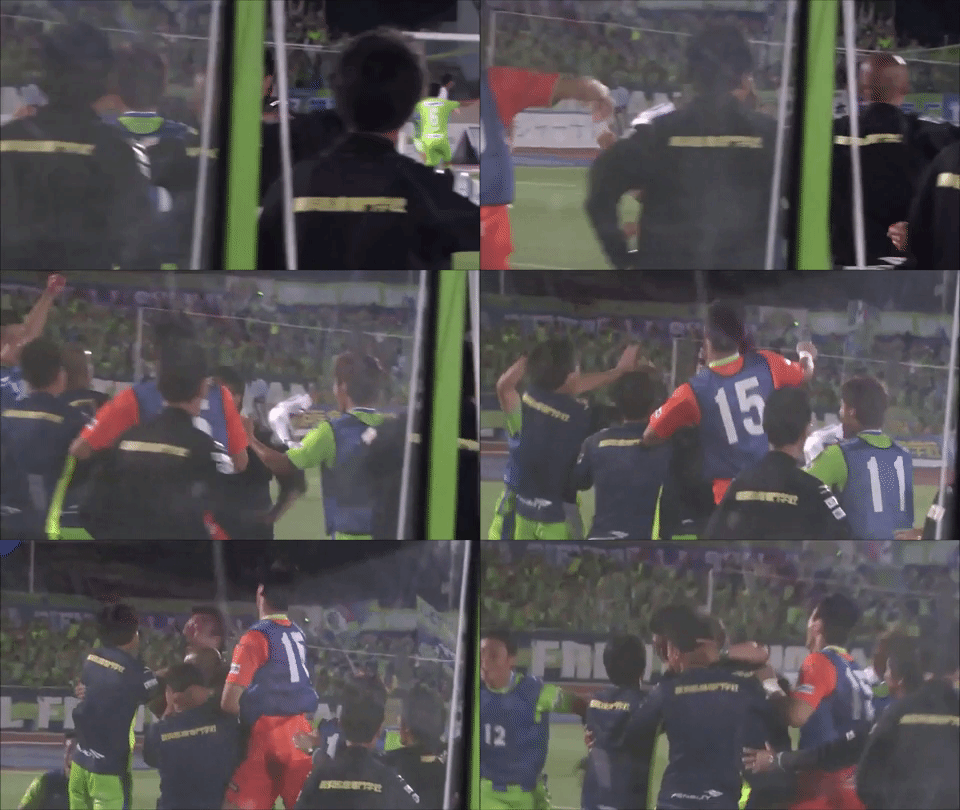
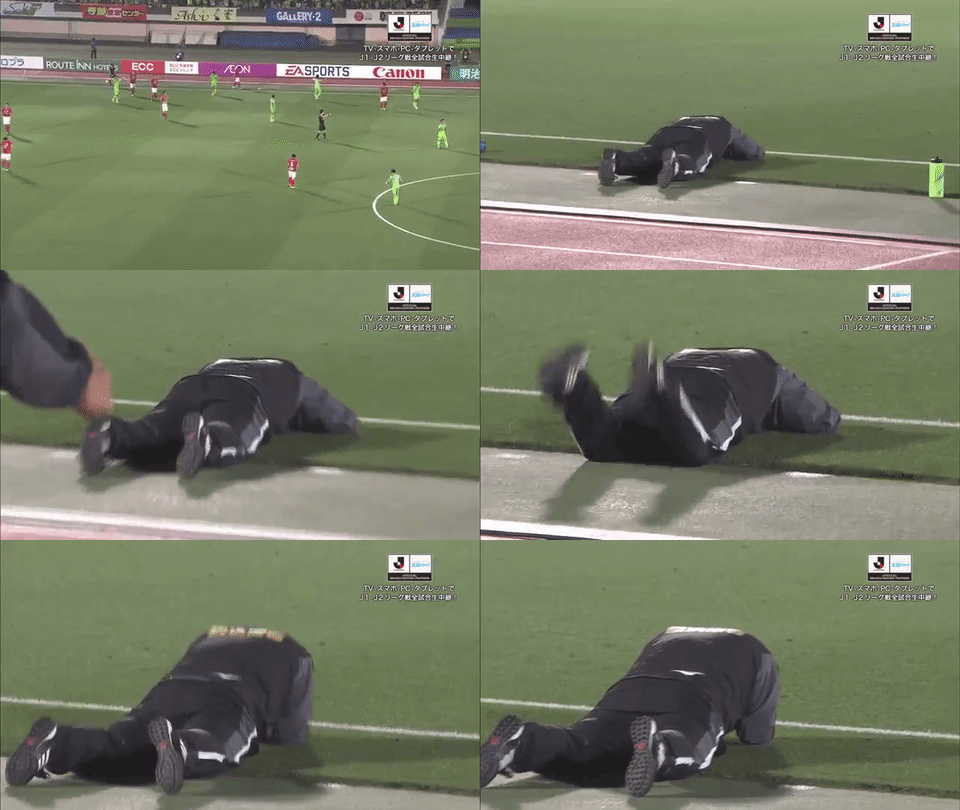
They knew Cho could turn this situation around, one more time. At the time he was hired, many elements of the board underlined how the manager was able to raise the mentality of youngsters, elevating them to a next stage. You can see that in the passion he puts on the dugout, how he embraces both victories and defeats, plus the affection Cho genuinely seems to feel for the faith of his club and boys.
Only with this kind of elements it was possible to rebuild again, one more time. Without Cho and a certain mentality, it’s not possible to elevate themselves from tough relegations and lesser resources than other environments. You could see that in cases like J2-relegated teams (Kyoto Sanga, JEF United Chiba) or J3-new faces (Kataller Toyama, Giravanz Kitakyushu, Gainare Tottori). Instead, Shonan did it again in 2017, winning another J2 title and even slowing on the final third of the season.
Cho did it with new faces, because transfer market always spoils the fun at Bellmare. Daisuke Kikuchi moved to Urawa Red Diamonds, Otsuki went to Vissel Kobe and Yuto Misao confirmed his spot at Kashima Antlers. The manager opted to bring back Yota Akimoto, relaunched a lost talent like Hiroki Akino and fished a couple of youngsters like Hirokazu Ishihara and Daiki Sugioka.
It worked, again. Another J2 title, with the promotion achieved with three matches still to play. Dinei scored only 12 goals and he was the top-scorer of the club, but the cooperative of goal still worked a treat for Shonan. Naoki Yamada became a fine player, Hiroki Akino found back his groove and the “outcasts” from other clubs – Takuya Okamoto, Ryonosuke Noda, Yuta Narawa – were all instrumental for the final result.
The Future
2018 has been a strange year. Shonan Bellmare were partially acquired by RIZAP Group, which promised to infuse a lot of money into the club in the next three years (1 billion of yen).
Yet, the transfer market worked as usual: a lot of changes, many departures and signings, another revolution. Yamada went back to Urawa Reds, expert Dinei and Tsuboi left, just like Shimoda. Cho counted on revitalizing Tsukasa Umesaki (it worked) and Mihael Mikic (partially worked), bringing back old faces like Kazunari Ono and spending his luck on the growth of youngsters.
Shonan Bellmare never fell into relegation zone, but always flirted with it, being between 11th and 15th for almost the totality of 2018. Still a good defence to show, but some problems in scoring: with five goals, their top-scorer in J1 is Shunsuke Kikuchi, captain and… central midfielder. After him, with four, there’s Ryogo Yamasaki, just arrived from Tokushima last summer. And then Takuya Okamoto at three: not the best.
Shonan never lost against Kawasaki Frontale and won away against Urawa Reds and Kashiwa Reysol, but they threw nine points in the last 15’ of several matches (twice against Cerezo and Consadole, but also versus Sagan and Kashima). A sign that this squad has a clear identity, but maybe is even too young for Cho’s standards: maybe it’ll pay in the future, but unexperience isn’t a good skill to retain J1.
Yet, the incredible path in League Cup – 12 games and a PK roulette against Kashiwa in the semi-final – took the club one step from their first Cup’s silverware in 22 years. With a Cup final to play against near rivals Yokohama F. Marinos, a safety to catch in a tough end of the season and another technical revolution on the doorstep, this 2018 might be cloud nine or hell.
Still, with Cho at the helm, nothing is gonna fear Shonan Bellmare.
3 comments on “Hail to the Cho”
[…] of Japanese football. This changed with Cho Kwi-jea, who won three promotions with Shonan and gave them several seasons in J1. Unfortunately, after winning the J. League Cup in 2018, internal investigations brought out a […]
[…] was a key-moment, though, because it led to the hiring which changed the history of Bellmare forever. Despite being South Korean, Cho Kwi-jae was born in Sakyō (a ward of Kyoto), had a modest J. […]
[…] era of Japanese football, he’s the second longest-serving head coach in the history of Bellmare, just behind Cho Kwi-jae. But he’s been way more in J1 than the current Kyoto Sanga head coach – he’s gathered […]
To provide the best experiences, we use technologies like cookies to store and/or access device information. Consenting to these technologies will allow us to process data such as browsing behavior or unique IDs on this site. Not consenting or withdrawing consent, may adversely affect certain features and functions.
Functional
Always active
The technical storage or access is strictly necessary for the legitimate purpose of enabling the use of a specific service explicitly requested by the subscriber or user, or for the sole purpose of carrying out the transmission of a communication over an electronic communications network.
Preferences
The technical storage or access is necessary for the legitimate purpose of storing preferences that are not requested by the subscriber or user.
Statistics
The technical storage or access that is used exclusively for statistical purposes.The technical storage or access that is used exclusively for anonymous statistical purposes. Without a subpoena, voluntary compliance on the part of your Internet Service Provider, or additional records from a third party, information stored or retrieved for this purpose alone cannot usually be used to identify you.
Marketing
The technical storage or access is required to create user profiles to send advertising, or to track the user on a website or across several websites for similar marketing purposes.

[…] of Japanese football. This changed with Cho Kwi-jea, who won three promotions with Shonan and gave them several seasons in J1. Unfortunately, after winning the J. League Cup in 2018, internal investigations brought out a […]
[…] was a key-moment, though, because it led to the hiring which changed the history of Bellmare forever. Despite being South Korean, Cho Kwi-jae was born in Sakyō (a ward of Kyoto), had a modest J. […]
[…] era of Japanese football, he’s the second longest-serving head coach in the history of Bellmare, just behind Cho Kwi-jae. But he’s been way more in J1 than the current Kyoto Sanga head coach – he’s gathered […]