It’s become harder and harder for a head coach to keep a hold of his job in the J.League. It doesn’t matter if you’re fighting for a J1 title with ACL aspirations, or just trying to keep your team within the pro-football world: tenures tend to last less and less. In fact, if you list the longest-serving head coaches currently enrolled for a Japanese club in the three division for the 2026-27 season, it’s hard to go beyond four years of service. There’s only one man with that kind of record.
The list is topped by a man who coached Blaublitz Akita already for 200 matches – he’s been around since 2020, so he’s far ahead at the top of the active longest-service head coaches. If we drew a table with the managers who had the most games with just one club, he’d be seventh all-time in J2, with a high chance of climbing to third place by the end of the 2026-27 season. With the same criteria in J3, he currently ranks eighth all-time via his previous adventure in the dugout.
He turned a perennial J3 side into a proper J2 candidate, and not just by getting them promoted. It was how, and how as well he kept them around for all those years. Akita isn’t exactly a small Prefecture, but it’s way harder to get results in the Northern part of the country – whether because it’s harder to convince players to come there, or because the budget and resources for those teams are way smaller.
That’s why Ken Yoshida can’t be considered just like every other coach in the Japanese football ladder. He’s been around for a full decade without any stops and he made not one, but two different clubs more relevant through his work. And if Azul Claro Numazu have discovered in the long-run where letting Yoshida go has drove them (they’re currently in the JFL), Blaublitz Akita definitely don’t wanna find out that.
Football at all costs
Yoshida was born in March 1970 in Tokyo, and for a while he hoped to become a player. He was mesmerized as a kid by football, which was an exotic passion in Japan in the 70s; the young Ken asked for “Soccer Magazine” and “Soccer Digest”, reading them end to end. So much that, as a sophomore in junior high school, he went to Brazil to study at CA Juventus, the same club where Kazuyoshi Miura moved his steps in Brazil.
That boy – enamoured of the 1982 version of the Selecao – ended up staying there two months, with Yoshida’s family supporting his will. Yoshida had his time in Brazil WHILE a young Miura was in the youth ranks of the club. And Yoshida still remembers that time: “I thought there wouldn’t be any Japanese people there, but I’m so glad Kazu-san was there. He taught me so many things besides soccer. I don’t think Kazu-san remembers me, but I was truly inspired by him.”
When Yoshida came back to Japan, he worked hard to make the cut for the Yomiuri youth ranks, who then got rebranded as “Verdy Kawasaki” when the J.League was launched. In the end, the defender didn’t make the team, opted to enroll into the Nippon Sport Science University and then featured for a couple of clubs like Ventforet Kofu and then Jatco SC, before retiring at the age of 28. Nonetheless, Yoshida had very well in mind what to do next.
A person who forced his family to send him two months in Brazil in the 80s as a middle schooler couldn’t leave football now. Not now that Japan finally had its own league, and so Yoshida entered Azul Claro Numazu – a back-then amateur side – as a youth ranks coach. He rose up the ladder in 15 years, being named head coach in 2015. Yoshida then proceeded to bring Azul Claro to the pro-world, almost to J2 (in 2017), and stayed there five years.
Miracle in the North
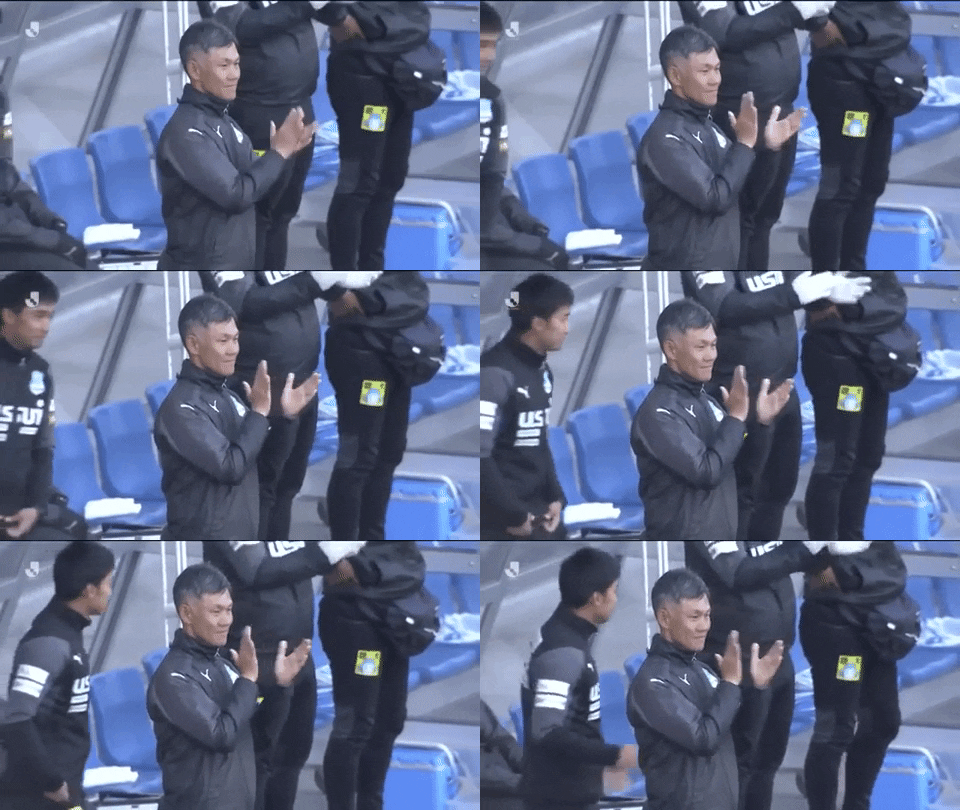
After a 12th place finish in 2019, Yoshida felt he couldn’t anything more for Numazu, and decided to move on. Next step? Well, his current employer: Blaublitz Akita. Back then, the club was a stable J3 side, who actually won the J3 League in 2017, but couldn’t go up because they didn’t have a J2 license. This time, though, they were qualified to do so, and their 2020 season was more than just winning the third division – they crushed it.
I rarely witnessed another team dominating like this. Akita had a tremendous defensive record, and sealed the promotion to the second division in a ploughed year in terms of schedule with six games to go. Even more incredibly, Blaublitz hadn’t lost any game in J3 until the promotion, then stepped on the brakes and won just one of the last six matches. In J2, it would have been a different story, but Yoshida made it look very easy.
Akita became a more defensive side compared to the only season in which Yoshida managed them in J3, but Blaublitz kept their place in the J2 League without risking anything for five years. Always mid-table, with the best result of 10th in 2024, and the worst of 14th in 2025. Under his tenure, players either peaked in terms of performances, leaving for somewhere else (Yudai Tanaka, Ryota Takada, Junya Suzuki, Ren Komatsu) or found a new youth (Genki Yamada, Ryotaro Iio, Masakazu Yoshioka).
It could very well be because Yoshida has been known to be a master motivator – the clips with his quotes are well-received on YouTube. So much so that the fans dig them up, and created a monthly calendar back in 2022 in co-operation with the club itself. Those quotes were displayed by fans on banners, and even sold as omikuji to finance the build up of a new football-specific stadium in Akita (a topic still debated in the region in the last months).
He’s not going anywhere
I was worried for Akita before the start of the “100-Year Vision League”, because the roster seemed weakened. Instead, Blaublitz actually won 11 games out of 18, and ended up sixth overall in the J2-J3 tournament. They won against Bellmare away, they won in Yokohama, they even defeated eventual champions Vegalta in Sendai. In the end, the squad even found some new answers to score, although a couple of them already left.
In fact, Daiki Sato joined Júbilo Iwata, Yukihito Kajiya already left for Tokushima Vortis, and Ryota Inoue moved to Tokyo Verdy. Nonetheless, Akita can find new toys within the broken ones: Yoshihiro Nakano might be an interesting add for J2 level; Kaito Umeda once rocked J3 with Tegevajaro and seems a nice fit for Akita’s offensive style. A couple of loans – Ryoya Iizumi and Tsubasa Umeki – can complete the roster.
If there’s one lesson from the 2025 season of the J2 League, it’s that hope is the last to die when you have to avoid relegation. Kataller Toyama were doomed, and then they were not; performances-wise, worst teams than Akita avoided relegation comfortably last year (yes, we’re talking about Oita Trinita). Genki Yamada, Takuma Mizutani, Ryuji Saito, captain Hiroto Morooka, Tomofumi Fujiyama are all still there – it’s a matter of finding some goals upfront.
It’s fair to assume that it’s gonna be another season of fighting for Blaublitz Akita, but with Ken Yoshida in the dugout, everything worked out just fine until now. And the head coach doesn’t want to stop there. In June, Yoshida set himself the posts a bit higher: “We will develop the strength to do everything we can. We will mobilize the efforts of the entire team, ensure we make it into the Top 6, win there, and be promoted to J1.” It’s a stretch, but I wouldn’t honestly bet against him.