One-hit wonders. A light in a strange career, which wasn’t made of sparks and constant success. A sudden corner of attention in an otherwise normal trajectory. There are seasons or years like these, with players capable of rising to the occasion when it’s needed the most. Just think of sudden protagonists, who made the front cover for a certain period, without repeating themselves after that season.
“Lost Treasures” is a column that featured a certain number of episodes until now, all talking about these kinds of players in the history of J. League. To pick whom to feature in this column, we looked at all the Best XIs composed by the J. League committee at the end of every season and chose four players who made an enormous leap, just to rarely or not repeat themselves in the successive seasons.
Another specific detail: we picked just J. Leaguers, who enjoyed most of their career in the Japanese championship, albeit there have been two exceptions. It’s been some time since the last piece in this column – it was November 2025 and we talked of Naohiro Ishikawa. This time, we picked a player who’s still active, but definitely won’t come back to the J.League Best XI. He made it once in 2018, when his team – Kawasaki Frontale – were in the midst of their dynasty.
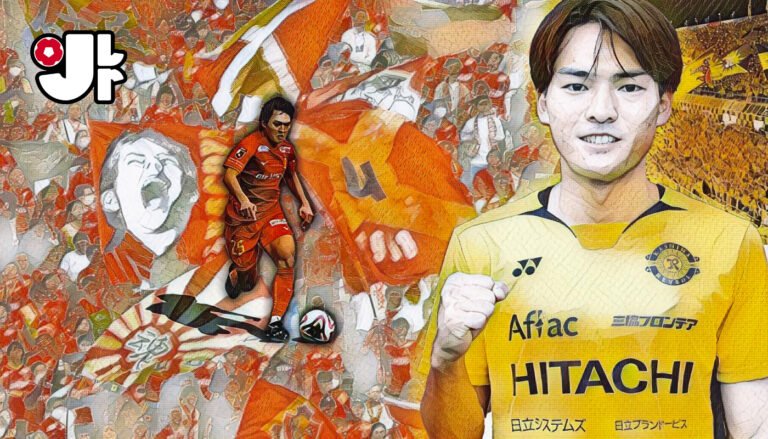
He’s been a midfield maestro, but injuries have plagued his career at every turn. He was a fan of “Captain Tsubasa”, hoping to follow the same route as the character from the manga by Yoichi Takahashi. In the end, we can’t say that the career of Ryota Ōshima is a failure. Nonetheless, so much regret is probably floating around his profile, and how things could have turned out if he was fit in the right moment.
The Beginnings
Born in 1993 in Shizuoka, Ōshima could have turned out as a local product for Shimizu S-Pulse, since he’s born in Shimizu City and he attended Shizuoka Gakuen. The young midfielder actually planned to enroll into a university, but the interest from J.League scouts intervened, and then Ōshima decided to join Kawasaki Frontale for the 2011 season. He was just 18 years old, and Frontale were in the middle between two different cycles.
The era under Takashi Sekizuka was done for a couple of years, but Yahiro Kazama didn’t arrive yet. Ōshima took his sweet time to find some minutes, and when Naoki Soma was fired in mid-2012, that changed his trajectory. Kazama clearly saw something in him, and starting 2014, Ōshima accumulated more and more minutes. From 15 games and just 955 minutes on the pitch in 2013, his numbers went drastically up the next season, featuring in 28 league games.
Not just that, because his growth within the team brought him as well to become the first Japanese player in Kawasaki Frontale’s history to wear the no. 10. Furthermore, Ōshima evolved as a player. He started as a mezzala, but he gradually become a defensive midfielder or regista to build up the tempo and plays from Frontale.
Many started seeing the chance that finally captain and club legend Kengo Nakamura had found his heir. Something that many hoped to be true already in the first back-to-back titles from Frontale, and his cameos at the 2016 Olympic Games in Brazil were laudable, to the point that Japan’s head coach Vahid Halilhodžić started calling him for the senior team. And in 2018, the clock seemed to tick in Ōshima’s favour for the next step.
The Blossoming
I think the maiden J1 title for Frontale unlocked a lot of things. The aging of Kengo Nakamura helped as well. Both instances gave Ōshima more agency and responsibility within the team, culminating in the 2018 season – the one in which the midfielder put together the run of his career. First of all, Ōshima won again the J1 with Frontale, in a back-to-back that was (almost) never in doubt that year.
That 2018 season saw the midfielder playing the highest number of league games in his career (29), with four assists and two goals – with a special one standing out. His goal against Vissel Kobe – coronating an incredible teamplay to give Frontale the lead after being 3-1 down – probably epitomised the best Kawasaki had to offer, and what Ōshima was at the time. Among the seven players selected from Frontale to be in the J.League Best XI, the no. 10 was there.
Ōshima was a hot commodity for the 2018 FIFA World Cup as well, to which he’s been actually called up. Regrettably, though, the emergence of Gaku Shibasaki – same position, one year older – and the change of head coach pushed the Frontale midfielder to the bench, and he didn’t play a single minute in Russia. It took a full year to see him again in a Samurai Blue jersey, when he captained the team in 2019 EAFF E-1 Championship (it was also the last time with Japan).
Some words from back-then head coach Akira Nishino before the FIFA World Cup sound like a curse waiting to happen: “Not only is he effective offensively, but he’s steadily building a solid foundation in his natural position as a defensive midfielder. […] The only thing left is whether he can improve his match fitness against high-level opponents, and whether he can build a shared vision and coordination with those around him. That will be crucial for Oshima’s success.”
The End
Funnily enough, there’s no end in sight yet for Ōshima. Sure, he’s 33 years old and his career has been plagued with injuries. Plus, he’s not a starter anymore at Frontale, but… we can expect glimpses of his class to occasionally show up with a Kawasaki jersey. And the no. 10 is still pointed out on his back. But most of the attention is gone – even the title of heir for Kengo Nakamura feels more of a fit for Yasuto Wakizaka (the current captain at Frontale) rather than Ōshima himself.
The same man who saw Deco and Pirlo as role models, and loves solving Rubik’s Cubes couldn’t find a solution to keep his fitness. Looking at his injury reports, it’s incredible how much time he’s missed while the Frontale dynasty was still going on. Since 2021, Ōshima couldn’t play more than 14 league games per season; furthermore, he played 10, 11, 16, 15 and five (!) games in all competitions in each season for Kawasaki from 2021 to 2025.
And yet, he won even more silverware than the counterpart who took his spot both at Kashima Antlers and at the 2018 FIFA World Cup. In fact, Gaku Shibasaki was the reason why Antlers never picked up Ōshima in the first place, since the young kid was even recommended by Frontale scouts to other clubs (at that time, Kawasaki had a limit on signing new kids, but the chief scout, Ken Mukajima, eventually won the front office over).
Ōshima is now today one of the few players still active from the Frontale dynasty which won everything between 2017 and 2023. It’s basically him, plus Yu Kobayashi and Akihiro Ienaga, who are though respectively almost 39 and 40 years old. Despite 16 years with the club, Ōshima is just ninth in the all-time table for games played with Frontale. And that goal against Vissel Kobe will probably be the testament of both his potential and his unfulfillment.