One-hit wonders. A light in a strange career, which wasn’t made of sparks and constant success. A sudden corner of attention in an otherwise normal trajectory. There are seasons or years like these, with players capable of rising to the occasion when it’s needed the most. Just think of sudden protagonists, who made the front cover for a certain period, without repeating themselves after that season.
“Lost Treasures” is a column that featured a certain number of episodes until now, all talking about these kinds of players in the history of J. League. To pick whom to feature in this column, we looked at all the Best XIs composed by the J. League committee at the end of every season and chose four players who made an enormous leap, just to rarely or not repeat themselves in the successive seasons.
Another specific detail: we picked just J. Leaguers, who enjoyed most of their career in the Japanese championship, albeit there have been two exceptions. It’s been some time since the last piece in this column. We enjoyed a trip to Memory Lane with Motohiro Yoshida, the man who divided and conquered Osaka – almost won a J.League title with Cerezo, but he’s been with Gamba and he’s currently their goalkeeping head coach.
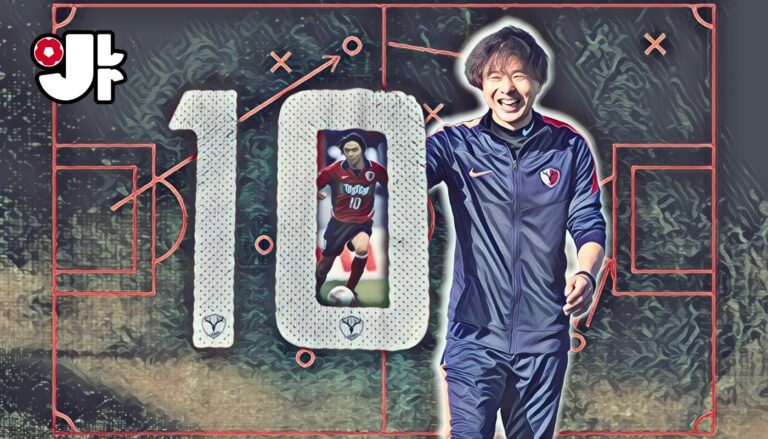
For this new episode, we move to Hiroshima, where 2012 has seen the blossoming of an atypical no. 10. He wasn’t running too much, he didn’t have a super-powerful shot, he didn’t have an intoxicating dribbling; his super powers were spatial awareness and an incredible sense for assisting team-mates. This is the story of Yojiro Takahagi, who has been the talk of the town for a few years, but he could have been so much more.
The Beginnings
Takahagi was born in 1986 in Iwaki, Fukushima Prefecture – a place now well-known in Japanese football, but back at the time mostly famous for hosting the J. Village Soccer School. And that’s where Takahagi started, being involved with the U-15 of Japan and skipping university after high school. Instead, invited by coach Toyoharu Takata (who nurtured his talent in Iwaki), he decided to join the youth ranks of Sanfrecce Hiroshima.
Back then, Sanfrecce Hiroshima were a very different beast. We’re not talking of a three times-champions in J1, but rather a mid-table J1 team, with some J2 seasons. Takahagi was registered as a second-tier player alongside Shunsuke Maeda, Issei Takayanagi, and Akihiro Sato (all regular J.Leaguers). Praised highly by back-then head coach Takeshi Ono, Takahagi debuted with Sanfrecce in April 2003 and became the youngest player ever to feature in the J2 League until then.
Back then, he was playing right-back, but he lived through several phases of Hiroshima – the coming back to J1, the nice years with Hisato Sato, another relegation, the rebirth under Mihailo Petrović. In the middle, there were also injuries, misunderstandings over his role (he wasn’t really fit to be a right-back) and a loan to Ehime FC alongside Ryota Moriwaki. In 2010, he had a first proper breakthrough by winning the “New Hero Award” in the J.League Cup (and he immediately joked that he wasn’t so new – having been a pro since 2004).
Finally, his star seemed to develop. He was missing the final piece – meeting his maker, the man who was supposed to replace Petrović at the end of 2011 (with the Austrian head coach joining Urawa Red Diamonds due to financial difficulties for Sanfrecce). Funnily enough, that man was one of the assistant coaches of Petrović, but he’s seen the whole trajectory of Takahagi in Hiroshima and he’s gonna become the current head coach of Japan: Hajime Moriyasu.
The Blossoming
In the 3-4-2-1 of Moriyasu, Takahagi found the sparkle which back then he had only in J2. In 2012 he dished 12 assists (being the top-scorer in that category: he had just six in his whole J1 career until then), he played every J1 match, and he scored on the decisive day against Cerezo Osaka to win the first-ever J1 title for Hiroshima. This brought him the first and only appearance in the Best XI, alongside another four team-mates from Sanfrecce.
He didn’t shy away from the fight as well in 2013 – when he inherited the vacant no. 10 and he kept his performances. Sanfrecce Hiroshima won another J1 title and added another Japanese Super Cup accolade (after the one won in 2008), and Takahagi seemed even more in control of the situation compared to 2012. His fitness problems were a thing of the past – he missed just five league matches between 2013 and 2014.
He also reached the Japan national team – winning the 2013 EAFF East Asian Cup with a group that left a good memory and hoped to have a spot for the successive FIFA World Cup. He probably never had a chance for Brazil 2014, but it was the right recognition for his growth. Nonetheless, he became the first player from Fukushima Prefecture to play for the national team in almost a century (since 1927, when Shigeyoshi Suzuki featured for Japan).
In general, you could see he was a unique player, son of a different time – he wasn’t physical, he wasn’t too much athletic. You could almost have the sense that he didn’t put physicality in the requirements for the game. But the football brain was otherworldly, so much they called him “a genius”. In this compilation below, you could see him orchestrating the game. As a collective, Toshihiro Aoyama was the engineer, and Takahagi was the orchestra director of Hiroshima.
The End
Although he was just 30 when he left Hiroshima, that’s probably when his career drifted away. His contract ran out with Sanfrecce and Takahagi decided to explore more from football, leaving Japan. He first joined Western Sydney Wanderers in Australia, where the head coach was Tony Popovic – the Australian had an experience in Hiroshima as a player. His experience lasted just six months, but he didn’t come back.
Then Takahagi signed FC Seoul in South Korea – a decision which was taken also because of the praises from head coach Choi Yong-soo, who saw Takahagi in an AFC Champions League match. 2.5 years of contract, with the accolade of MVP in the K-League FA Cup tournament, first time for a Japanese player. But even there, Takahagi cut the experience short and opted to return to Japan – in a swap deal with FC Tokyo, with Ha Dae-sung going the other way.
When he returned to Japan, Takahagi wasn’t the same as before – his peak was gone and his role wasn’t any more so close to the goal (he was reinvented as a defensive midfielder). He stayed in Tokyo five seasons and a half, but he wasn’t as flashy as before. For four seasons, he was basically a starter and he won another trophy, the 2020 J. League Cup. Then he opted for 18 months at Tochigi SC and close his experience with Albirex Niigata… in Singapore.
Many described him as a genius and we have to owe this to Takahagi. His atypical style probably wouldn’t survive in today’s football (and J.League), but it’s been a pleasure to the eyes to see him playing. Tough to say what the future will bring to him – he’s been spotted as a guest both in Tokyo and Hiroshima, and he continues to support his local region, being associated also with Iwaki FC in the meantime.
One comment on “Lost Treasures – Yojiro Takahagi”
[…] Another specific detail: we picked just J. Leaguers, who enjoyed most of their career in the Japanese championship, albeit there have been two exceptions. It’s been some time since the last piece in this column. We enjoyed a trip to Memory Lane with Yojiro Takahagi, whose sparkle didn’t last forever, but he really embraced the no. 10 mentality and guided Sanfrecce Hiroshima to three J1 titles in four years with his class. […]
To provide the best experiences, we use technologies like cookies to store and/or access device information. Consenting to these technologies will allow us to process data such as browsing behavior or unique IDs on this site. Not consenting or withdrawing consent, may adversely affect certain features and functions.
Functional
Always active
The technical storage or access is strictly necessary for the legitimate purpose of enabling the use of a specific service explicitly requested by the subscriber or user, or for the sole purpose of carrying out the transmission of a communication over an electronic communications network.
Preferences
The technical storage or access is necessary for the legitimate purpose of storing preferences that are not requested by the subscriber or user.
Statistics
The technical storage or access that is used exclusively for statistical purposes.The technical storage or access that is used exclusively for anonymous statistical purposes. Without a subpoena, voluntary compliance on the part of your Internet Service Provider, or additional records from a third party, information stored or retrieved for this purpose alone cannot usually be used to identify you.
Marketing
The technical storage or access is required to create user profiles to send advertising, or to track the user on a website or across several websites for similar marketing purposes.

[…] Another specific detail: we picked just J. Leaguers, who enjoyed most of their career in the Japanese championship, albeit there have been two exceptions. It’s been some time since the last piece in this column. We enjoyed a trip to Memory Lane with Yojiro Takahagi, whose sparkle didn’t last forever, but he really embraced the no. 10 mentality and guided Sanfrecce Hiroshima to three J1 titles in four years with his class. […]