In these days, when football is super scattered by data and multiple analytics, it’s hard to find a “surprise factor” that changes the scenario. But in a young football movement like Japan, that can still happen. I just didn’t think that this kind of crazy variable would have looked like one of the million Brazilian players we’ve witnessed in the J.League.
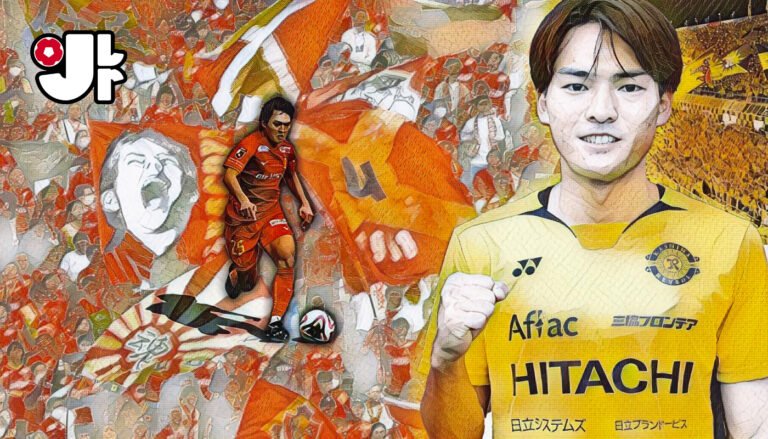
When he arrived in Japan, he had already 25 years and a strange career in Europe behind him. Nonetheless, he started down the ladder, between J2 and J3. And it’s strange to think that now this Brazilian striker is deciding games in the top flight for a small club like Fagiano Okayama. And we have to enjoy him as much as possible, because he said he’s not gonna stick around once he’s done playing.
He said it himself: “For me, football is about playing. I feel joy when I’m on the pitch as a player. That’s why I don’t think I’ll become a manager or coach. I’ve been suggested to become an agent, but I’m not very interested in that either. After I retire, I’d like to do something completely unrelated to sports, like managing a farm or ranch, or becoming a landlord of an apartment building.” And that’s another rarity for people who try to stay in the business after retirement.
Lucão Marcos Meireles, we got it, is different. His story, his development, his current status in the J.League – they don’t make sense at all for football in 2026. And yet, here we are: “What I consider most important, more than playing or training, is character. That applies to any profession. Refine your qualities as a person, always be grateful to those around you. If you continue to work hard on that, your dreams may come true.”
From Brazil to Europe
Lucão Marcos Meireles was born in 1995 in Dores du Turvo, a very small farming village from Minas Gerais. In a town of just 5,000 people, it was hard to come through as a footballer, so Lucão helped his family with the tomato factory they had: “My parents weren’t good at studying, and Dores is a really rural area, so they had no choice but to farm to survive. That’s why they always encouraged their children, telling them that becoming a professional footballer could change their lives.”
But in the end, Lucão never attended any youth academy in Brazil, and nurtured his style by himself: “I never knew about youth academies, but somehow, I managed to become a professional. It was tough leaving my hometown and living separately from my family, but my dad always encouraged me and supported me.” And that’s how Lucão ended up playing for Arsenal-MG, a small amateur club in his state. But it wasn’t enough to have a proper salary, and Lucão took another trick: YouTube.
Lucão started doing and uploading videos of himself playing, in the hope to be seen and get a better deal. And that deal materialized itself from Europe: “Even so, I wanted to continue my professional career, so I moved to North Macedonia, which seemed like the best option. But it was really tough at first. Above all, the language was incredibly difficult, and even though I studied it, I couldn’t master it easily.” FK Makedonija GP and FK Renova were his first two stops, and then Lucão moved forward.
Playing in the second Greek division with Apollon Larissa was a small step, but when Brazilian offers were at his door, a Japanese one actually reached out to him: Kagoshima United FC, who at the time were in J2. “My agent was an honest guy and told me that Kagoshima, who wanted me, would probably be relegated to the third division next season. But he was confident that my power and speed would definitely work in Japan, and I was confident in that, so I decided to join the team.”
Travelling through divisions
Kagoshima was a wonderful place to start, but the club wasn’t in a good place. KUFC would eventually drop back to J3, and Lucão scored just three goals in 16 games. Nonetheless, the striker fell in love with the country – his two sons are born in Japan. Therefore, the Brazilian opted to be loaned out to Zweigen Kanazawa, where he bagged 10 goals in 24 games in J2. It seemed the beginning of something great, and moving to Matsumoto Yamaga should have been exactly that.
Injuries took over his development in Japan, pushing him to the edge: “That was the toughest period of my career. After the surgery, I had rehabilitation, and I often felt down. But my wife always supported me, and being with my children helped”. In fact, his whole experience in Matsumoto between J2 and J3 shows just four goals in 27 matches. A disappointment for what the striker hoped to be a great next step.
So Lucão ended up returning to Brazil, but incredibly, it was just a brief stop. As a free agent, he was sought by Fagiano Okayama, who needed some reinforcements upfront. And head coach Takashi Kiyama explained how Lucão evolved: “When he first joined the team, his physical condition wasn’t good. But it improved, and he’s a really hard worker. He’s starting to understand his own strengths, accepting what he can’t do, and working hard at what he can do, giving strength to the team.”
What did this exactly mean? Well, that Lucão isn’t your typical no. 9 – he said it himself: “I don’t have the kind of technique you’d expect from a Brazilian player, so I’m trying to improve in other areas. My family has always done manual labor, but they work hard with a cheerful and positive attitude. I’ve seen that and helped them out, so I see taking work seriously as a natural thing.” And that hard work came handy for Okayama in time of need.
Paradise in Okayama
It’s incredible how goal metrics have nothing to do with his performances. Sure, he can score a few ones – but his numbers have been drastically different between the three divisions. That’s not where you measure how much of a resource Lucão has been, especially in Okayama. Just to give an example: he scored just once in 2023, then five in 2024, then another five in 2025 – but this time the goals were in J1.
Lucão has been a machine as well in 2026. And again, it’s not about the goals – he scored just once. But he provided three assists, and he’s been a factor for Okayama. So much that Fagiano actually continued to fish into the Brazilian market – Werik Popò spent six months there before moving to Avispa Fukuoka, and Leo Gaucho was supposed to be an experiment, but he’s now a steady backup for Lucão, with some goals under his belt.
It’s even hard to drew comparisons. If I think about European football, the story of Bebé comes to mind – the Portuguese forward could have even featured in the homeless World Cup and then signed for Manchester United in 2010. Another one, within the J.League-sphere, would be Junior Santos – who had an amazing impact for Yokohama F. Marinos and Sanfrecce Hiroshima despite having started way low in the ladder of Brazilian football.
It’s always hard to find this “cheat codes” within today’s football. And that’s why the story of Lucão is so fascinating to me. He represents a football that almost doesn’t exist anymore. And probably the country the most in love with this sport needed to meet the highest-rising football movement in the world to produce such a story. For now, let’s enjoy Lucão: the “heavy tank”, playing at the speed of 34,8 km/h, has torn down already a few barriers.