There are moves, career-moves, that can ruin everything you’ve worked hard for. He hasn’t been neither the first nor the last, but Nelson Baptista is just another Brazilian manager who tried for a long time to make it in Japan. He came to the Land of the Rising Sun for the first time in 1995; twenty years since that moment, it seemed the right time to call the day on his time in Japan.
We recognize how Vissel Kobe hasn’t been the easiest gig for many managers (ask to Akira Nishino), but who’s writing has always asked himself if firing Nelsinho midway through the 2017 season was indeed the right move for a splashing market-reality without a particular history or mentality behind them. After two half and years, despite two trophies in the cabinet, we still think it wasn’t the right call.
Nevertheless, we are not here to review crazy management in Kobe (we’ve already done that in a certain way, by talking about Lukas Podolski’s adventure in Japan). We’re to talk about the other side: Nelsinho was supposed to leave Japan and indeed he did that. He came back to Brazil to coach Sport Recife and, 22 years after his first gig in J. League, everything seemed over.
Until Kashiwa Reysol came along, again. And when this COVID emergency will be over, they could be the dark horse of this championship.
It’s a long way to the top
Nelson Baptista Júnior – born in 1950 in Campinas, same city which gave birth to another two Brazilian football figures in recent history, Fabinho and Luís Fabiano – played for 16 years as a professional football in Brazil, spending those years mainly with São Paulo, the squad who stayed in his heart the most. He also won a Série A title as a player, in 1977. Once he retired, though, he opted to stay in the pitch as a manager.
For a decade, he went around in circles all over Brazil. He coached several teams, even managing such important clubs like Corinthians and Palmeiras, while also having experiences abroad in Colombia and Saudi Arabia. The time for a Japanese adventure came right after coaching Al-Hilal, since back then-Verdy Kawasaki needed a new coach to replace Yasutaro Matsuki, who just resigned after winning the title in the first two J. League seasons.
It wasn’t the best run you could possibly live. Verdy Kawasaki were already beginning their descent and so Nelsinho won “just” two trophies (the 1995 Japanese Super Cup and the 1996 Emperor’s Cup), despite having a still healthy and decisive King Kazu (who just turned 30… it seems a long time ago). When Nelsinho left, little did Verdy know about their incoming future: seven managers in three seasons and a huge fall in performances.
Meanwhile, Nelsinho went back to Brazil and he fulfilled one of his true desires: coming back to São Paulo. He did in two separate stints and he still maintained a good reputation as a head coach, pushing again Corinthians to success. He also had another foreign experience, this time in Chile with Colo-Colo. When in 2003 he received the offer of then named-Nagoya Grampus Eight, he took the chance and came back to Japan for a second time.
We have to think that Nagoya Grampus Eight weren’t exactly thriving. They had to say goodbye to Dragan Stojković just one year before and their results on the pitch weren’t exactly significant. Sure, Grampus were always in the top half of the table, but they were missing the last step to clinch the championship (they instead won two Emperor’s Cup and one Japanese Super Cup).
When Nelsinho came into the picture to replace Zdenko Verdenik mid-season, many were expecting them to peak. Instead, everything became even worse: despite having players capable of being in the Top XI at the end of 2003 – like captain Seigo Narazaki or the Brazilian magical duo composed by Ueslei and Marques –, Nagoya didn’t build up on this moment and got stuck in the middle of the table.
And while 2005 season started on a positive note – after 10 games, Nagoya were second –, the form rapidly declined, bringing Grampus to win just three of the successive 13 matches. At that point, change was unavoidable and Nelsinho was sacked in September 2005. After two years of hard work, he didn’t deliver, again. Nagoya isn’t an easy place to put on the football map (basically Arsene Wenger and Dragan Stojković were the only ones to make it), but another Japanese opportunity got squandered.
Of course, he came back to Brazil. He had a terrible stint with Santos, he coached Flamengo, he had another passage at Corinthians, but most of all he found a good home in Sport Recife. He stayed there two years, managing to do something amazing: the club became the first club from the North-East part of Brazil to win the national cup, defeating teams like Palmeiras, Internacional, Vasco de Gama and then Corinthians in the final, after losing the first leg.
Sport Recife also conquered the promotion to Série A and the right to play in 2009 Copa Libertadores, actually winning then their group (with Palmeiras, LDU Quito and Colo-Colo). It was a massive result, but a fallout with some of the key-players put Nelsinho in a tough spot, with the manager resigning. After such a run, he probably needed some time to think about what to after such an adventure.
But the right opportunity came along immediately and he couldn’t say no: it was time to go back to Japan.
Kashiwa-bound
We might think that Kashiwa Reysol built a reputation for Nelsinho Baptista, but it has been a mutual fortune. When the club picked him to be the new coach in July 2009, Reysol were back then a team with no glory. Their best season-ever was in ’99, when they came third on the table and won the Emperor’s Cup. Sure, they featured super-stars like Careca or Hristo Stoichkov, but there were some problems.
The first one was their neighbors, JEF United Ichihara Chiba. They had been more successful, they won more trophies and they hadn’t suffered yet a relegation. This was going to be solved soon, but Reysol were as well directed to J2, after being there just three years before. Reysol also suffered the probably most iconic defeat in the history of relegation/promotion playoffs, being defeated 6-2 by Ventforet Kofu in the second leg of the playoffs. Baré scored all six goals.
The squad wasn’t particularly inspiring, despite youngsters were interesting. Reysol had always featured one of the best youth sectors in Japan and they had some cards to play: Hiroki Sakai, Wataru Hashimoto, Junya Tanaka and Masato Kudo, just to make some names. The squad came 16th on the table and needed a shake to start from scratch in the 2010 season of J2 League.
Yuta Minami’s departure to Kumamoto gave Takanori Sugeno a full starter spot, while Tadanari Lee already left mid-season in 2009. Meanwhile, the arrivals were exciting and gave new fire to the club: Hirofumi Watanabe was signed from Senshu University, Hiroki Sakai and Kosuke Taketomi came back from a loan in Brazil (to Mogi Mirim); Akimi Barada was promoted from the youth sector and most of all Leandro Domingues – back then certainly unknown to many Japanese football fans – joined from Cruzeiro.
Nelsinho had what he wanted to put his 4-4-2 in full motion, despite França picked up an injury who de facto ended his experience with Reysol. Starting eleven was pretty solid: Sugeno in goal, with Kobayashi, Kondo, Park and Hashimoto in front of him; Barada and Otani as holding midfielders, Kurisawa and Leandro Domingues on the flanks (with Otsu ans Sawa as alternatives). There were a lot of alternatives in front, where Kudo, Tanaka, Hayashi and Kitajima splitting the minutes.
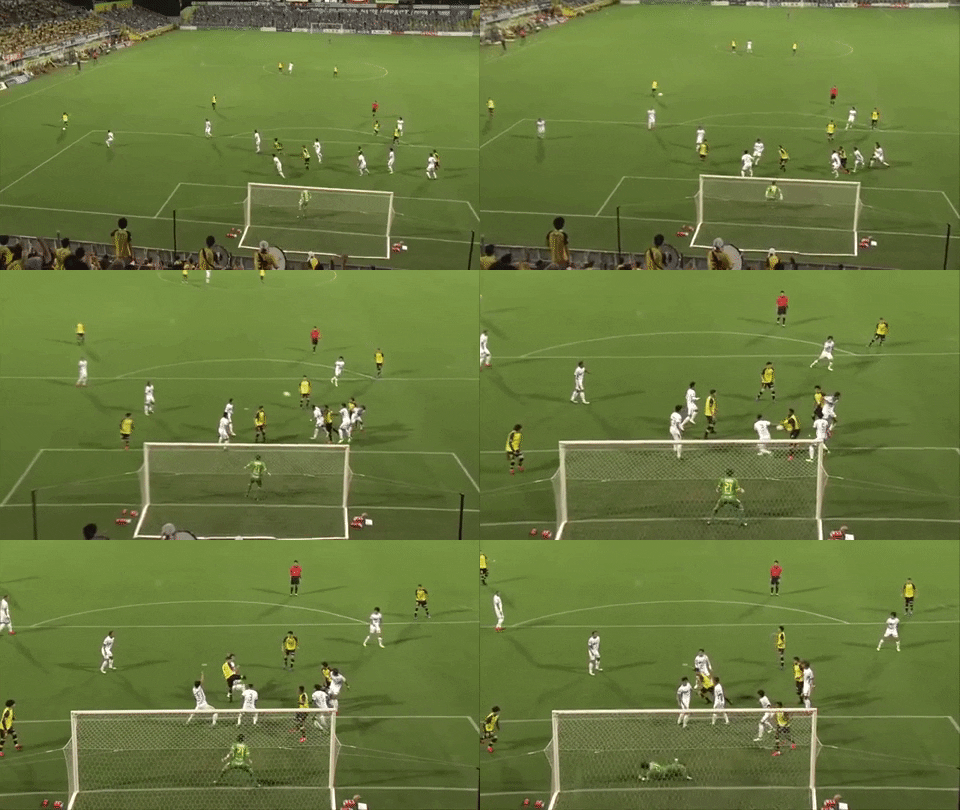
It was so effective that it took 21 games to see Kashiwa falling: they lost just two games in the whole season (one at home against Verdy and one away in Oita with the same score line, 1-0). By September, it was already clear they were going to sweep everyone else: with a home win against FC Gifu, they assured themselves the return to J1. They did it also by overcoming their neighbors and rivals JEF United Chiba, who didn’t come back from their descent to J2.
You would have said that 2011 season was all about seeking safety. The club lost some pieces, but the main structure stayed intact and actually found two key-additions to fill the roster with quality: left back Jorge Wagner from São Paulo – who had one of the best single-seasons ever in J. League by a foreign player – and Tatsuya Masushima from Kyoto Sanga. On their opening match for 2011, Reysol trashed S-Pulse 3-0 with goals by Wagner, Park Dong-hyeok and Domingues.
Sometimes, though, life and sports are strange: after that performance, the Tohoku Earthquake hit the country on March 11, 2011. It was a changing-life event, but also a changing-season occurrence. We already know how the season went for Vegalta Sendai went, building two years of great performances under Teguramori. The kind of same stars-alignment happened also for Kashiwa Reysol, who appeared more constant and prepared than their rivals for the title-race.
When the season resumed, Kashiwa had the pace. They lost eight games all season long (twice against both Gamba and Júbilo), but they had a slightly better record than Grampus at home and then Gamba away. Especially in the last stretch of the season, they won nine out of the last 11 games. Some matches were key-moments to snatch the title: the two slim wins against Antlers, the comeback against Frontale, the home win on Nagoya.
On the last matchday, a 3-1 away win against Urawa Red Diamonds granted Reysol their first ever-championship and most of all they won it as a newly-promoted team. It happened again in 2014 with Gamba Osaka, but Kashiwa never seemed to have the cards to do this. Instead, they pulled it off in a strange season, but with solid credit. And from there, Nelsinho built the moment to keep winning in the successive seasons.
After playing the 2011 FIFA Club World Cup and coming fourth (defeated by Santos and Neymar in the semi-finals), Reysol won the 2012 Japanese Super Cup against FC Tokyo and ended sixth, having though a wonderful run in cups. In the ACL, they were knocked out in the Round of 16, but they reached the semi-finals in the J. League Cup and won the Emperor’s Cup, defeating Gamba Osaka in the final with a goal by Hirofumi Watanabe (after playing the B-team of Reysol in the Second Round).
This wave of successes progressed throughout the next two seasons, since Reysol had another good run in the AFC Champions League (reaching semi-finals in 2013, before meeting future champions Guangzhou Evergrande), won also the J. League Cup in 2013 (defeating Urawa Red Diamonds) and the Suruga Bank Championship in 2014 (overcoming in Lanus in a really tense game between the two teams).
To judge Nelsinho’s success, you have also to remind how many players made a leap forward in their careers under his management. Yuki Otsu excelled in the London Olympics and joined Borussia Mönchengladbach, Hiroki Sakai moved to Germany a year later, while Masato Kudo signed for Vancouver Whitecaps and several elements of that team had a chance with the national team. Not to mention that many current J. Leaguers have featured there under Nelsinho.
The goodbye, the return and the future
Nelsinho actually said goodbye in August 2013, after a harsh defeat against Kashima Antlers. Despite his will, the club managed to keep him around for another year, until September 2014, when the manager announced he was going to be for the last year at the Kashiwa Soccer Stadium. They ended in fourth place, snatching another ACL-participation, the third in four years. But this would have gone ahead without him.
When he opted to leave, Nelsinho left a big hole in the managerial side of Kashiwa. The club proceeded to have a huge pool of talent – just think of Kosuke Nakamura, Junya Ito, Yuta Nakayama and many other solid players they had or have –, but lacked managerial stability. Tatsuma Yoshida was a disaster, Milton Mendes stayed shortly, Takahiro Shimotaira didn’t last long enough. Last but not least, caretakers Nozomu Kato and Ken Iwase didn’t work out, leading Reysol to be relegated again in 2018.
And what about Nelsinho? Well, he accepted the chance offered by Vissel Kobe for the 2016 season, succeeding Akira Nishino. Vissel weren’t already in the madness shopping-flu we’ve all witnessed in the last two seasons, so the Brazilian manager had time to build something. After a shaky first stage, Vissel Kobe stormed out in the second one, ending as a runners-up in the second part of the championship and equaling their best finish-ever in J1 (seventh overall).
There was something to build on, but after another difficult start and the revolution started by Mikitani with signing every possible star available to moving to Japan, Nelsinho had to go. He then came back to Brazil another time, going to other main adventure of his career: Sport Recife. Unfortunately, the second coming in Recife lasted just six months before seeing how the economical situation impacted on the club, leaving shortly after the start of the 2018 season.
When Nelsinho accepted to come back to Japan for a fourth time and for a second stint with Kashiwa Reysol after their relegation, it felt like going down through Memory Lane. It felt natural for it to happen. 2019 season in J2 League didn’t present big opponents, so Kashiwa had the chance of winning it all in even a stronger fashion than 2010. And it was different, because this time key-pieces of the club mostly stayed: no revolution was needed.
Sure, Reysol lost some players: Nakayama went to Netherlands, Ito to Belgium, Daisuke Suzuki signed for Urawa and others left, but the main players stayed. They had Kosuke Nakamura on goal, captain Otani still in the midfield, some loanees coming back (Koga and Kobayashi), but most of all… they had a wonderful line of attackers. Ataru Esaka, Yusuke Segawa, Cristiano and Michael Olunga, all together, playing every weekend in a strongly offensive-oriented 4-4-2.
There’s no comparison with the roster that swept opponents in 2010. This one actually had more problems in finding the rhythm: it took 25 games for Reysol to grab the top of the table, although they’ve never left it from there. They scored 85 goals, they won 11 games in a row between June and August and they closed the season in front of their crowd by winning 13-1 against Kyoto Sanga, with Olunga almost snatching the top-scorer title from Leonardo’s hands with eight goals scored in just one game.
Olunga, Esaka, Cristiano and Segawa scored together 65 goals. If you keep in mind Matheus Sávio – who joined last Summer through a loan and then moved permanently last Winter from Flamengo –, we have 72 goals on the table. Promotion came only on Matchday 41, but the vibe is there. And the first match in 2020 J1 League against Hokkaido Consadole Sapporo was on the same pattern of the ones we’ve witnessed in J2 League last year.
This Winter, Reysol spent their money well: they brought in Kim Seung-gyu, the former Vissel Kobe keeper, who is really solid and Nelsinho already trained in his times with Vissel. They signed some assets for their defensive line-up with Kengo Kitazume (subbing in for Koike, who went to Belgium as well), Hiromu Mitsumaru, Yuji Takahashi and Takuma Ominami. They welcomed Hayato Nakama, an all-rounder of midfield who did exquisitely well with Fagiano Okayama.
They also signed wonder kid Yuta Kamiya from Shonan Bellmare (probably as a back-up for both Esaka and Cristiano) and Hiroto Goya from Gamba Osaka, who scored 22 goals in J2 last year. You know, just in case the firepower in front forget how to put the ball in the net. This is huge. This could really shape the championship, with just two question marks (actually three).
One is about the current situation: will this COVID-related stop inflate Reysol’s hopes of a title-run? Or will it boost them? Second: will the adds in the defensive department be enough to make this squad stronger in that sector? And third: can this line-up – with this super-offensive 4-4-2 featuring all the starts in the pitch – really stand the test of J1 League? Because 2018 offered a same story line under Shimotaira. And it didn’t work well (also for other reasons).
If the stars align and these questions will find a positive answer, then Nelsinho is ready to surprise again. We don’t know in which measure, but beware of Reysol, because they might have something under their sleeves.
[…] we mentioned in the pre-season retelling Nelsinho’s trajectory with the club (here), we also talked about the additions of Kamiya and Goya. But instead, we probably said too few […]
[…] to settle to J2 reality. But the club kept most of its pieces, including the striker. With Nelsinho back on the bench, Reysol worked on their structure, but then endured a wonderful run of results and Olunga was […]