Two flashy moments, two rays of glory. In the middle, a 30 months-journey and probably a huge amount of anticipation, followed by mostly disappointment. July 29th, 2017 and January 1st, 2020: these dates represent the best moments of Lukas Podolski in Japan. The debut with an immediate brace against Omiya Ardija and the Emperor’s Cup final, won by Vissel Kobe, which also meant the first trophy in the club’s cabinet.
Yet, after two and a half years in Kobe, January 18th, 2020 represent the end of this journey: as the club stated in the last hours, the German striker and Vissel have parted ways. It was pretty clear, since Podolski was pictured in Malaysia trying to strike a deal with Johor Darul Ta’zim, while many talked about his possible return to Cologne or a new Turkish opportunity (Antalyaspor were first in line).
Between that brilliant debut in J. League and this ending, there has been way less than promised. Although, a final resume about Podolski’s experience in Japan depends from your expectations. Given how his career was going on back then in Summer 2017, we weren’t expecting that much on the long run. But before giving a final opinion about this experiment, it’s right to put everything in perspective.
You can’t always get what you expect
To understand better what has been going on with Podolski and Vissel Kobe, you have to remember where both parties started before this agreement. The World Champion featured in several clubs and was deservedly praised for international performances: while with clubs he struggled a little (besides FC Köln, where he always thrived), his displays with the German national team were amazing.
Podolski, born as a secondary striker, was able to re-invent himself as a winger and play a minor part in the 4-2-3-1 of the team who won the World Cup in 2014. Despite that, his adventure with Bayern Munich wasn’t stunning, he signed with Arsenal when the Gunners started their fall and his adventure on loan to Internazionale was terrible. When he opted to join Vissel Kobe, he was playing for Galatasaray and just retired from the national team.
It seemed a good idea, because Podolski was indeed declining in his form, but he could have been a decent signing for a club which wasn’t “on the map” of Japanese football. Yes, Kobe is one of the best cities in Japan, but Vissel haven’t exactly covered themselves in glory in two decades of history. Last but not least, the league was trying to lure some stars and Podolski was the first to draw some interest from Europe.
At the same time, Vissel Kobe were just coming out from their best season ever in history: in 2016, Nelsinho Baptista turned around the ship after a disastrous first stage and the club registered 35 points in the second part of the season, coming seventh in the general table, three points shy of the AFC-spots. After the promotion from J2 of 2013, it seemed that Kobe finally had a core to dream about victories and even better positions.
Leandro was the top-scorer alongside Sanfrecce Hiroshima’s Peter Utaka; Kazuma Watanabe provided solid scoring skills; some youngsters – Takuya Iwanami, Yuya Nakasaka and Seigo Kobayashi – were developing pretty well. The add of Podolski to this core – rumored by the “Kölner Stadt-Anzeiger” to earn almost 20 million of euros over almost three seasons – would have meant another leap forward.
Instead, it didn’t happen.
It ain’t easy being a star
It’s easy to enjoy the first bites of happiness in Japan, especially for someone who has pushed hard on his move. Podolski signed in March 2017, but arrived in Japan only four months later for a never seen-before presentation. Hiroshi Mikitani – the Rakuten CEO and the owner of Vissel Kobe – dreamt to see his club thriving thanks to this signing, with the clear intent of splashing the market.
Unfortunately, the brace at the debut against Omiya Ardija wasn’t enough to switch the moment. Vissel reached the Emperor’s Cup semi-finals, but ended ninth on the table and didn’t give the impression of having the talent to raise their ceiling. Actually, Nelsinho lasted just one month after the arrival of the German star, but switching to Takayuki Yoshida – a legend for this club – didn’t work.
Vissel signed some interesting players during the following Winter – Hirotaka Mita, Jung Woo-young, Yuta Goke and Theerathon Bunmathan –, but the whole project seemed messy and confused. Yoshida didn’t seem able to give a clear mark to his team and losing Iwanami to the Urawa Reds threw the defense into despair. It took the arrivals of Andrés Iniesta and Kyogo Furuhashi to fix things a little, but it wasn’t enough.
Actually, Vissel changed again manager in late 2018, hiring Juanma Lillo to probably make Iniesta feeling more comfortable with the start of his Japanese adventure. Meanwhile, Podolski – who was nominated as captain at the beginning of the season – gave away his real feelings about this adventure with his body language more than with his words (just like it happened with Torres and Sagan Tosu), although the results were a good reason to be nervous.
Vissel Kobe ended the 2018 season only tenth, just four points shy of the relegation line after having been fourth in July. Things went down pretty fast and there’s a game you could use as a proof of these troubles: the draw away at Shimizu S-Pulse, with a game conducted for most of time and then ended 3-3 because goalkeeper Yuji Rokutan decided to become the star for a day.
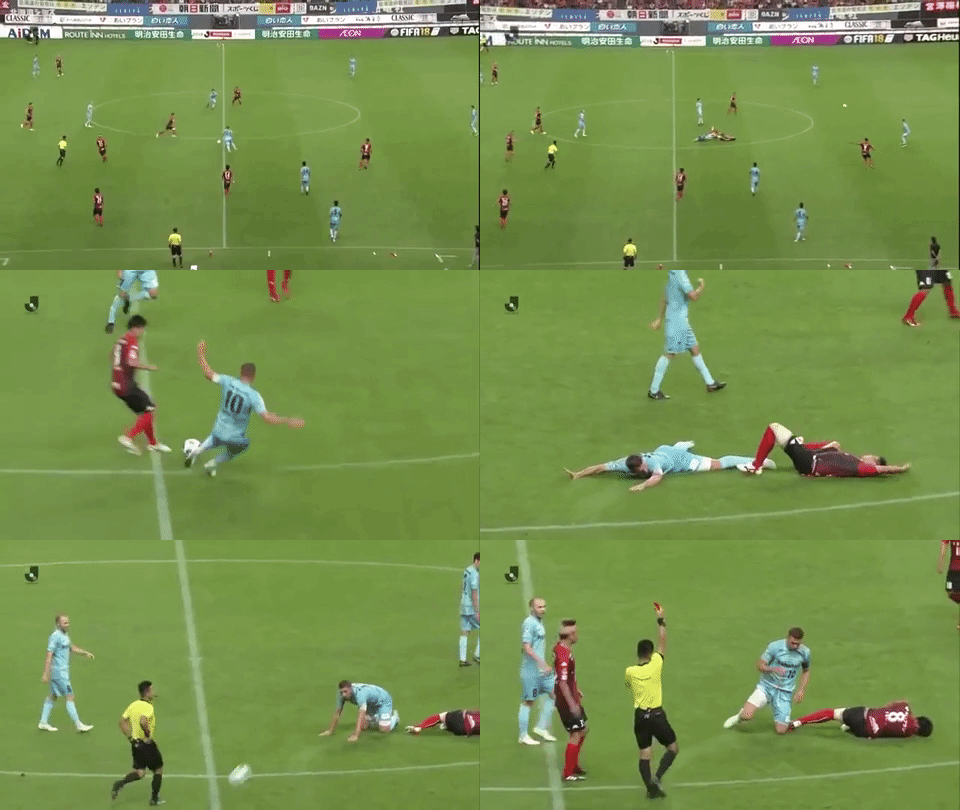
But there’s another tale forgotten by that day. Wellington tackled hard Kaneko, which prompted a foul, the ejection of the Brazilian striker and a mega-fight on the sideline. Some members of S-Pulse’s technical stuff got into the brawl and Podolski is clearly among the protagonists of this event. Result? The German can still start for Vissel in the final match against Vegalta Sendai.
And things didn’t improve in 2019. In a full restructuring process, Lillo didn’t last and Yoshida came back for a few months before Thorsten Fink got hired. Most of all, the German the lost the captaincy and tweeted some sort of meme to prove a point: loyalty is important. But then again, to captain a team, you should take into consideration more than that. And you could see why this was a good move anyway.
In 2019, the former Bayern and Arsenal player didn’t play that much, but still made the headlines: he got into a small fight with a ballboy in German, refused to engage in dangerous questions in the mixed zone with foreign journalists and pushed the boundaries of stereotypes just a little further by mimicking a sumo-related celebration after a goal (yet the experience of Lavezzi and Cardona with Asian-esque gestures should have taught him better than this).
Despite winning a trophy and the nice ending (including a hat-trick in the last league game against Júbilo Iwata), it seemed all was set for a goodbye.
This was the end
Taken all into consideration, Podolski’s adventure in Japan won’t stand in our minds. Not at least among regular Japanese football fans, while Vissel Kobe can brag about having featured three World Champion in their squad (Podolski was the first, then Iniesta and Villa came along). The German leaves Kobe with 60 games played and 17 goals in all competition, although with four braces and one hat-trick (so goals haven’t exactly been distributed throughout this two and a half years).
The impression is that other signings – Iniesta, Villa, Furuhashi, Vermaelen, G. Sakai – were in fact more instrumental to elevate Vissel’s profile on the Japanese football map. Now the club has resources to spend and they’ve already started doing that, this time by picking the right signings, such Ryuho Kikuchi from Renofa Yamaguchi, and not splashing the market (but it’s still January, who knows).
Most of all, Vissel seem to have already some depth in the forwards department. Wellington is on his way out and Villa retired, but Furuhashi for now is still in Kobe; they hope to have Iniesta more fit in 2020 and they also feature Douglas, who signed from Shimizu S-Pulse and he’s tipped to be the bargain of this Winter transfer market. Put there also Noriaki Fujimoto, Keijiro Ogawa and Junya Tanaka… they seem pretty covered.
And what about Poldi? It doesn’t matter that much. Vissel can re-start without him and they’ll have to play in the AFC Champions League, while the German has already picked a new adventure. Despite he clearly needs to face a slightly weaker level – since J. League proved to be challenging for the 34 years-old striker –, Podolski picked Antalyaspor and the Turkish Super League for a new challenge.
But the journey is over. At least in Japan.

Thanks for this great article. I actually like Poldi the brand. Always thought he had good leader-esque traits and good work ethics. When he first landed in Japan, I thought he had the right attitude towards the entire marketing stint and would be able to popularise the J.League in Europe, at least a little bit. Maybe that was just wishful thinking, but it was interesting to follow the ride… It may not have gone according to plan for Vissel and Poldi, but they tried and (hopefully) learned from it. On a different note, still waiting for the J.League to be available for streaming in Switzerland, ideally on DAZN.
Had a quick read (don’t want to embarrass by commenting publicly so it seems like I take pleasure in correcting! Not the case!) .. but this has Peter Utaka playing for Vissel.
All the best Alan
http://www.jsoccer.com Twitter: @JSoccerMagazine
>
[…] we are not here to review crazy management in Kobe (we’ve already done that in a certain way, by talking about Lukas Podolski’s adventure in Japan). We’re to talk about […]
[…] If you look at the history of non-Japanese nations who made it to the Best XI, Germany currently ranks fourth, tied with Australia. Only one player made it in that list, despite we’re talking of one of the best football movements in the world. This record stayed despite the huge wave of enthusiasm for the arrival of Lukas Podolski, who then didn’t confirm all the premises coming with his pedigree in Kobe (we’ve already talked about this). […]
[…] project without patience. There’s no will to see this flower flourish (and we pointed at this in another article. And another one), while it seems that’s exactly what Kobe would need. This season could have […]