When Japan debuted at the FIFA World Cup in 1998, many were happy and surprised. The three defeats were disappointing but pretty close. Soon Japanese football proved able to create several players, in different positions, especially up front. Creative no. 10s and wingers with good talent were proliferating. There were some roles where Japan struggled to provide talent.
One of them was the centre forward. Masashi Nakayama scored the first goal for Japan at the FIFA World Cup, but he never played in Europe. Akinori Nishizawa and Takayuki Suzuki didn’t leave the mark they were expected to. Naohiro Takahara had the best European career but wasn’t at his best at the 2006 WC. Shinji Okazaki then played in three World Cups, but he’s more of a great player than your classic no. 9.
There was though a profile who left some hope. Japan called him for the first time in January 2010, in a game that now looks like a “Unicum” in Japanese football. Yemen-Japan 2-3, played with a super young side – average age 21,6 years old – and the debut of many future Japan national team members (Gonda, Makino, Yoshida, Kashiwagi, Inui) and J.Leaguers.
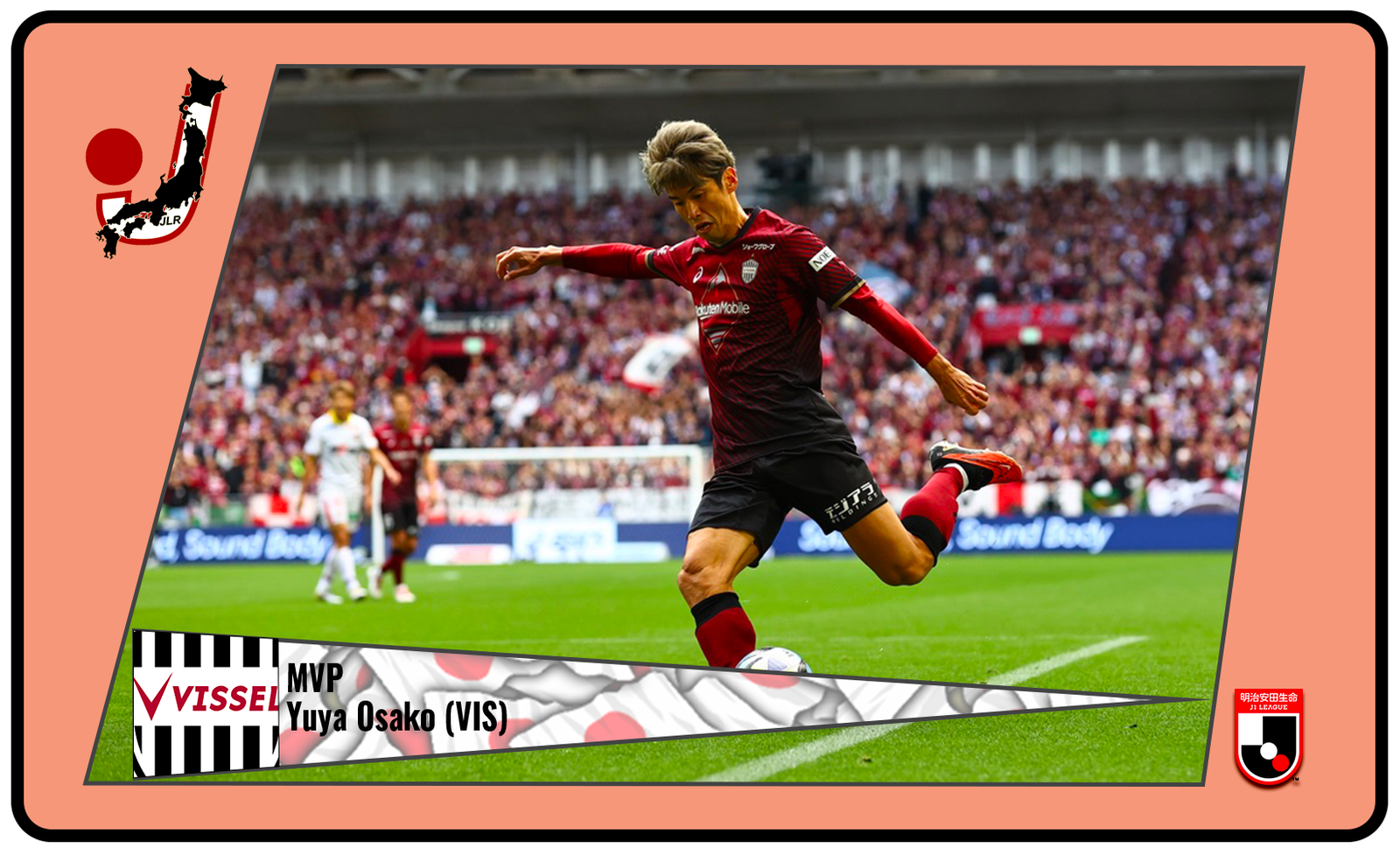
Among the ones who stayed on the bench and didn’t debut, you had Shusaku Nishikawa, Gotoku Sakai, Takuya Aoki, and a young striker coming out from his rookie year with Kashima Antlers. Almost 14 years later, Yuya Osako has a career he can brag about and a rightful MVP award in his hands (both from our readers and at the J.League Awards). But we wondered if he should have shown something more for him at this time.
What we expected
The expectations over Osako were massive. Born in the Kagoshima Prefecture in 1990, Osako still holds the record of goals at the National High School Soccer Championship (10 with Kagoshima Josei, with whom Osako lost the final and initiated a famous soccer meme in Japan). Six clubs were on the search for him, but in the end, Kashima Antlers convinced him and the Ibaraki-bound squad was hoping to find the successor of Atsushi Yanagisawa.
The investment paid over five years. Osako debuted in his rookie year and struggled initially to find pitch time – Antlers were at the tail of their “treble dynasty” (2007-2009) and had an excellent offensive department (Marquinhos, Tashiro, Koroki – and we’re talking just of the centre forwards). 2012-13 finally saw Osako’s breakthrough: 2500+ minutes played in J1, the first double-digits of goals, and the first trophies clinched.
Osako was the top-scorer in the 2012 J.League Cup won by Antlers in 2012 – one of their worst seasons ever – after scoring the decisive goal in the final of the year before. He won two more trophies with two Suruga Bank Championships, especially in 2013 – where his hat-trick defeated a Sao Paulo side with Ademilson, Ganso, and Rogerio Ceni. He topped that with a first trophy for Japan, winning the 2013 EAFF Asian Cup (and Osako scored a decisive brace against Australia).
At 23 years old, he’s ready to fly. He reminded me a lot of Mirko Vucinic as a type of player – an atypical no. 9, capable of playing away from the penalty box and helping the squad bring up the balance. The weakness? Efficiency in front of goal, exactly like Vucinic (who missed some incredible sitters in his career) – Osako showed that deficiency already at a young age and he’ll bring it with him to Germany, where he’ll stay for the next eight years.
What we got in Europe
First stop? A pretty good one, TSV Munich 1860. Back then, the Löwen were still in 2. Bundesliga and Osako joined them mid-season with a contract of 3.5 years. With the no. 9 on his back, the Japanese striker scored six goals and provided three assists in just 15 games. Not bad looking towards the 2014 FIFA World Cup – enough to grant some attention from other clubs.
It was new to see a good Japanese prospect up front – and that’s why 1. FC Köln invested 1.5 million euros in him. Osako stayed four seasons at the Effzeh, showing exactly what was expected of him – good health, great sacrificing spirit and connecting tissue of the attack, but few goals (19 in 120 games for the club – an average of 0.14 goals per game). At 28 years old, and after another World Cup, Osako moved on to another German club.
Werder Bremen took a shot at him and Osako stayed in Bremen for three seasons. And his numbers slightly improved – he closed with 15 goals in 87 games for the SVW -, but nothing worth stretching the stint in Europe. He probably had his best season in Germany with Werder (2019-20, eight goals in 28 games), but also the worst (2020-21, no goals in 24 games of Bundesliga).
And what to say about his Japan stint? It’s not closed yet (on paper), but Osako scored 25 goals in 57 caps. An excellent record, but if we have to “weigh” those goals… the balance might be different. His goal against the Netherlands was encouraging, then Osako needed another three years to find again the net. Beyond the goal against Colombia in the World Cup and the brace against Iran in the 2019 Asian Cup, can you come up with other key moments from him?
What we missed
As said, Osako partially disappeared under Vahid Halilhodzic, who preferred other options. He played in two World Cups, but he scored most of his goals after those two tournaments, bagging eight of those goals against Mongolia and Myanmar. It seems to us that his value lost meaning after the 2019 AFC Asian Cup. And when Werder got relegated in 2021, Osako regretfully came back to Japan.
Where? To Kobe, where Vissel were stacking former national team coming back to their own country. Mostly the ones who disappointed the expectations – Hotaru Yamaguchi, Gotoku Sakai, Yoshinori Muto. Osako was the biggest piece in this stack, in a constant strategy of bringing the biggest possible names on the pitch rather than the most useful players. Osako had a solid stint in 2021, while he struggled last year.
It’s not an accident if Osako didn’t play his third World Cup (to think that Vissel Kobe set up a press conference at the time because they were expecting him to go to Qatar). Nevertheless, Vissel helped Osako thrive. They dropped the non-sense strategy of putting Iniesta on the pitch no matter what and put Osako at the centre, exploiting his playmaking skills in the no.9 position.
It worked: Osako was by a landslide a key player in 2023 for Vissel’s title, a deserving MVP, who scored the biggest number of goals in a season at 33 years old. He scored against 15 of the other 17 J1 squads, racking up 22 goals and seven assists. Osako became the oldest J1 top-scorer since Yoshito Okubo made it for the third time in a row in 2015 with Kawasaki Frontale (he was also 33 years old at the time).
All these accolades leave a sour taste in our mouths. Osako is maybe the epitome of a generation that failed Japanese football? Yamaguchi is a class ’90, like Kakitani. Muto is a class ’92, like Usami, Shoji, and Shibasaki. That generation between class ’90 and ’92 disappointed us massively. We can’t help but wonder how things would have turned out if Osako showed this kind of consistency earlier in his career.



[…] career will inevitably leave some regrets in the end – but he found a way to close it properly. Read here about his contentious […]
[…] our readers. And we often don’t agree with the choices done at the J.League Awards, but – just like for Yuya Osako last year – we can’t deny this is super-deserved. It’s a perfect redemption story – with […]