March 20th, 2016 – Tokyo. We’re at the Ajinomoto Field in Nishigaoka, and 3,584 are following the first home outing ever of FC Tokyo U-23, who just started their J3 adventure that year with the same categories from Cerezo and Gamba Osaka. The opponents are FC Ryukyu, a fun side to watch in the third tier. The final result will see the guests prevail, with a 3-2 win to confirm a good start to that season.
Among the scorers that day, there’s also a 20-year-old forward, who couldn’t play the first game and so debuted in that specific match. It was his first approach towards the J.League, and he wore the no. 15, playing behind the lone striker. A header opened his account, and he would score again in the successive match, always away, but this time in Osaka against Cerezo U-23. Unfortunately, those will be the only two goals he will score that season.
It’s incredible to think that kid – who featured 23 times in that J3 season, scoring two goals and providing five assists – became the top-scorer of the J1 a decade later and a constant menace for each defence of the top flight in the last three to four years. That’s the story of Leo Ceára, who broke a personal record for the “Regista Awards”, winning three of them in one shot: MVP, Best Foreign Player, and Best Goal. That’s never happened.
Not only that, but Leo Ceára was also the top scorer for this season, after coming close to this title. He was the no. 9 that Kashima Antlers needed to have that extra edge over opponents, and his partnership with Yuma Suzuki worked wonders for Toru Oniki and his side. Furthermore, the Brazilian striker is now a hot commodity in J1, despite a somewhat unusual start in 2016 when he was on loan to FC Ryukyu.
From Fortaleza to Japan
Leo Ceára was born in 1995 in Fortaleza, and he came through the youth ranks of São Francisco-BA and Vitória. Ironically, he debuted as a pro coming in for another future J.League player, Alan Pinheiro (who played with Tokyo Verdy), in January 2014. Back then, Leo Ceára was just 20 – he needed to gain some experience, so he started going on loan. First, the experience in Okinawa, then several others in Brazil (Campinense, Confiança, CRB), before coming back to Vitória.
The striker climbed the Brazilian football ladder from Série D to Série A, but the top flight was a tough ask for him. He did way better in Série B, amassing 30 goals in two seasons. And that’s when he decided to give Japan a second shot, signing for good with Yokohama F. Marinos. Basically, he was brought in at the tail of the cycle of Ange Postecoglou, before the Australian head coach moved to Europe to manage Celtic in Scotland.
In the end, Leo Ceára had mostly a secondary role in Yokohama, almost as a joker. Compared to his experience with FC Ryukyu, he was no longer a general forward, but a real no. 9. The problem was that Ange Postecoglou and then Kevin Muscat saw other players as more of a fit for that starting position, with compatriot Elber and Teruhito Nakagawa or Kota Mizunuma assisting from the wings. Basically, Leo Ceára was a card to play when you were in trouble.
Nonetheless, he proved to be a commodity: he scored 10 goals in his rookie season with just 27 games, then 11 more in 31 matches in 2022. All of this by playing way fewer minutes than the others, mostly coming off the bench. Marinos had first Daizen Maeda (who won the top scoring title in 2021), then Ado Onaiwu, and lastly Anderson Lopes in that position. Leo Ceára would have never been the starter, so he decided to leave for another J.League club.
MVP-esque
The forward joined Cerezo Osaka for the 2023 season, a club that proved to be way less winningful than Marinos, but where he could actually rack up all the minutes he wanted. In fact, under head coach Agio Kogiku, Leo Ceára doubled his pitch time in 2023, then played even more in 2024 – 3227 minutes, putting him third in the table for minutes played in J1 among Cerezo Osaka players. It was a lot, but he didn’t disappoint the expectations.
He had an MVP-esque impact, despite Cerezo Osaka finishing clearly as a mid-table side, ninth in 2023 and tenth in 2024. But if the pink side of Osaka couldn’t enjoy any top-flight air, Leo Ceára was clearly ready for the next step. He improved as well on his finishing, and his performances between these two seasons: he scored 12 goals in 33 games in 2023, jumping to 21 in 38 matches the following year. Only Anderson Lopes scored more than him last season in the league.
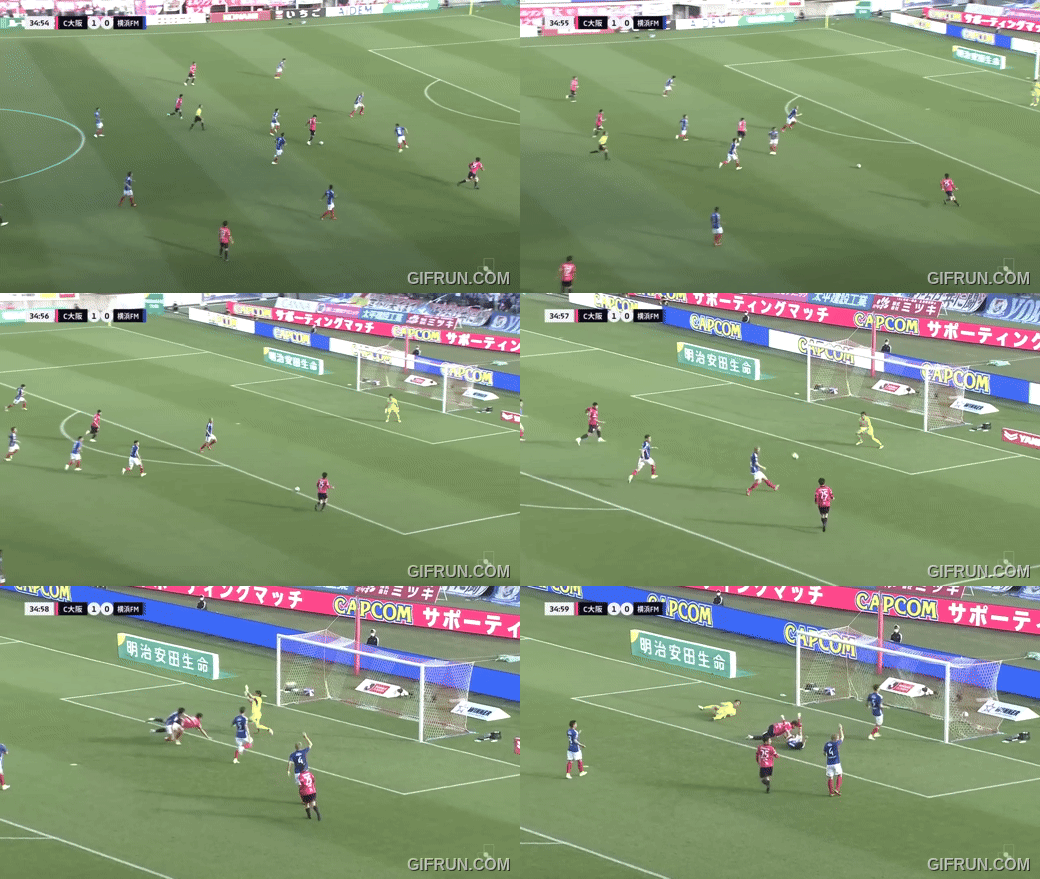
Leo Ceára was fundamental for Cerezo Osaka, one of the best attacking sides of the J1 League. He scored 36,2% of Cerezo’s goals, but furthermore, he was the most impacting player for any side in J1. No one was more crucial than him for the fortunes of his own team, scoring five match-winners among the 21 goals he racked up in 2024. After four years in Japan, he also started to be the captain of the team, especially in such a young environment like Cerezo.
When he decided to leave Cerezo Osaka after two years and join Kashima Antlers, the question wasn’t any longer if he was going to score: at 30 years old, he was clearly at the peak of his form and shape. The question was more about Leo Ceára being able to be a key factor in a winning team, because both situations never happened at the same time. He was either a joker in a winning team in Yokohama, or an absolute star on a mild team like in Osaka.
Master of Impossible
The list of no. 9s at Kashima Antlers wasn’t so prestigious (most notable wearers were Yuya Osako, Takayuki Suzuki, Yuma Suzuki, and Everaldo), but the list of Brazilians was clearly impressive. Not only were Brazilians the highest percentage of foreign quota in Antlers’ history (60 out of 73), but that country brought in players like Zico, Jorginho, Leonardo, Mazinho, Bismarck, Bebeto, Marquinhos, Léo Silva, and many, many others.
So keeping the level was a key request, and the perfect partnership with Yuma Suzuki worked very well. Suzuki turned into a player who’s not a classical no. 9 (and maybe never was), but rather a player who tends to space out on the pitch looking for the ball. On the other side, Leo Ceára started as a general forward and became, in his early 20s, a clear no. 9, so the match-up was perfect, and the 4-4-2 by Toru Oniki found its perfect interpreters.
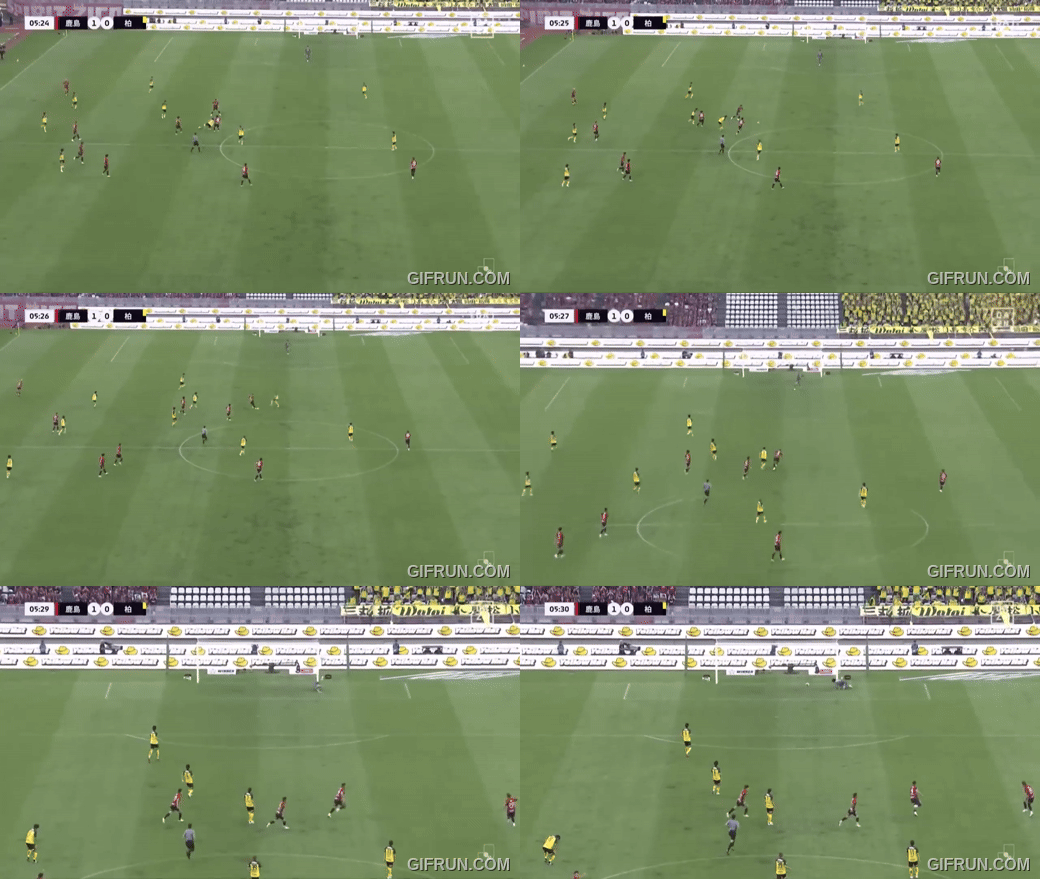
In the end, Leo Ceára responded to the call from Kashima. He became the top scorer, scoring two goals on the last round to win the title, racking up three braces and one hat-trick, including the “Best Goal” of the season against Kashiwa Reysol (in a game that, in hindsight, proved to be crucial for Antlers to clinch the trophy). He also won the monthly MVP twice this season, and it was the first time that happened since July 2022, when he was still playing in Yokohama.
What’s next then? Well, Leo Ceára scored 75 goals in 163 matches in the J1 League – we wouldn’t rule out seeing him reach the 100 goals mark. If he stays in Japan for another 3-4 years, he could be clearly destined to become a J.League legend. And he’s got a record to keep up: in five seasons in Japan, he always scored at least 10+ goals per year. That’s a hard record to keep up, but if there’s one master of the impossible, Leo Ceára seems to be the guy for it.



[…] I think I’m not wrong when I say that’s the first time a player racked up three accolades just for himself. This needed a proper homage to the Brazilian striker, who was one of the key players to bring back the J.League title to the Kashima Antlers, and you can read it here. […]