It’s been strange to see clubs changing their status in the Japanese football’s ladder. It’s a sum-zero game: whenever someone rises (e.g. Machida Zelvia, or the newly-promoted teams to J2 and J3), someone else has to fall (e.g. JEF United Chiba took 17 years to come back to J1, or in the last two years we had our first clubs relegated to the JFL). It seems counterintuitive, but this principle goes as well for players.
It’s basically the reason why we always had the mid-season report of “The Market Report”, to check on whoever needs a break or a leap towards bigger heights. But there also players who live on a rollercoaster of this spectrum: they find a breakthrough, they then struggle at the higher level, and maybe they finally resettle to be their best version in a certain project. And today’s protagonist did indeed that.
But this player hasn’t just done that. He recovered from a full disappointment, after being purchased by the club he liked, from his home area, and then being ditched after a few months. He could have fell through the ladder into anonymity, and instead he found the right project to shine… to the point he actually reached the national team, although he featured for Japan just in a symbolic way for a small tournament.
The story of Tōjirō Kubo is very inspiring. He hasn’t just survived the risk of disappearing from J1, but he’s a key-player for one of the best teams in the league, the revived Kashiwa Reysol under head coach Ricardo Rodríguez. And I’d go even further by saying that Reysol wouldn’t be so fun to watch and they wouldn’t have been so successful in the last 18 months if they didn’t have Kubo wearing the no. 24 for them.
Aichi-Boy
Born in the Aichi Prefecture in 1999, Tōjirō Kubo actually attended a soccer school tied to Nagoya Grampus. It seemed a natural match – born in the Prefecture where Grampus are the thing to be at –, but Kubo had then attended high school and the Chukyo University before becoming a professional player. And that didn’t happen at home, but in a nearby place: Shizuoka, where Fujieda MYFC were getting stronger after a few years in the third tier, under head coach Daisuke Sudo.
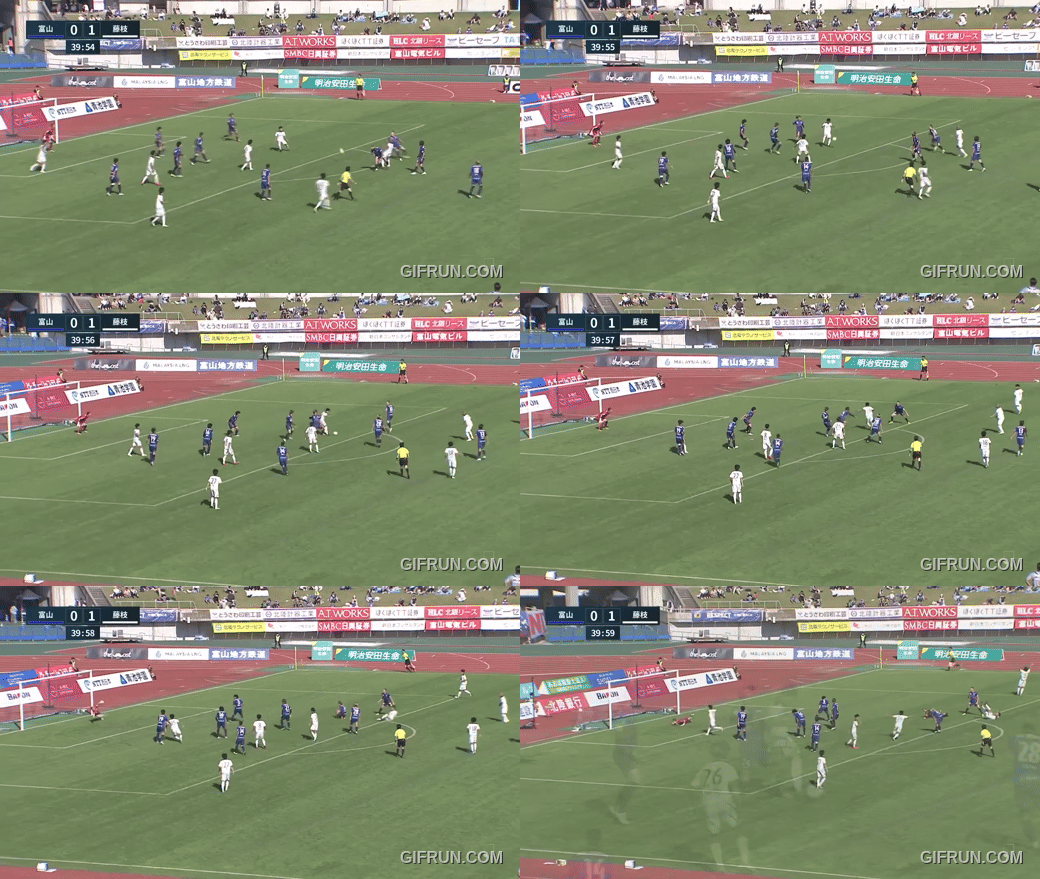
We’ve talked about the growth of the club and their impact on the pitch, but 2022 was a crucial year: when Kubo was just a rookie, he joined the club right when they were about to approach the season in which they got promoted in J2. Kubo showed some promise already in 2021 (six games and two goals as a special designated player), but he confirmed that in 2022. In his first full season as a pro, Kubo played 30 league games, scoring 10 times and provided six assists.
That’s how Fujieda MYFC got promoted to J2, and whoever feared a harder reality in the second tier got surprised. Fujieda had a strong start, and Kubo showcased his class: in just six months in 2023, he racked up 27 league games, five goals and eight assists. That’s when home came by to knock on his door: Nagoya Grampus wanted him back. And that’s exactly what happened, when Kubo joined the club in July 2023. It seemed a dream coming true for the kid who watched Grampus in the stadium.
He was very open about it in his presentation message to the fans: “I am really happy to be a part of this club, which I have always admired and watched at the stadium since I was a child. I will do my best to win and to play in a way that will inspire children’s dreams”. Unfortunately, there was one problem with a name and surname: Kenta Hasegawa. And that’s happened in a club which was already struggling.
Dreams and Nightmares
Hasegawa wasn’t the right fit for Kubo, and it showed through 12 months. Kubo had some starting chances at the end of 2023, but 2024 started badly for Grampus, and the winger felt he needed just one good game to turn things around. Meanwhile, the coach complained about his form: “He’s gaining power and strength. However, he hasn’t yet figured out how to use it effectively. By continuing to work at it, he’ll break through and become a new player”.
As we know though now after 18 months with Kashiwa Reysol, combining strength with dribbling isn’t Kubo’s suit. He needs offensive freedom, and that’s not how a team coached by Hasegawa works. In the end, Kubo racked up 29 games in all competitions (starting just 15 times), but the breakthrough never happened. Actually, Grampus felt the need of loaning him out mid-season, sending Kubo to struggling Sagan Tosu.
And that’s the strange part: despite Sagan got relegated at the end of 2024, and Kubo featured just in seven league games, he scored two goals and showed some flashes of his class seen in Fujieda. When the loan ended, Kubo wanted to stay in J1, but he couldn’t find a spot in Nagoya, so he had to look somewhere else. And the solution appeared to be at a smaller club, still struggling, and in search of a new project.
Kashiwa Reysol barely kept their J1 slot in the two previous seasons, and a new course under head coach Ricardo Rodríguez was the way to follow. Kubo bought into the project: “It’s important to have players who can follow the rules, but if all you can do is follow the rules, you can’t break down the opponent. The manager also tells us: “You have to decide for yourselves. You’re the ones who play on the pitch, so make your own decisions”. I want to show my individuality within that framework.”
The Place to Be
2025 was a golden year for Kashiwa Reysol in general, fighting for the J1 title until the end, even with some regrets if I may. But for Kubo it was something more: he won the Monthly MVP award from the J.League in June, followed by the call-up by Japan for the 2025 EAFF E-1 Championship, won by the Samurai Blue. He coronated this season with seven goals and four assists in 31 matches, playing 2545 minutes.
And he showed the will of getting better and better even after such a successful year: in the pre-season of 2026, Kubo travelled to Brazil for 10 days. To play? To see if there was an offer? No, to train with a specific coach and improve his physical ability: “I want to play like a foreign player who comes in to help the team, going all out in one go, so in that sense it was pretty good.” And even if Reysol have lost Tomoya Koyamatsu, Kubo has become even more important for Reysol.
To the credit of head coach Ricardo Rodríguez, he created the right suit for Kubo. Just like he did for the other offensive demiurge, Yoshio Koizumi (another player who fell out of favour in a bigger club), Rodríguez understood that the stamina that Kubo provides is a resource. Yes, the winger was also a member of the track and field club in high school, even considering competing in that sport before switching completely to football.
I think there are three things striking me about Kubo. The first: his tactical acumen. He understands when the situation needs a change, just like when he was used a right-wing-back in Fujieda instead of his role, right-winger. Secondly: his stamina is unbelievable, sprinting data are off the charts. Third and not last: the resilience. A rejection from your dream club could have broken anyone, but Tōjirō Kubo has still a lot to run for.