It’s not easy to be relevant in Japanese football. You might think that being from the Kantō area would actually help you, but it’s not like this. You might ask to Tokyo Verdy what they think about it or just look slightly North and observe how JEF United Chiba have squandered their solid history in J1 with more than a decade in J2. Even the club of the capital – FC Tokyo – still can’t impose itself on other rivals in the same region.
You might then imagine that having two teams in the same city of a such over-populated area might be tough. Especially if you live in a city where those teams used to be one: Yokohama is the embodiment of this situation. We wrote already about it – thanks to a wonderful piece by Tobias Dreimann (you can find him here on Twitter) –, but Marinos versus Flügels was a nice rivalry, which ended abruptly just before the beginning of the new century.
After playing their last game on New Year’s Eve of 1999 (and winning the Emperor’s Cup!), the club was disbanded and one of their two main sponsors – ANA – actually met with Nissan Motors, accepting the merger of the two teams in the city. With a seven years-history behind them, Flügels fans never accepted it and founded instead another team, called Yokohama FC and based on the supporters’ trust-model (e.g. FC Barcelona).
With the club being operated by his fans, Yokohama FC as a club preserved its own soul and spirit, but what about the pitch? Would they ever be able to see glory days after being dropped to the third division? The answer is meh. After winning twice the JFL, the club got promoted to J2 League, but they witnessed just another J1 season in 2007 and mostly spent their time in the second tier.
Which trait would you remember the most about Yokohama FC? Kazu Miura. The King of Japanese football keeps playing at 53 years old thanks to the second club of the city, which exploited his popularity to stay relevant. The club hosted also other famous senators, like Shunsuke Nakamura, Leandro Domingues and Daisuke Matsui, generally relying on expert figures. This changed last year.
And it’s not a case that Yokohama FC finally got what they wanted in the first place: coming back to J1. This result came on the wave of good acquisitions, promising players coming through and a new head coach, ultimately capable of developing that potential. The Yokohama FC-version of Takahiro Shimotaira isn’t just here for a sweet two years-ride, but they might be here to stay.
Stuck in the middle
As we said, Yokohama FC came back to J1 after a 13 years-drought. It seemed impossible to overcome the last hurdle, since the club struggled to get even near to the Top 6 for a whole decade. They featured in the playoffs in 2012 and 2018, but they never got to the final step. Between those runs, there were terrible season, even touching the bottom of the table a couple of times (like in 2009 and 2011).
Even on the bench, nobody was able to keep the ship steady on the long run. After Takuya Takagi won promotion from J2 in ’06, he didn’t even finish the following season in J1. Many coaches were changed – from Yasuhiro Kikuchi to Motohiro Yamaguchi, from Yasuyuki Kishino to caretaker Hitoshi Nakata, passing through the foreign options of Miloš Rus and Edson Tavares –, but nothing seemed to work.
And even though Marinos weren’t exactly thriving – they lost the 2013 title after dominating the season and they won just one trophy in the long J1-drought of their city rivals –, Yokohama FC didn’t have so much to play for. Yes, some decent players wore their jersey: Kosuke Ota, Kosuke Onose, Naoki Nomura and Yohei Takaoka are some examples, but they were lacking a Blockbuster-prospect.
Also, some key-figures went through the YFC gig, like Masashi Oguro, Tetsuya Okubo and Yuichiro Nagai… but besides that? What’s beyond the King Kazu narrative and being in a football-passionate city like Yokohama? The club struggled to find its spot in the Japanese narrative, honestly. Until 2018, where solid signs of growth were seeable under head coach Edson Tavares, reaching the playoffs final and losing it against Tokyo Verdy.
It seemed the senators’ structure was valid, with Yokohama FC featuring the third oldest roster of the whole league (26,1 years old on average), but getting results. Ibba Lajaab upfront scoring a lot of goals, Yuta Minami on goal, Leandro Domingues creating chances and a bunch of reliable defenders: it worked, but something was missing. That something came a season later, but YFC needed a different alchemist.
The perfect fit
Tavares stayed, but he didn’t last too much. Yokohama FC started badly their 2019 season and a sluggish beginning pushed the Brazilian to the door: after a 1-1 home draw against Machida Zelvia, Tavares was sacked and replaced by a man we seemed to have forgotten. Tomohiro Shimotaira helped building a very good-looking version of Kashiwa Reysol and he was sacked too soon the year before, when Reysol lacked results.
Kashiwa ended up getting relegated anyway and Shimotaira was looking for a fresh start, after being involved for so much time within the organization. Yokohama FC seemed a tough gig, but he had nothing to lose: if the season would have proceeded in a bad direction, he could have still told that the squad wasn’t shaped on his principles. Instead, he immediately racked a last minute-win in Kagoshima, changing a few things.
Instead of relying on the 3-4-2-1 seen under Tavares, the former Reysol coach bet all his chips on a 4-4-2, reminiscent of the formation he used in his previous experience. He quickly tested multiple line-ups, always keeping the four defenders-backline. In the end, a 4-2-3-1 was the ultimate pick, but the set-up made a difference to a certain extent; what’s actually changed YFC’s route to J1 were the players used.
While keeping some senators on the pitch – Minami stayed in goal, captain Kensuke Sato was one of the best midfielders of the year and Ibba was confirmed as a no. 9 –, rookies became a key-part of the line-up. Just like at Reysol, Shimotaira wasn’t afraid of testing in J2, especially with a season that seemed already compromised. That’s where new heroes came in play. And those heroes were mostly in the offensive department.
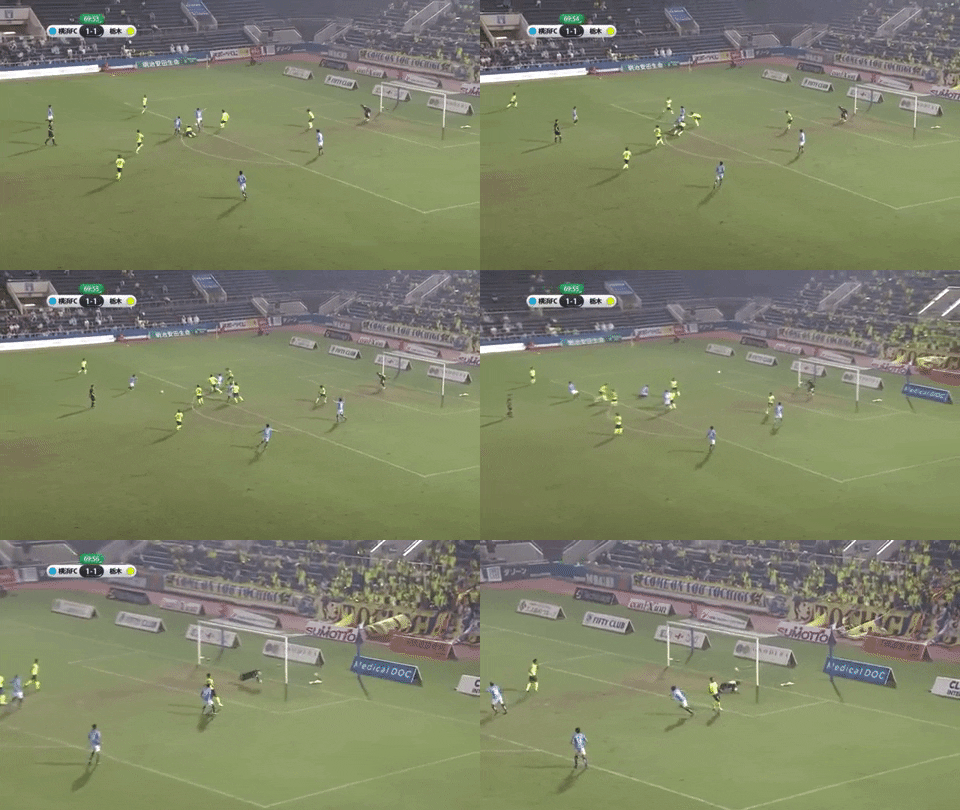
Kosuke Saito (class ’97) wasn’t a starter, but he became useful as a joker during games. Yuki Kusano (’96) followed the same path and was stopped by some injuries, but he scored four crucial goals along the way. Katsuhiro Nakayama (’96) was underused by Tavares, but he never misses a match under the new coach. And then Shimotaira found two absolute gems, the “Blockbuster deals” Yokohama FC were missing in their previous seasons.
One was Yusuke Matsuo (’97), dropped by Urawa Reds’ youth sector and welcomed in Yokohama as a rotation member. Instead, the winger was an absolute beast, tearing down opponents on the flanks. The other was Koki Saito (2001!), who debuted already in 2018. Seeing him and Miura on the pitch was surreal, but Saito played a solid season, showing maturity and ductility despite being just 18 years old.
Once Shimotaira put everything together, the squad climbed the table pretty rapidly, racking up seven wins in a row and experiencing a 18 positive results-run to access the playoffs zone. With Kashiwa Reysol clinching promotion with some games to spare, Yokohama FC overtook Omiya Ardija on the finish line, coming second thanks to another solid run of five wins in the last five games of the season.
The drought was over after 13 years.
What’s at stake for the future?
The jump could have been difficult for a club missing in the top tier for such a long time and many were concerned about surviving chances. Last but not least, Marinos were the defending champions in J1. Instead of fearing the comparison, Yokohama FC went on with their plan, given their moves on the last Winter transfer market. Excluding the lost of Kengo Kitazume (who joined Reysol), the group remained intact.
Meanwhile, the club made some smart moves. They acquired Takaaki Shichi, who had a solid year with Mito HollyHock, while also signing Matsuo with a pro-contract. They mostly saw players joining on a loan, but with four key-adds: Maguinho from Frontale, Kohei Tezuka from Reysol, Yuji Rokutan from S-Pulse and Kazunari Ichimi from Gamba, who was probably the most important of these movements.
Instead of splashing the market without tomorrow, Shimotaira and the club opted to keep the core of the promotion and strengthening the roster in a few roles. It worked: after a first period of adaption to J1 football and the pandemic, Yokohama FC scored some important results. They won against Antlers, Reds, Grampus and FC Tokyo: no relegations this year, but they’re comfortably away from the bottom three (+11 after 24 games).
Meanwhile, their project of developing players is working. After a solid season in Kyoto, Kazunari Ichimi looks a veteran in J1. Youske Matsuo is crushing opponents also in the top tier, while Koki Saito – recently rumored to join Manchester City, just like Ryotaro Meshino and Ko Itakura did last year – is assuring everyone he’s a prodigy. Rokutan gives a back-up option for Minami and rookie Tatsuki Seko is thriving in the midfield.
In this scenario, the senators are staying on the bench. Kazu Miura played just 56 minutes, Leandro Domingues 230’ and Shunsuke Nakamura featured for the same minutes, although in more games. The development process is going so well that the club let Ibba go, with the striker joining Omiya Ardija. This is a massive job both by the club and Shimotaira, who are granting YFC a chance to survive once relegations will come back.
It seems so unfair to see the world – and Japanese media themselves – still highly celebrating the old glories featuring in the roster, while Yokohama FC are in J1 because the bunch of young guys who actually brought them there. While nobody in their right mind would deny that King Kazu helped YFC staying relevant, it would be unfair to say now that the club must count on his pedigree to stay in J1.
That status has to be confirmed on the pitch, where this young core has shown to be deserving the category. The future is now and it might be brighter than anyone could possibly imagine for a club once dissolved.
[…] is normal, because the club is clearly following another path, based not anymore on experience, but on the youngsters available on the roster. And it’s […]
[…] in J1. In the end, it’s the same approach he took with Kashiwa – and it worked. Yokohama FC found young blood – Yusuke Matsuo and Koki Saito above all – and got a 15th […]