April 2019, Nissan Stadium in Yokohama. Marinos are hosting Nagoya Grampus for one of the two J1 matches featuring on a Saturday night (better than Cerezo v Consadole, surely). The game will be one of the best of the season so far, but what strikes me most is the change in goal. Since Park Iru-gyu has been named a starter, things have improved for Marinos, but not for one player in particular.
In the preview for this season, I thought that Marinos might have been in the Top 6 at the end of the season, but they were still short of a couple of players to actually fight for the title. The indictment of Park Iru-gyu may have shortened the wait, but I still believe they’re missing depth for 34 games and a good centre-back alongside Hatanaka (sorry, but I’m not at all sold on Thiago Martins).
Celebrating this renewed and updated version of Marinos may, though, take us away from a deep dive into one of the strangest careers of all: after a lot of effort to understand Postecoglou’s way, Hiroki Iikura is now on the bench. And it doesn’t seem this is going to change.
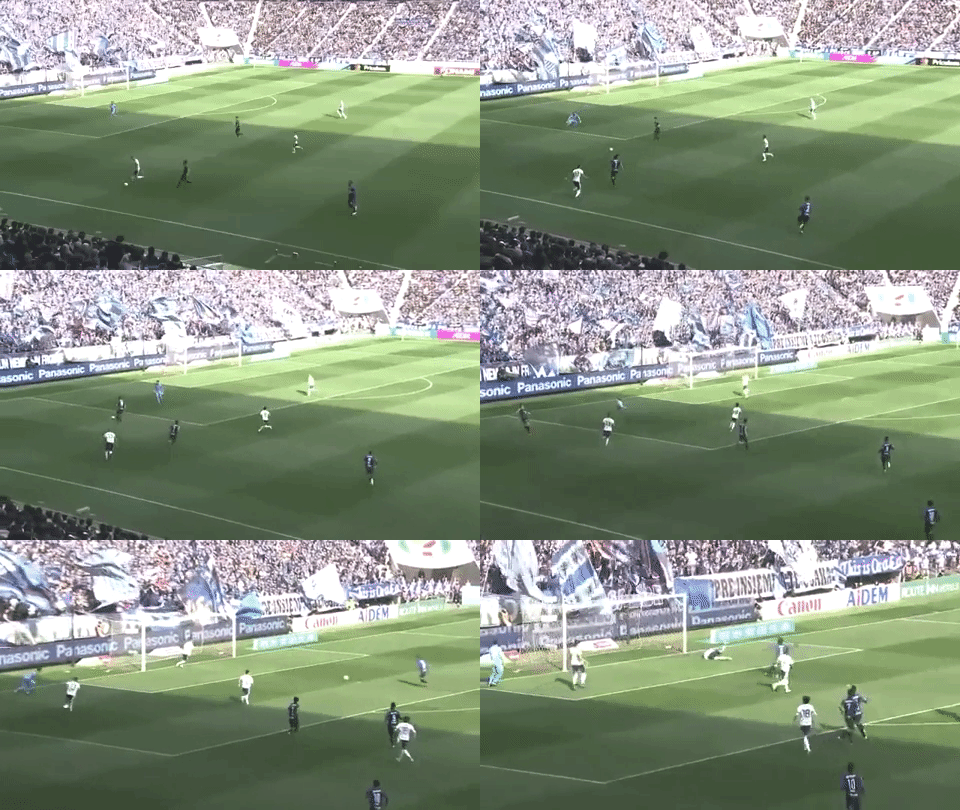
A long-time kid from Marinos
Born and raised in Yokohama, Iikura’s career hasn’t been so stable, despite staying with the same club for over a decade. Developed in Marinos’ youth ranks, the goalkeeper had to wait two seasons to debut in J1 while playing for then-Rosso Kumamoto in the JFL. When he came back to Yokohama, he debuted with Marinos in J1 against Shimizu S-Pulse, in a 2-0 home defeat in August 2007.
Unfortunately, for two full seasons, Iikura remains on the bench (alongside another J1 starter at this day and age, 19-year-old Yota Akimoto). He’s young, and Marinos can still count on Tetsuya Enomoto, preferred over the two young keepers. Something is about to change, though, because if Kokichi Kimura is the first manager to let him play more, Kazushi Kimura will confirm him between the posts.
He might be growing as a player, but he doesn’t go unnoticed on the field. Take, for example, the episode of 2009, when he blatantly pushed Juninho during a J. League Cup semi-final against Kawasaki Frontale. The striker tried to kick the ball after a whistle from the referee, but Iikura didn’t take it well and got ejected. Despite this, the competition with Enomoto kept going.
This was until the arrival of Yasuhiro Higuchi, who’s currently living a renaissance between his work at YSCC and his start at Ryukyu, but no one has forgotten the massive failure at Marinos. Yokohama almost celebrated a title in 2013, only to squander it with two losses (at home against Albirex and away at Kawasaki) to Sanfrecce Hiroshima.
In that squad, Iikura had no place. The keeper was the starter in 2012, but featured in zero league games in the two seasons after that one. Even a young Yuji Rokutan – so many of today’s starters began to face pro football at Marinos, didn’t they? – got more caps than Iikura in those years. With Higuchi leaving and Erick Mombaerts coming in, things shifted again.
Iikura regained his starting spot (featuring in all J1 games of 2017 and 2018), Enomoto moved to Urawa Red Diamonds, and Iikura improved a lot. Under the French manager, he was probably one of the best keepers in the top tier of Japanese football. In my mind, I would have put him in contention to be the third goalkeeper for the 2018 FIFA World Cup. Then, a massive change materialised in Yokohama and changed his career.
The failed match-up
When Ange Postecoglou left the Australia NT job to come to Yokohama, Scott McIntyre – a good voice to hear when you’re talking about Asian and Japanese football – pointed out how his way of playing would have put the J. League through a revolution. This has partially happened: the 2018 version of Marinos was entertaining, but confused. Spectacular, but massively flawed. This resulted in a relegation escape just at the last breath.
One of the reasons might be found in the never blossomed-love between Hiroki Iikura and his manager. Or, more precisely, the style of football Postecoglou imposed in Yokohama. Mombearts was a manager with a clear and simple plan, way more stable than the proposal by the Australian head coach. You have to say, though, Marinos haven’t been that entertaining for a long time.
With that style of playing – long build-up plays, continuous possession of the ball, a lot of passes to avoid pressure from opponents and find spaces behind the defence –, Iikura had several troubles. Unfortunately, Marinos didn’t look out for a different player, so Postecoglou opted to work on Iikura’s skills. A project that didn’t work as Ange probably supposed.
Marinos conceded an average of 0,93 goals per game in the three seasons under Mombaerts, ending seventh, tenth and fifth in his three years. There was room for improvement, especially under the renewal the squad faced in recent times. But in goal, Iikura was one of the few key players established; instead, the Postecoglou treatment put him and his skills under consideration.
Whoever could have tried a half-line goal… has done it. His name could be Kikuchi, Fujimoto or Patric, but they often succeed. Iikura wasn’t set to play as a sweeper-keeper, and it took him a lot of time to adapt. In the last games of the 2018, he seemed to have found a minimum stability, but he needed more time to improve. Instead, everything worsened last Winter.
Marinos bought Park Iru-gyu from FC Ryukyu, a veteran of the J3 League defending champions and a man in the Top 5 for games played in the third tier. It seemed like a backup for Iikura, but the reality is that Park is way more suited to play in Postecoglou’s system. The Australian manager realised that during the J. League Cup games, and he switched the goalkeepers, with the former FC Ryukyu captain now starting and doing pretty well. Iikura, instead, is warming the bench.
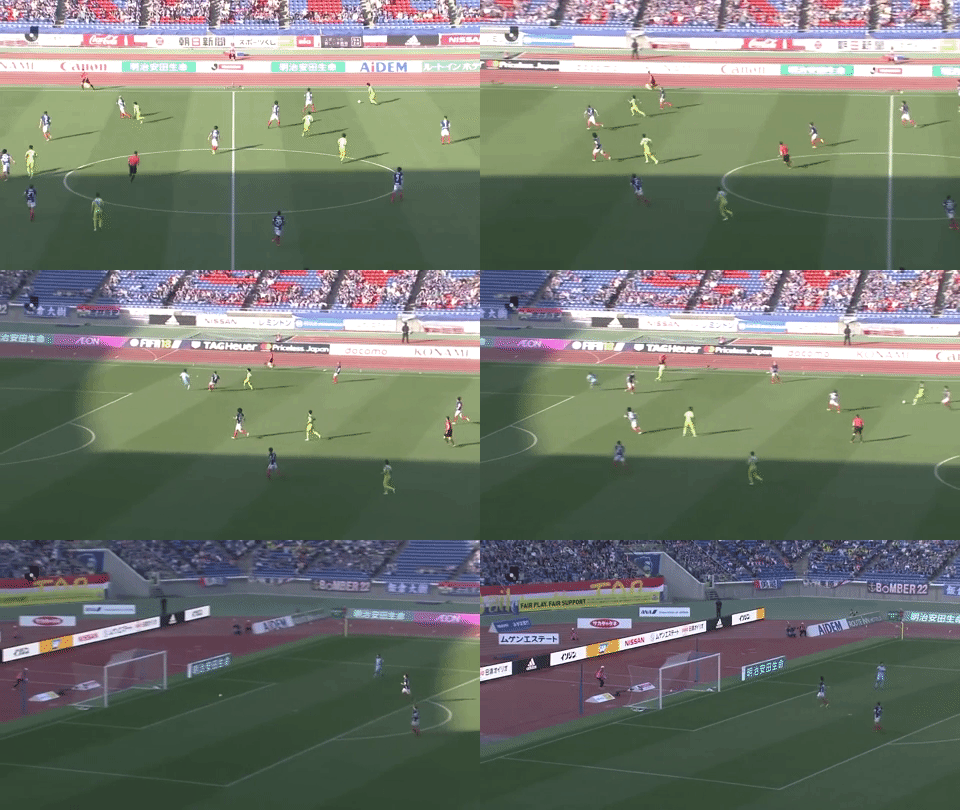
Is there a future from here?
I think it’s a question Iikura may have asked himself, despite the change at no. 1 being recent. And I’m sure his career is far from over; being benched at almost 33 years old doesn’t exactly sound wonderful. But I think this: it’s not like Iikura isn’t a good keeper by J. League standards, but he isn’t fit to play in such a system. And that would open many hypotheses.
We’re still talking of a man who played more than 200 league games with Marinos, being almost in the Top 10 of most present players with this shirt. But it maybe the time to look for another destination; the Postecoglou system will get better and better, maybe even bringing back a title next year (I think J1 2020 season might be the right chance to snatch it all).
Instead, Iikura could be really useful for many other teams in J1. What if Sagan Tosu, Cerezo Osaka or Vissel Kobe could feature someone like him, with experience and solid skills, despite some mistakes from time to time? They could improve their chances of reaching their goals for the 2019 season. So he doesn’t have to lose hope, even if his starting spot in Yokohama might be gone for good.
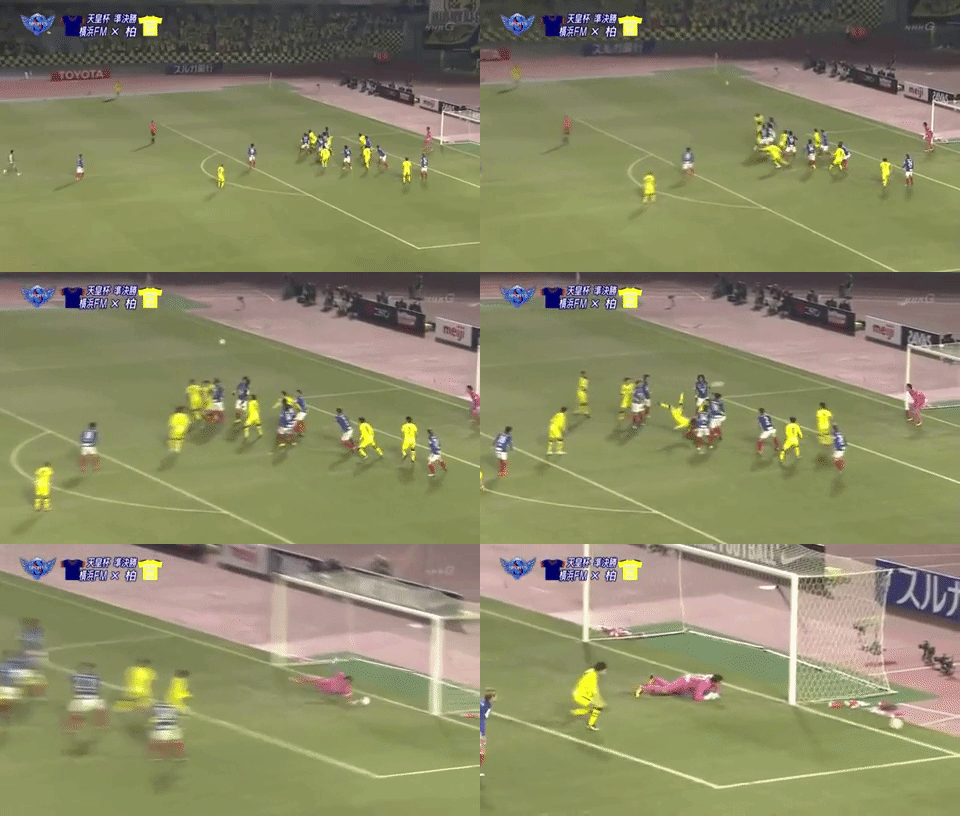



[…] fact, Sato didn’t fit the sweeper-keeper-figure the head coach wanted for the no. 1 (like Iikura had a rough patch at Marinos under Postecoglou). Esnáider tried both fellow countryman Diego Rodríguez and […]
[…] Daiya Maekawa, class ’94, got called up, but he’s still fighting for the no. 1 spot at Vissel Kobe against expert J. League Hiroki Iikura. […]