There are games which left a mark on each country’s football culture – and Japan is no different. Until now, the Samurai Blue have played 25 FIFA World Cup matches in eight different editions. They won seven of them, got six draws, and lost 12 times, scoring 25 goals in the process and conceding 33. And some of them left an undeniable scar, whether it’s good or bad.
“Pitch-Term Memory” (or PTM, as we abbreviated it) is about remembering a special match for each FIFA World Cup edition in which Japan featured it. From 1998 to 2022, we’ll go through memory lane – from terrible disappointments to unimaginable joys.
And we couldn’t start from something different from the first match ever for the Samurai Blue: it’s June 14th, 1998. After a long wait and an atrocious pain four years before, Japan is finally there. And they’re gonna play Argentina in their debut on the biggest football stage.
The World Cup aura in 1998
Thinking back at how Japan’s football movement was in 1998, it’s almost another century. It actually is, but it seems way farther away than slightly less than three decades. In 1994, the “Agony of Doha” found space in the Japanese public discourse: a 2-2 draw against Iraq left Japan out of the 1994 FIFA World Cup. It would have been the first qualification, just one year after the birth of the J.League. It didn’t happen.
Therefore, the successive four-year cycle started with an imperative: we must qualify. Furthermore, Japan got the rights to co-host the 2002 FIFA World Cup with South Korea. But if they were already at several World Cups, Japan never had the pleasure. And they needed to do it: the World Cup was expanded from 24 to 32 teams for the 1998 edition, with the AFC getting 3.5 spots. But the pressure was already there from the qualification rounds.
Japan slightly edged Oman in the group stage of the first round, then succumbed to South Korea in the group stage of the second round (by drawing a lot of matches…), and so the Samurai Blue needed a play-off against Iran. Team Melli had the upper hand in their group, but it was a very balanced group; so, Iran drew at home against Kuwait and lost in Qatar in the last two matches, finishing incredibly as runners-up.
The play-off game was set up in Malaysia as a neutral venue, with one match instead of a two-legged contest. It was a crazy game, even with the pre-match being completely lunatic. Despite Iran agreeing on Malaysia as a neutral venue, the flight connections were a problem – Iran came pretty late to Malaysia – and the time difference was easier to absorb for Japan. Furthermore, two days before the match, Iranian players tried to get under the skin of their Japanese counterparts, though failing.
Despite all these shenanigans, Japan could count on more support from the fans and from companies being on the ground for accommodation. The game was a tight contest: Japan took the lead, then went down 2-1, found the equaliser, and then the golden goal at the 118th minute of extra time. That night – with an average viewership of 47,9% on Fuji TV at home – Japan booked their first ticket to the FIFA World Cup.
But if the “Joy of Johor Bahru” needed to leave space for something else. It was time to think about the tournament itself – and Japan got a tough group ahead, with a strange trait: three out of those four teams (Japan, Jamaica, and Croatia) would have played their first FIFA World Cup ever. But the Samurai Blue would have featured in their maiden match against Argentina.
Samurai Blue: group before stars
It’s always strange to rethink that time and imagine that some key figures were not involved in the FIFA World Cup. Out of the 18 players from that torrid night in Malaysia, only four didn’t make the final cut into the 22 players for the trip to France. And only three players who made the trip for the pre-tournament training camp in Switzerland didn’t make the cut. But if the young Daisuke Ichikawa had found a spot four years later, the other two wouldn’t.
Those two exclusions were heavy-hitters. On one hand, Tsuyoshi Kitazawa, who actually played until April ’98 with the national team, and he was the heart and soul of the Verdy Kawasaki team, which dominated the first year of the J.League. Kitazawa also won the 1992 AFC Asian Cup, and he almost moved to Europe in 1995 (Sporting Lisbon were after him) – he was an affirmed player. Nonetheless, Kitazawa didn’t think he was going to be dropped, and the third name was even more surprising.
Like Kitazawa, Kazu Miura was a star of the Japanese national team, won a lot with Verdy Kawasaki and lifted the 1992 AFC Asian Cup. Today he’s a living record, but back then – at 31 years old – he seemed indispensable for the first FIFA World Cup Japan ever played. It was his dream, but the head coach saw it differently; he even hoped Miura would have stayed to support his teammates, but Kitazawa and Miura immediately drove off to Milan before catching the first flight to Tokyo.
And who was the man behind these hot decisions? Well, it was a back then-42 years old who became the national team’s head coach after predecessor Shu Kamo was dismissed after a bad start to the qualifying round. He hadn’t been coaching yet as the main man, but rather as an assistant first, and worked as a pundit as well. Takeshi Okada was in the technical staff, and to think that he was hired because another assistant, Eijun Kiyokumo, recommended him for the job.
Even more – when Kamo was sacked, and the JFA offered the position to Okada, he initially refused. Okada changed his mind only after talking with Kamo, who wanted him as his successor. And he was an interim manager for the whole qualifying process, becoming the official head coach only when Japan got their spot for France ’98. He doesn’t know that by then, but he’s gonna write the history books of Japan’s football trajectory. But you gotta think about the opponents too.
The Opponent: Argentina, the post-Maradona era
Just eight years before that time, Argentina played in the third final in four editions of the FIFA World Cup. The problem is that the Maradona era was over after 1994, when El Pibe was disqualified from the tournament. Their golden era – with three World Cup finals and two Copa América wins in 1991 and 1993 – was behind them. Nonetheless, the squad was more than a simple dark horse for the title; the potential was there.
The undisputed star was Gabriel Batistuta, the striker from Fiorentina. Diego Simeone was the captain, while the first no. 10 after the Maradona era was chosen in Ariel Ortega, one of the moodiest players on a football pitch. Furthermore, you had Claudio Lopez, Juan Sebastian Veron and Hernan Crespo. No Under 21 players, only two over 30. Argentina won their CONMEBOL group largely, although without Brazil taking part in it and with Paraguay and Colombia just a few points away.
The head coach was Daniel Passerella, who was also the first captain to lift a World Cup title in 1978, in one of the most discussed World Cups ever. Passerella imposed a military regime within the squad, banning long hair, earrings and homosexuals (can you do that? How?) from his squad. Not an accident if one of the most talented Argentinian players, Fernando Redondo, refused to play for the national team under his reign. And his 4-3-1-2 promised fireworks, but they’ll be rarely witnessed.
The Game
For Japan’s debut on the biggest world stage, Toulouse was the place to be. Situated in the South-West part of France, the city is renowned for two things: the European aerospace industry and its university. But sports-wise, football isn’t even the main activity, since Stade Toulousain is one of the best teams in rugby, while Toulouse FC rarely made the headlines at the time within French football. Nonetheless, Argentina-Japan was going to be the second match hosted at the local stadium.
It was the first Group Stage game, and Okada had a clear view in mind of how to get through in Group H: “Four points will be enough. We need to win one, draw one, and lose one”. Realistic take, and I think the game to lose was the debut against Argentina. Passerella fielded the best formation, with the right confidence: in five pre-WC friendlies, Argentina won all of them, without conceding even one goal, and even defeating Brazil 1-0 in the process.
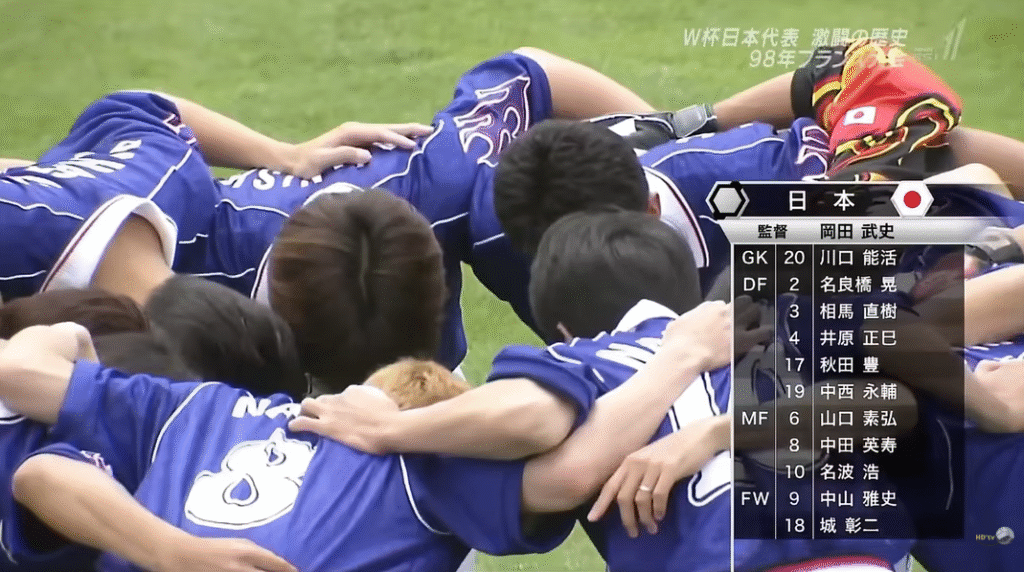
Japan took their 3-4-1-2 approach and put their maiden line-up composed like this: Kawaguchi in goal; Akita, captain Ihara, and Nakanishi in defence. Narahashi and Soma as wing-backs, with Yamaguchi and Nanami administering the midfield. Nakata would have played alongside them, but with a license to run up the field. Upfront, with no Kazu Miura available, Okada chose the tandem Nakayama-Jo to lead up the charge.
You have to imagine a very different Japanese side from now – the first commandment of that game was: don’t concede. As long as we do that, we’re in the game. And you could see that – in the end, Argentina had the ball most of the time, the 3-4-1-2 provided some good coverage, and you have to say that the most eye-catching player in the first half is… Naoki Soma. No, not Nakata or Nanami, but the no. 3, a dynamic wing-back capable of defending and attacking with his speed runs on the left.
It could very well be because of Passerella’s coaching style or because it was the first game of the tournament, but… looking back, Japan were not taking much of a risk. And you could clearly see what Japan’s strategy was: Jo and Nakayama pressing Argentina in defence, Nanami and Nakata with the duty of inventing something, and the other six just for pure defending. And there was some extra attention over Ariel Ortega, whom his opponents always double-teamed.
After 25 minutes, Argentina started to pick up the rhythm a bit. First two shots, and then the advantage scored by Gabriel Batisuta – and the credit goes anyway to Ariel Ortega, who created some confusion in the last 25 meters with his movements. A through ball by Diego Simeone knocked off Hiroshi Nanami’s ankle – and who was there to pick up the pieces? The Argentinian no. 9, who chipped Kawaguchi and brought Argentina up 1-0.
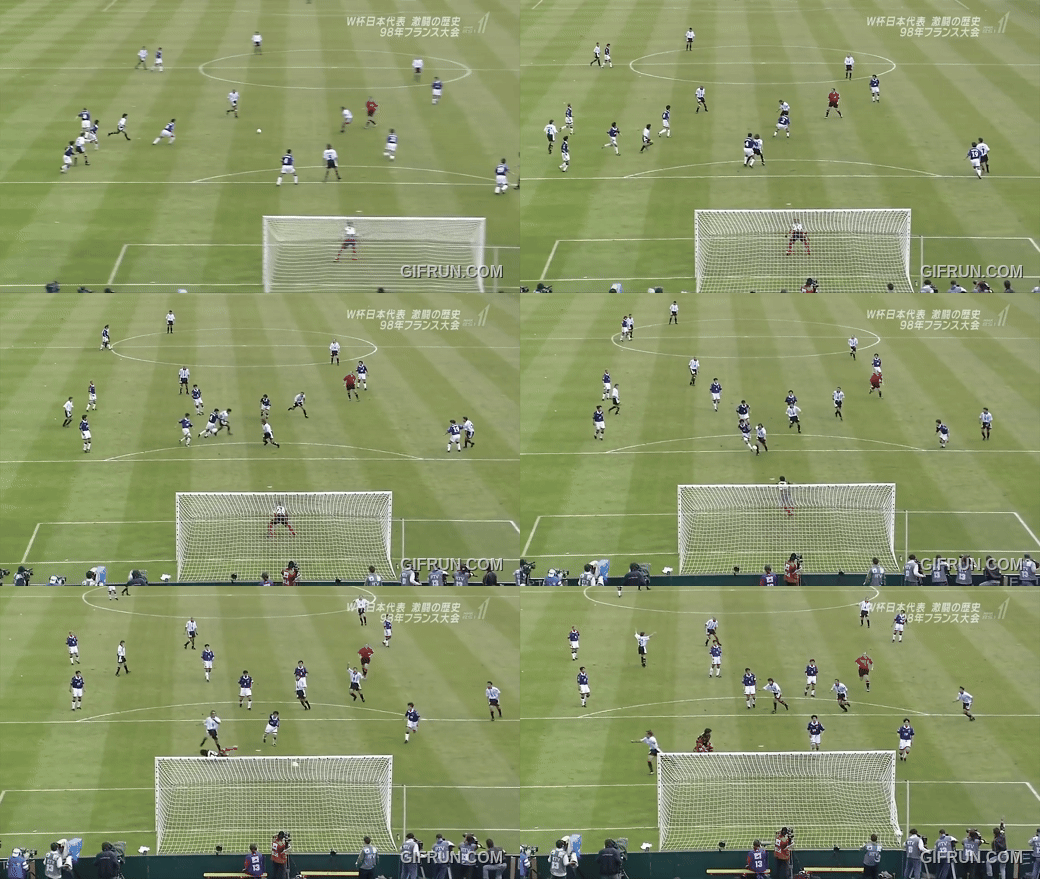
Argentina proved to be a passive team in terms of football building – once they got the upper hand, they relied on slow rhythms to keep the advantage and eventually catch Japan off guard. In the end, Nakata and Nanami were not enough on their own to change things, let alone against Argentina, in their first FIFA World Cup match ever. Actually, Japan were lucky enough to avoid conceding a second time, with Batistuta hitting the post with a header and Claudio Lopez not taking advantage of the rebound.
When the first half finished, Japan could even be satisfied. They pulled through; they were just 1-0 down, and they were showing some decent effort against one of the tournament’s favourites. But the second half won’t produce that much. Argentina had the comfort of the advantage, and it was Japan’s turn to find the net. Unfortunately, the best chance came with a through-pass by Nakata to Narahashi, but the right wing-back didn’t take his chance, shooting wide once in the penalty box.
It was actually Argentina who were more dangerous – Veron tested Kawaguchi on a free kick, while the no. 20 needed some handball skills to avoid sub Abel Balbo to score the second goal. The last chances for Japan came in the final minutes, with a header by Akita just wide and a number by Eisuke Nakanishi, who suddenly dribbled off both Almeyda and Simeone, but the shot by Wagner Lopes rebounded off a defender into a corner kick.
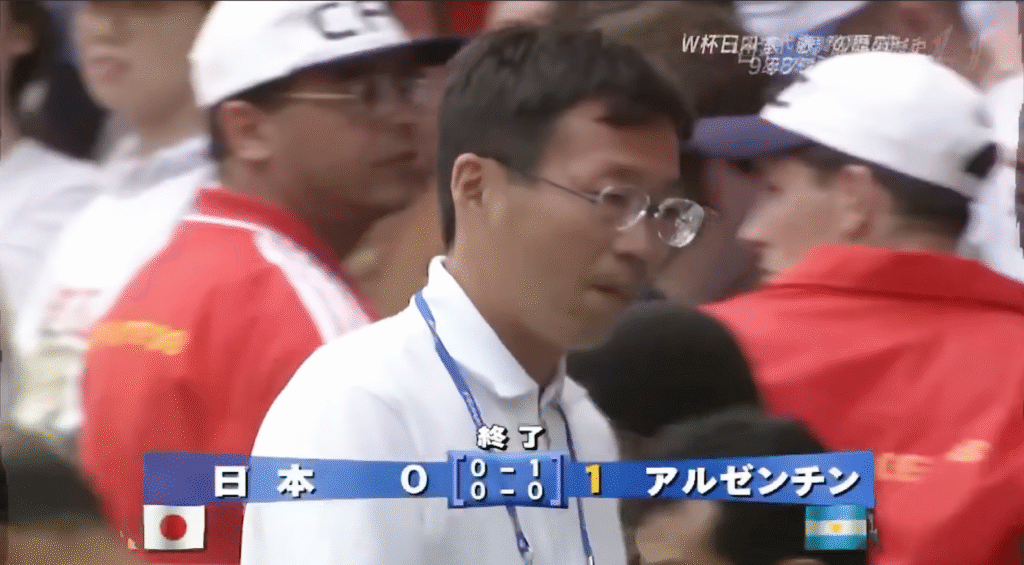
In the end, subbing in Wagner Lopes and midfielder Takashi Hirano – in place of Nakayama and Soma – didn’t make the hoped difference. Japan stood tall on the biggest world stage, and they avoided being heavily defeated. Who would have thought back at the time that Japan would have surprised the football giants more than once, even within the same tournament?
The Aftermath
That Group H ended up being a disaster. Not so much over single games – Japan lost again 1-0 against Croatia and 2-1 against Jamaica, but rather on one major weakness, which the Samurai Blue will bring with them for the upcoming decades: scoring. The strikers were not ready for that level; in fact, Japan didn’t create much in those three games, but even when they did, they rarely shot on goal. And you can’t win without scoring.
With his strong choices, Takashi Okada didn’t do himself any favour. And after three defeats at the first World Cup ever, it was natural for the JFA to move on: they chose French manager Philippe Troussier to succeed him, and it was a decent move. Meanwhile, Okada came back to coaching Japanese clubs, being hired by Consadole Sapporo. But this won’t be his only appearance in this column, I promise.
Regarding the players, the immediate effect was that some of them were followed by European clubs. Nakata ended up in Perugia, beginning his European adventure. Nanami had to wait one more year to join him for a forgettable experience in Venice. Kawaguchi and a very young Shinji Ono will have to wait until 2001 to leave Japan, but they’ll have their shot too. Meanwhile, history has been made: Japan have finally made it to the FIFA World Cup.
Well, that was it – this is the first number of a new column we’re going to try out in the wake of the 2026 FIFA World Cup. Only the first game will be available on the website; if you wanna follow through with the next numbers, you gotta go on our Substack, which you can find here. Hopefully, it’s gonna bring some followers down there. See you soon!