Japanese football has reached almost every angle of this country. Japan used to be a nation without professional sides, and now there are 60, plus a couple who featured in the pro-world within the Japanese football ladder. This has allowed the J.League to be everywhere, especially in the last decade, since the third division was launched in 2014. Well, not exactly everywhere. Almost everywhere – some places are still out.
Out of the 47 Japanese Prefectures, only five didn’t have a professional football team within their area. The list? Well, it featured Mie, Fukui, Wakayama and Shimane. Especially the first one – which has two JFL teams (Veertien Mie and Atlético Suzuka) in the fifth division – had high hopes of reaching the pro-world, but to this day still it hasn’t happened. And remember: besides Mie, all the remaining three Prefectures are among the lowest-populated in the country.
You counted four and you’re not wrong. But we didn’t forget it; it’s just that its status changed. Yes, because Shiga Prefecture was another place where football was vivid for a long time, but their local team was a perennial JFL side, with no intention of going up. That changed after COVID, and now we have them featuring in the J3 League for the first time ever. And it’s fair, because Shiga Prefecture has a bigger population than Nagasaki or Oita, all places with a team in J2 (at least).
That’s why the debut of Reilac Shiga can’t be just a random one. It’s a way to keep Shiga on the map – the birthplace of many important Japanese players in pro history, like former Japan national team captain Masami Ihara, winger Takashi Inui, holding midfielder Koji Nakata, and former European-bound wonder boy Masaya Okugawa. And the story of Reilac Shiga is like many within the Japanese football ladder: transforming to become something bigger.
The “Mito HollyHock” of the JFL
Funnily enough, when the club was founded in 2005, they didn’t have this current denomination and they were not even in Shiga. Sagawa Express Kyoto Soccer Club were disbanded in 2005, and someone in Kusatsu decided to take over their title and name, calling the club “FC Mi-O Biwako Kusatsu”, with the club based in Kusatsu (not to be mixed with “Thespakusatsu Gunma”, who were instead located in the Gunma Prefecture).
That then became “MIO Biwako Kusatsu” in 2008, and finally “MIO Biwako Shiga” in 2012 – the longest-ever denomination the club ever retained. The club took the spot in the Kansai Soccer League, and finished as runners-up in back-to-back seasons, being promoted to the Japan Football League in 2007. This happened because two clubs merged to become the actual version of Kataller Toyama, and in 2007 both Ro(a)sso Kumamoto and FC Gifu were promoted to the J2 League.
From there on, MIO Biwako Shiga started floating around in the JFL. They were there, but there were not a contender for promotion, and they were not in danger of going down back to the Regional Leagues, given the JFL had 18 teams until 2013. When the J3 League was inaugurated and a lot of clubs got promoted, shrinking the JFL to 14 and then 16 teams, MIO Biwako Shiga kept their place in the JFL because of this despite finishing 16th that season. They then barely risked anything, recording a streak of results between 7th and 13th between 2015 and 2021. They kinda became a Mito HollyHock version of the Japan Football League.
No memorable players, no major features, no big crowds (they never overcame the 1,000-mark in average attendance before the last rebranding), and no major runs in the Emperor’s Cup (where they reached at best the second round a few times). But the real wake-up call came in 2022, when MIO Biwako Shiga came last in the JFL, and didn’t get relegated because the Top 2 teams that season got promoted to the J3 League (FC Osaka and Nara Club), and one more team was disbanded (Kagura Shimane). It could not go on like this.
Dying to emerge
Something had to change, starting from the identity. MIO Biwako Shiga was rebranded as “Reilac Shiga”, with a new crest symbolizing the Shiga Lake, and the name coming from a mixture of Spanish (“rey” = “king”) and French (“lac” = “lake”). The investors behind the club were also one of the main cosmetic dermatology and plastic surgery clinic in Kusatsu, and the aim was to make the club a pro-team in the space of three years.
After a long time spent just surviving, it was fundamental to have this renewed fire for the club. In fact, in 2023, Reilac Shiga came third, missing second place to Briobecca Urayasu just in the last match. The average attendance doubled, although the stadium wasn’t yet to J.League standards. This changed in 2024, when though results didn’t support the push towards professionalism, with Reilac Shiga finishing fourth – seven points shy of second place.
There were two good news though. First: the club finally obtained a J3 League license, so they were ready facilities-wise to do the next step. Second: the average attendance doubled again, overcoming the 2,000-people mark for the first time ever. This tally went up again in 2025, when the average attendance reached 2,356 people – the best of the season in the 2025 Japan Football League. There’s more: in the last game of the regular season, Reilac Shiga attracted 5,432 people.
With a second-place finish on the pitch, Reilac Shiga gained the right to play the promotion-relegation game against Azul Claro Numazu. Theoretically they were the favourites, but Reilac won the first leg 3-2 at home and then snatched a 1-1 draw in Numazu to win the tie. It was a major result, because their opponents were in the run for promotion just 18 months prior, and finally the curse was broken for Shiga Prefecture.
The Debut in the Pros
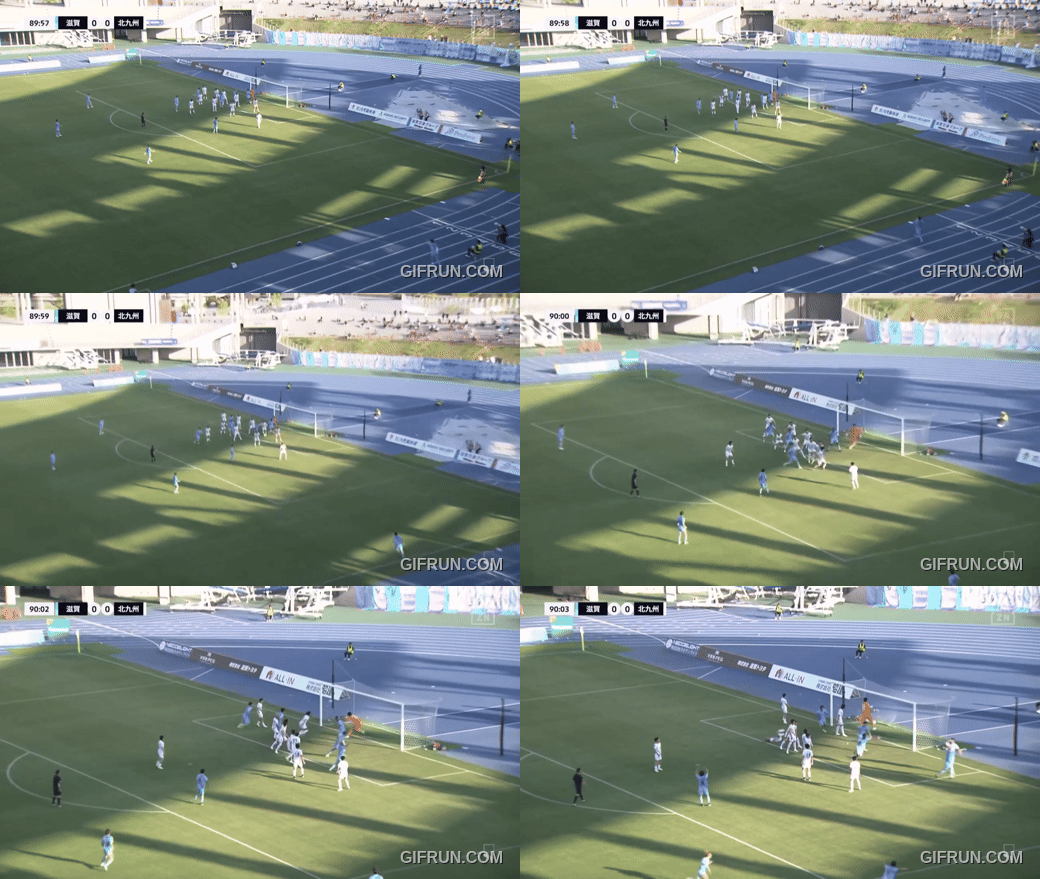
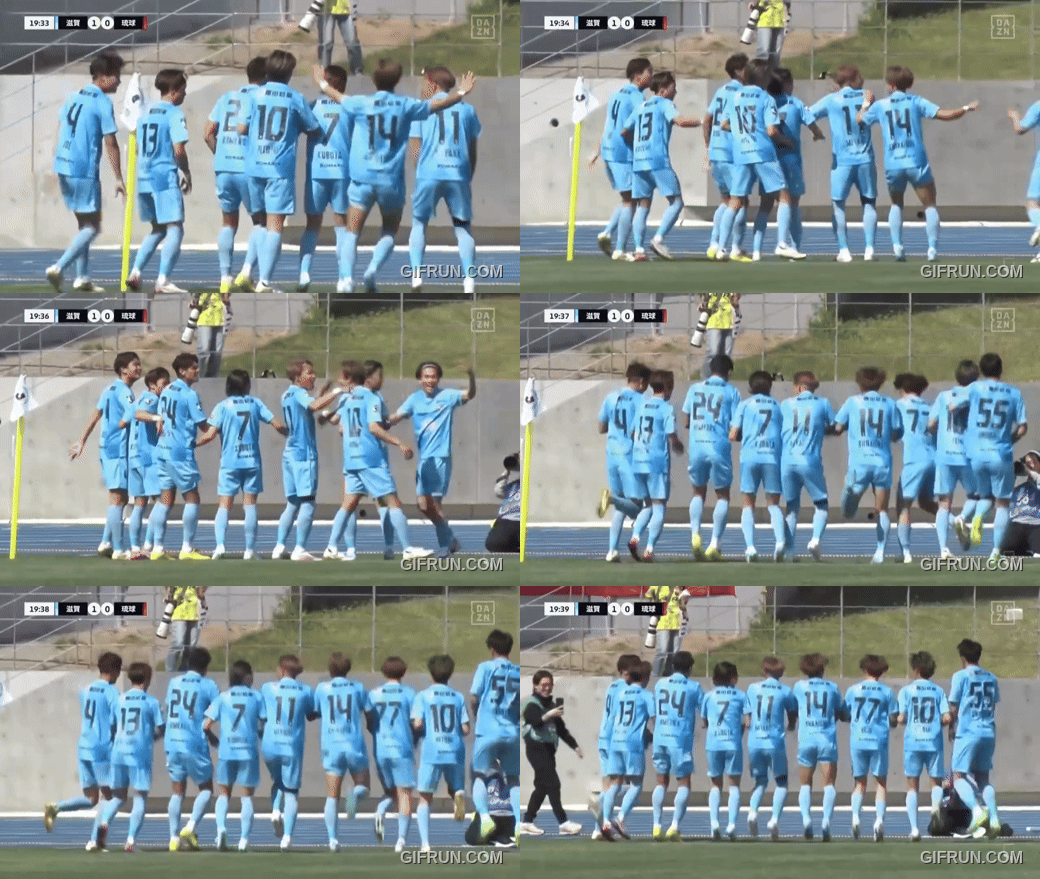
Reilac Shiga have also another major advantage: the calendar switch. With the “100-Year Vision League” tournament, they had both six months of time to settle towards the level of pro-football and see if they were actually up for it. The answer is yes: Reilac won six games out of 18, took 21 points, finishing above FC Ryukyu and Giravanz Kitakyushu. They haven’t shown exactly an exciting brand of football, but when you’re debuting in the pro-world… honestly, who cares?
Looking at the them, I feel they could be up to a season like Kochi United had last year in their J3 debut: a struggling one, but a season in which they can avoid relegation if they do just enough to rack up enough points in the first part of the season. There are 2-3 sides who have shown more worrying signs in the transitional tournament, and the debutants in J3 always tend to avoid the worst given the surprise factor.
If you look at the roster or the manager, there’s no major figure standing out. Makoto Kakuda is the head coach, who took over Reilac Shiga in 2024, and had a strange story. Former J.Leaguer for 19 years, Kakuda coached the team to promotion, but he needed a higher grade (the JFA-A level coaching license) to manage the club in the pro-world. So Haruo Wada (former MIO Biwako Shiga head coach) took temporarily the duties for the 100-Year Vision League, and now Kakuda is back.
Even the squad has some expert J.Leaguers – goalkeeper Masatoshi Kushibiki, defender Masafumi Miyagi and So Fujitani, offensive all-rounder Frank Romero –, but no stand out profiles. Most of the roster arrived once the rebranding was on – so much so that just three players are there since the club was still called “MIO Biwako Shiga”. It’s gonna be a team effort if Reilac Shiga want to keep their place in the professional ladder.