April 26th, 2017. It’s a warm night in Shizuoka. J.League Cup is up for the Yamaha Stadium’s crowd, who’s ready to see Júbilo Iwata facing FC Tokyo. It’s going to be a win for the home side, a nice 3-1 to defeat the opponents. The three goals will all come from the same scorer, a young striker who will score also in the next game against Reysol. He’s just 20, but he seems to have the right skills to lead the attack one day.
That night, when Koki Ogawa scored a hat trick, it seemed the start of something beautiful. Just like 18 months later – when one of his goals will prevent Júbilo from facing relegation –, the striker was left with anticipation of what he would have done in the future. Unfortunately, that horizon never materialized and Ogawa officially closed his Júbilo stint with 21 goals in 102 games, mostly in J2 or in the J.League Cup.
Ogawa needed to leave twice – first on loan and then for good – to actually be himself. It never worked out with Júbilo like it was meant to be, not even after a bright 2019, which saw him debuting with the Japan national football team and fitting wonderfully within Mito HollyHock’s system designed by Shigetoshi Hasebe. He never found the right fit with Iwata, not even in J2.
That’s why his return to Yokohama – the place where he actually comes from – felt so right last Winter. In the end, it turned out to be the best move for the player and a fruitful decision by the club, who can now enjoy a true no. 9 who promises to light up defenses also next year in J1, after a deserved promotion.
No Júbilo in his Soul
In 2016, Ogawa joined Iwata from Tokogakuen High School. He was the real deal since he already debuted as well with the U-19 of Japan, where he scored 7 goals in 15 games. The irony of destiny left him with the no. 18 on his shoulder, the one from another great striker from Júbilo’s history: Ryoichi Maeda. Unfortunately, in four years on the roster of Iwata, he played just 42 games in all matches, scoring six times.
When he came back after a short loan in J2 and with Iwata in shambles after the relegation, we wrote back then how Júbilo should have relied on him to reboot the project. They partially did, but Fernando Jubero was out of the door mid-season and the return of Masakazu Suzuki saw dropping minutes. He never played a full match under the new coach, and contracting Coronavirus at the end of the season made the rest, leaving him at 9 goals in 2020.
Furthermore, Ogawa took on his shoulders another heavy number: the no. 9, which Júbilo fans always associate with Masashi Nakayama, the Golden Boy from the first era of Japanese pro football and one of the best strikers in Japanese history. Nevertheless, Suzuki opted to rely fondly on Lukian, playing speculative football and counting on the Brazilian’s lightning speed and shots to finish matches.
This left Ogawa on the bench for good. He started only the first game, a 1-0 loss in Okinawa against FC Ryukyu. Then he came on 23 times from the bench throughout the whole season: he never started again a match in J2, scoring just once (a decisive goal to win it in Nagasaki against V-Varen). Sure, he scored two braces in Emperor’s Cup against high schoolers and Honda FC, but nothing too fancy.
Signs of Encouragement
But was Suzuki’s choice that wrong? Not for Júbilo, although they’re paying the price by facing a probable relegation back to J2. Meanwhile, Ogawa showed away from Shizuoka the best signs of his talent. He scored 7 goals in 17 matches when Mito took him on loan mid-season in 2019; he debuted with a goal and scored also for the successive matches. He racked up 5 of his 7 goals in his first 8 games.
2019 was a magical year. Ogawa played already with Japan, winning the U-16 AFC title (with a discrete squad, we’d say…) in 2016 and featuring in the 2017 U-20 World Cup. When Hajime Moriyasu had to call the players for the 2019 EAFF E-1 Championship in South Korea, J. League players were mostly considered, although a few university kids were involved (Shunta Tanaka was there before signing for Hokkaido Consadole Sapporo).
Ogawa was called with Kyosuke Tagawa – back then at FC Tokyo, now at Santa Clara in Portugal – and Ayase Ueda – who signed this Summer for Cercle Brugge in Belgium from Kashima Antlers. Despite having two more celebrated teammates, Ogawa found his spot against Hong Kong and scored a hat-trick, granting himself the top-scoring title. After the 2021 season, that time seemed a long time ago.
A Different Shade of Blue
He needed to change. That’s why leaving Shizuoka for good seemed the only option, signing for Yokohama FC. One of the reasons why the club got relegated the year before was the lack of goals upfront: in J1, Kazuma Watanabe and Saulo Mineiro were the best goal scorers with… 4 each. The whole forwards’ department produced 16 goals from six different players, with Sho Ito never scoring at all.
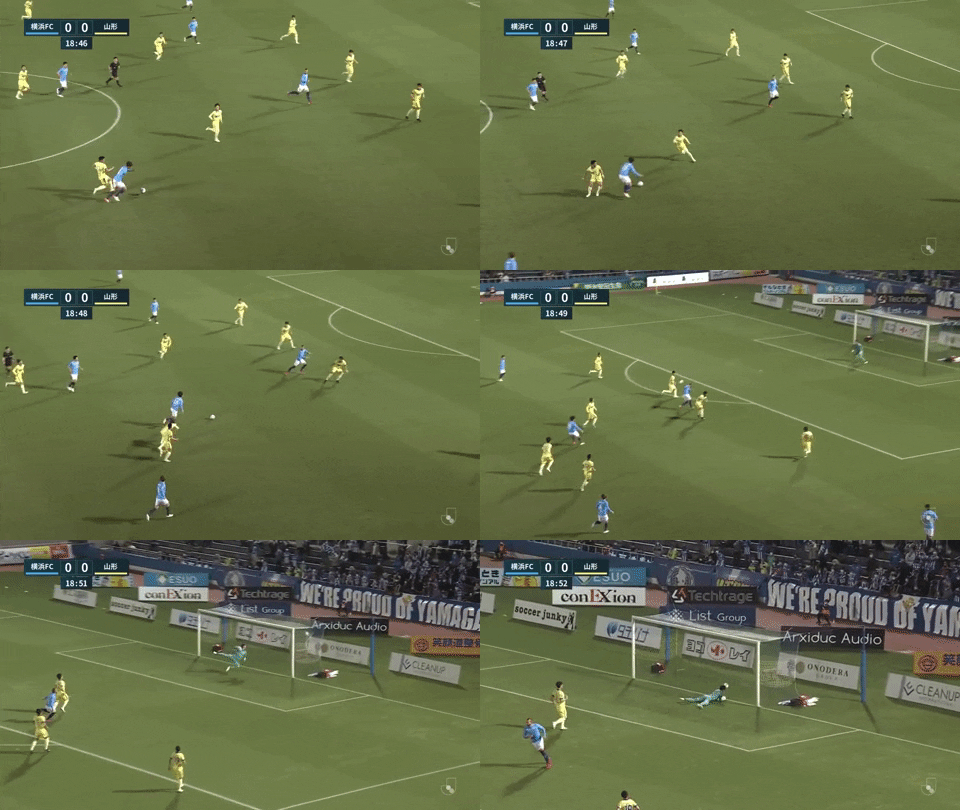
Kléber, Ito and Watanabe stayed. Felipe Vizeu played a handful of matches until mid-season. Saulo Mineiro was there and not. Last Summer, Yokohama FC added also Marcelo Ryan, who had a solid impact. But there wasn’t any doubt that Koki Ogawa was the centerpiece of Yomoda’s renaissance plan: the no. 18 played 41 of the 42 matches from J2 League, scoring 26 times (with seven braces, the last yesterday against Roasso).
Twice J2 monthly MVP, Ogawa found his spot within Yomoda’s 3-4-2-1, which suited him in the end. 26 goals are five more than the ones Ogawa scored in his whole period at Júbilo. From the 19 games when Ogawa scored at least one goal, Yokohama FC got 46 points: it’s an average of 2.42 PPG. The kind of rhythm that usually grants you a direct promotion without sweating.
With his 26 goals, Ogawa became the top-scorer of this year’s J2 League with a 10-goals advantage over the runner-up, Fagiano’s Tiago Alves. Out of these 26 goals, only one came from a penalty – the winning goal against FC Ryukyu. Among the top scorers from 2012 (the year when J2 reached 22 teams), only Leonardo with Albirex Niigata in 2019 (28) and Davi in 2012 with Ventforet Kofu (29) scored more goals than him in one season.
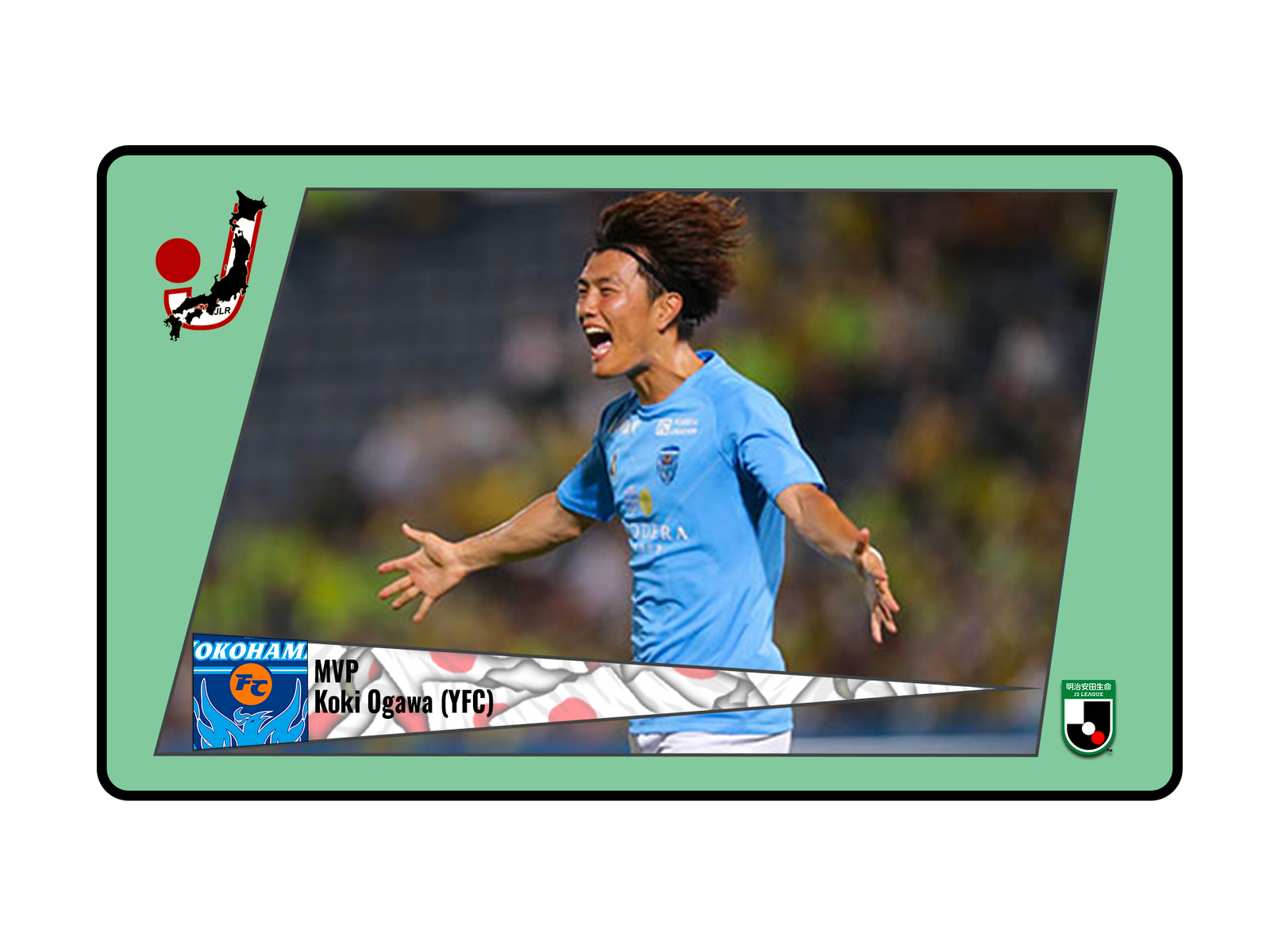
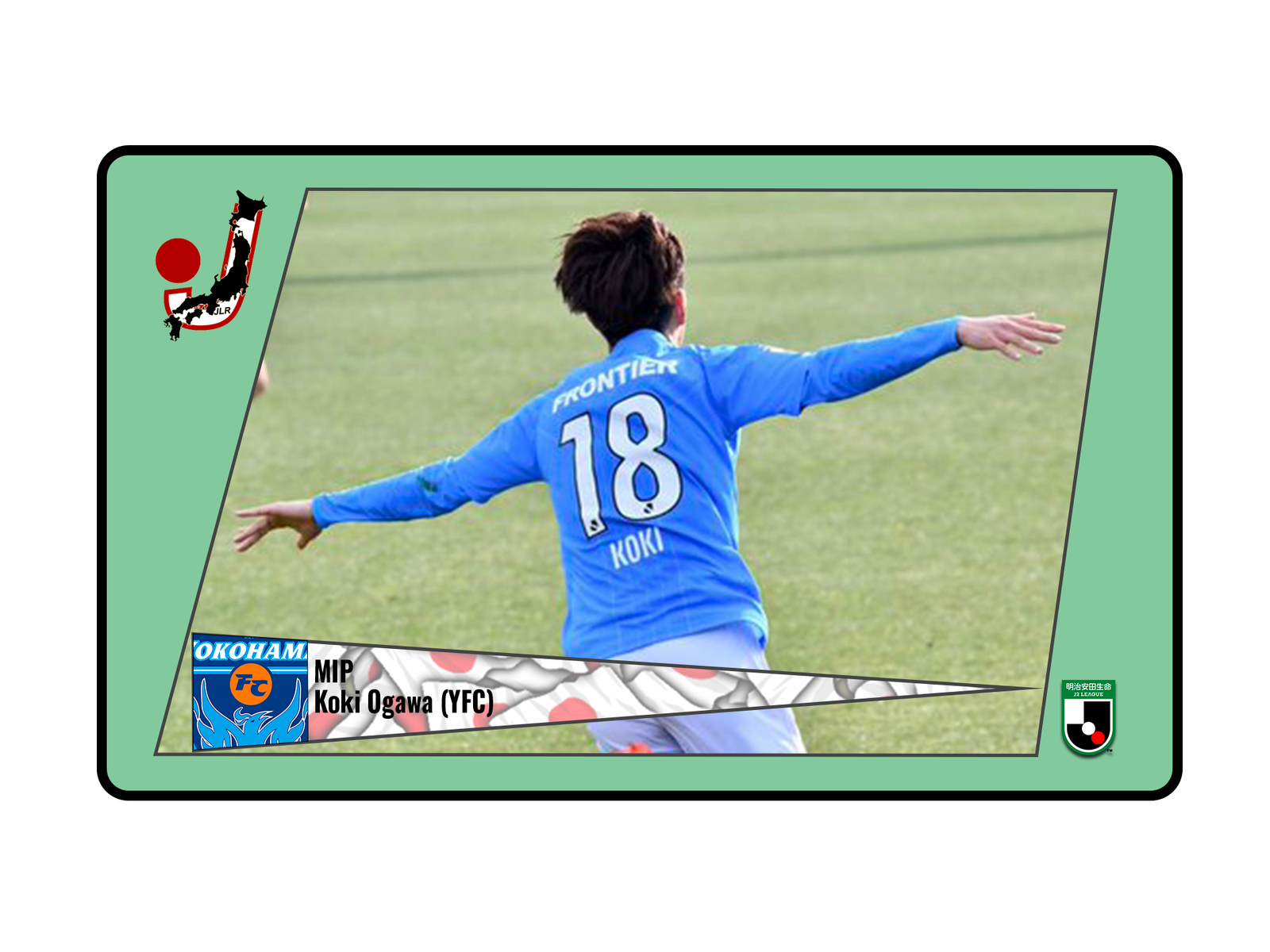
There’s a reason why the readers of J. League Regista awarded him both MVP and MIP for this season. And that’s a good one, for sure. Hopefully, he’ll light up defenses as well in J1 and will find a spot within the national team from the next cycle.


[…] glory. Which was predictable, since Koki Ogawa was a real factor in Yokohama FC’s return to J1. Here we wrote about his importance within Yomoda’s system this […]
[…] – is the main name, but others debuted with him (Hiroki Ito, Seiya Nakano, Daigo Araki, Koki Ogawa, […]
[…] is confirming that his development is proceeding steadily. Koki Ogawa was almost forgotten, and now he’s actually a option in J1. Shuto Machino keeps ninja-ing his way towards Europe with Shonan Bellmare after making the cut for […]
[…] Ayase Ueda has to find proper pitch time at Feyenoord, but he scored eight goals in the qualifiers. To support that, Koki Ogawa scored six, and he’ll probably move on from NEC Nijmegen after two solid seasons. To […]