December 6th, 2010 – it’s a cold night in Tokyo. The championship is over, and the J.League has embraced a maiden team winning the whole thing: Nagoya Grampus. They dominated the championship, clinching the title with some games to go. It was the credit of the team, the supporters, head coach Dragan Stojkovic, and some historical figures. But there’s one man above everyone else.
The MVP is usually awarded to someone who features for the team that won the J1, and 2010 made no exception, except for one thing: it was the first time that a goalkeeper received this accolade. And that keeper was Seigo Narazaki, a man who wrote several pages of history (more in the J.League than with the national team, to be fair), and became the all-time leader for games played in J1 (until Yasuhito Endo overcame him).
That year, Narazaki played an impressive season, but the award felt mostly a “career-related” achievement. Narazaki began his pro-career in 1995 with the dissolved Yokohama Flügels, then switched to the Nagoya Grampus Eight, and stayed loyal to the team despite their struggles to win the whole thing. Furthermore, Narazaki had just closed his national team career with four World Cup appearances, although he was the no. 1 only in the 2002 edition.
It seemed a fluke, a way to homage the player rather than the role… until 2025. J.League have awarded the MVP to a keeper, but this time we’re talking about a young, rising no. 1, who made his team capable of winning the J1 title, and he’s a fierce successor of Hitoshi Sogahata, who could be described as “Mr. Antlers” himself. That young man is Tomoki Hayakawa, who won the “Best Goalkeeper” award in our polls with the entirety of the votes.
Regret for Kanagawa
Born in Sagamihara in March 1999, Hayakawa could have been a hope for the Kanagawa Prefecture in general. In fact, the young keeper moved his first steps with Yokohama F. Marinos, playing for them until high school. Then Marinos took another direction, and they let Hayakawa go, but he didn’t surrender, enrolling on the Kiriin Gakuen High School. It’s incredible to think about who Marinos could have between the posts by now.
Things went well in high school, so Hayakawa decided to enrol at Meiji University. A prestigious university where he also found several future J.Leaguers as part of that team – for example, future teammate Keigo Tsunemoto, striker Ryuga Sato, forward Tsuyoshi Ogashiwa, defender Yota Sato, and many more. Hayakawa stayed there for the canonical four years, but in 2020, he was already announced to have joined a pro team.
That club was Kashima Antlers, who announced Hayakawa as part of the team from the 2021 season onwards. It was a rough ride to live and breathe football in Ibaraki at that time: Kashima just missed the AFC Champions League, and they had to sit back and watch Kawasaki Frontale, Yokohama F. Marinos, and then Vissel Kobe taking the league by storm. Furthermore, the keeper situation was somewhat chaotic at the time.
Hitoshi Sogahata just retired, but Kwoun Sun-tae was the established no. 1, given the experience and the trophies won by the South Korean goalkeeper. Furthermore, young Yuya Oki had a breakout season in 2021 under head coach Antonio Carlos Zago, and hoped to become the next guardian. Hayakawa then had a small entrance in 2022 with just five caps, but his future at the clubs was about to change with the retirement of Kwoun Sun-tae.
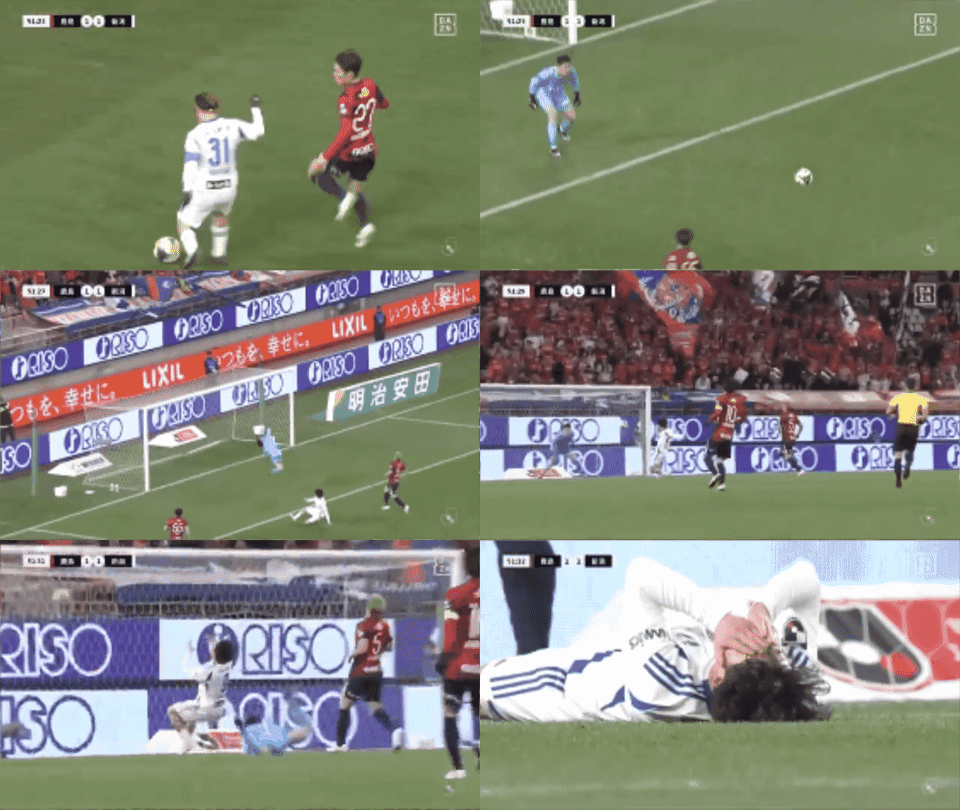
The Breakout
Things changed when Antlers let Zago go and, after an intermission by Naoki Soma and the Swiss René Weiler, the club hired former club legend Daiki Iwamasa in August 2022. With a full season ahead, Iwamasa decided to put Hayakawa between the posts and use what I call the “deer mentality” – there’s a way of seeing football within Antlers that’s not comparable to other clubs, due to their winning culture, the grit-and-grind mentality, and the overview of a historical figure like Zico.
Iwamasa didn’t survive the 2023 season, and then Ranko Popovic took over, but this didn’t change Hayakawa’s destiny. Actually, the young goalkeeper took over the no. 1 left by Kwoun Sun-tae. Hayakawa improved season by season: 34 games played and 34 goals conceded with just 15 clean sheets. Then 38 games and 41 goals conceded with 15 clean sheets in 2024. It wasn’t an improvement because the defence didn’t support his growth.
Furthermore, what was impressive was (and is) that Hayakawa played all minutes from the 2023 and 2024 seasons. And it was like that only in 2025 – basically, he’s one of the two players who featured all league minutes in the last three seasons. And can you guess the other one? Naomichi Ueda, Antlers captain and defensive anchor. Kashima built an iron-made alliance for their spinal cord within the pitch.
Hayakawa has been playing all league games non-stop since September 16th, 2022 – the first time Iwamasa put him on the pitch as the starting keeper for Kashima. That’s a streak of 115 league games in which the no. 1 has defended the posts of Kashima Antlers.
From Ibaraki to the World
2025 set new heights for Hayakawa. We’ve already mentioned the fact that he played each minute of this season, but there’s more. Indeed, Ryosuke Kojima (Kashiwa Reysol) and Matheus Vidotto (Tokyo Verdy) had more clean sheets, both in absolute terms and by percentage of games played. Nonetheless, there was more to the eye about the saves that Hayakawa made – so flamboyant and fundamental you couldn’t overlook them (he had 107 saves, more than any keeper in the league).
Antlers had the second-best defence of the whole league (only behind Sanfrecce Hiroshima), and Hayakawa won the “Best Save Award” four times this season, plus a monthly MVP last October. It’s a lot for a keeper, and Hayakawa knows it very well: “I’m happy to receive this award. It’s the second time that a keeper wins this award – and that’s a good spot for the goalkeeping position. I wouldn’t have done it without my teammates and winning the J1 title.”
In fact, if this award for Narazaki was a legacy award, for Hayakawa, it might just be the beginning. He finally debuted with the national team in July, winning the 2025 EAFF E-1 Championship, and playing both games in November (all three games were clean sheets). And sure, Zion Suzuki and Keisuke Osako are shoe-ins for the FIFA World Cup next Summer, but the last spot as a keeper is very much on the line, and Hayakawa could be good competition for Brandon Taishi Nozawa, Leo Kokubo, and many others.
In the end, the Antlers’ mentality reminds a lot of a deer, an animal which tends not to abandon its youngsters. And Antlers did the same in these years – it was very touching to see Yuma Suzuki, Naomichi Ueda, and Kento Misao all hugging at the end, crying for the title, or Gaku Shibasaki holding speeches after the title. Whether Hayakawa will become an Antlers legend or if he’s ready for a rising future in Europe, time will tell – for now, the “deer mentality” prevailed again.
[…] Same here: I don’t remember someone winning a category with 100% of votes, and Hayakawa became the second goalkeeper to win an MVP from the J.League Awards after Seigo Narazaki in 2010. This prompted a special article also about the no. 1 of Kashima Antlers, which you can read here. […]