I always loved certain stories in Japanese football. There’s one category that particularly fascinates me: the ones over players who made from the amateur sides to the top flight. I think we touched those a couple of times on these pages – like Ryuta Koike making it from a part-time job in Yamaguchi to be called up for the national team, or Noriaki Fujimoto becoming a cult hero in Oita after almost quitting when they disbanded the club he was playing for.
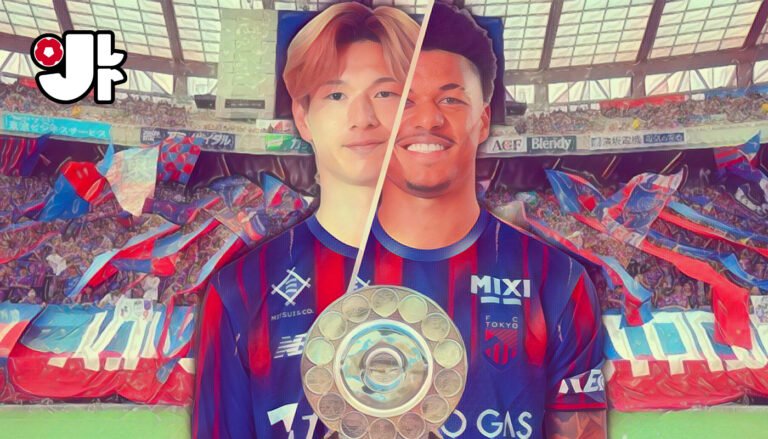
There’s another story popping up these days in J1. It’s one about a striker who made his debut in the top tier at 27 years old, with one of the giants of Japanese football, Yokohama F. Marinos, in a dreadful season where everything was going wrong. 12 months later, he’s the symbol of that partial renaissance, which could be the recap of the player’s own experience. A player who wasn’t even a striker when he went pro.
When he actually joined Iwaki FC in 2020, he was even overweight. His fitness was a problem, especially for a club which pushed aggressive pressing as a football brand. His minutes were shaky, and the thought of the club not renewing his contract worried him for his future as a player. So the protagonist of this story decide to change his diet, especially after harsh conversations with both the club’s president and head coach.
Yuzo Tamura, who coached the player in two different stints at Iwaki, said: “Even then, I knew he wouldn’t give up and would continue to work hard behind the scenes. He would run every night to reduce his body fat, and he was the player who paid the most attention to nutrition. I cherish all six years we spent together.” That player is Kaina Tanimura, who has been torching J1 defences since he joined Yokohama F. Marinos last year.
Starting in the shadows
Born in one of the toughest Prefectures to start in football (Iwate) in 1998, Tanimura wasn’t exactly a thriving prospect at a younger age. In four years at Kokushikan University, he put together just six goals out of 35 games. His profile wasn’t exactly screaming “goal scorer”, and in fact in high school he changed his position from striker to defensive midfielder. Anyhow, no J.League teams came forward for him… not the ones at the time, at least.
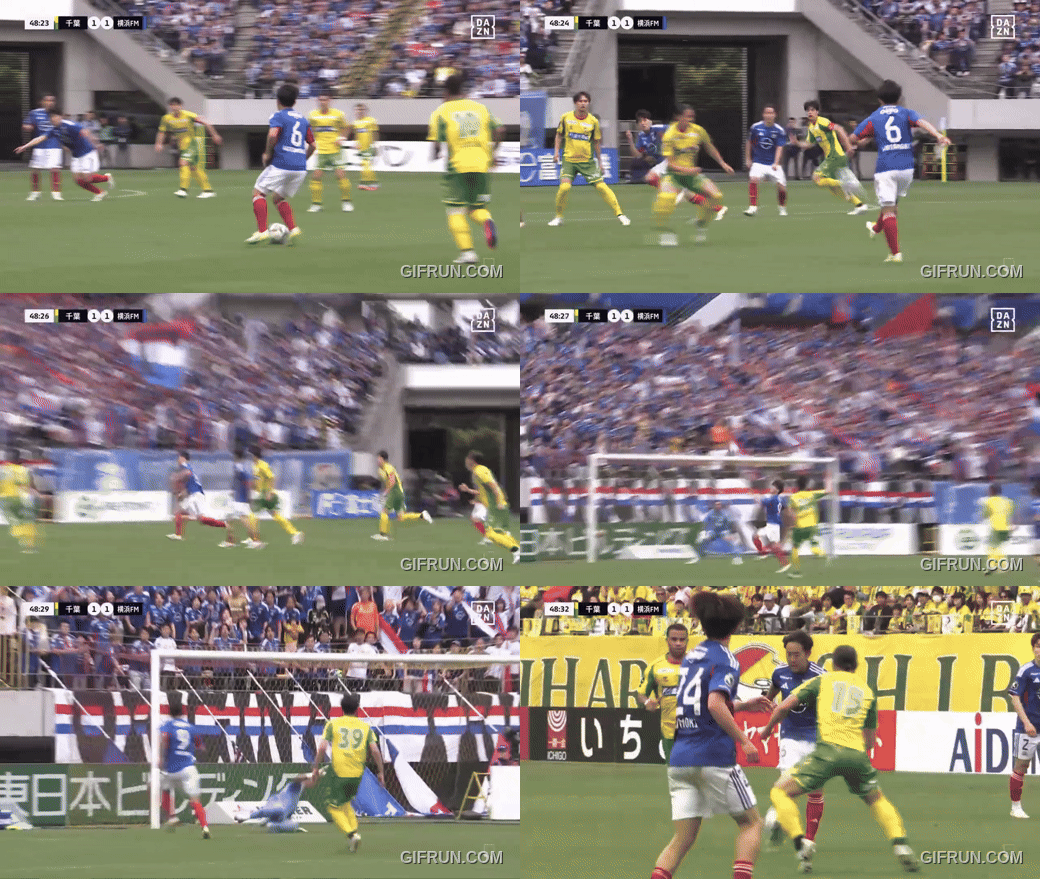
Actually, the one club to offer him a contract was Iwaki FC. Today we know about their rise, and they were ambitious as well six years ago, but they were no pro-club. And the club itself asked him to switch back his position to striker. And in fact, despite Iwaki FC being at the time in the Japan Football League, the first two seasons by Tanimura were not exactly thriving: 30 league games (only seven in his rookie year), seven goals.
When Iwaki FC got promoted to the pro-world and they were ready for the 2022 season to play in the J3 League, that’s where Tanimura started having a first step. 29 league games in 2022, although just three starts, because Iwaki had already an answer upfront in Ryo Arita, whose career has definitely taken a nosedive after that year. And even when Iwaki won the J3 straight away at their first try, things didn’t change that much in J2.
Sure, Tanimura began the season as a starter alongside Arita, even scoring back-to-back in their first two outings in the second tier. But minutes decreased throughout the year, with the forward going back to the bench, with players like Hiroto Iwabuchi gaining pitch time. Luckily for Tanimura, the 2024 pre-season was a key one: he got the no. 10, both Iwabuchi and Arita left for rival clubs in J2, and now Iwaki had to invest fully in his profile with a new head coach, Yuzo Tamura.
Rushing up the ladder
Being closer to the goal and the lone leader upfront made their difference: Tanimura played all 38 matches in J2 in 2024, and brought home 18 goals (including three braces) and six assists, plus a spot in the J2 “Best Eleven”. He slowed a bit after the Summer, but he ended the season as a runner-up in the scoring table, just behind Hiiro Komori and tied with Matheus Jesus for goals. It was just an appetizer of what would have come next.
Yes, because even if 2025 didn’t have the same pace – he scored eight goals in the first 22 league matches, and he needed to wait seven games to find his first goal –, someone took notice. Several J1 clubs were looking at Tanimura, but it was the most desperate one to make the move: Yokohama F. Marinos were basically on the verge of relegation, and decided to shuffle their cards to avoid an incredible and treacherous drop from J1.
In fact, Marinos let go many protagonists in that Summer: Anderson Lopes to Singapore, Elber to Kashima Antlers, and Yan Matheus to Qatar, plus Katsuya Nagato to Vissel Kobe. They definitely some new faces, and Tanimura was the unexpected hero of that season. The striker took the no. 9 and scored in his maiden appearance, in front of his fans, for a 3-0 win against Nagoya Grampus. A very much needed one, since Marinos were last in the table.
From there, Tanimura scored five more goals, all to grant wins, and a stretch of four successive ones between October and November kept Marinos out of troubles. What could have been seen as a fluke didn’t stop there: in the 100-Year Vision League, Tanimura scored 10 goals in 19 matches, giving him a tied top-scoring title with Leo Cearà and Yuya Yamagishi. Someone might argue that he scored most of his goals against bottom-table teams, but… does it really matter?
A ticket to Saudi Arabia?
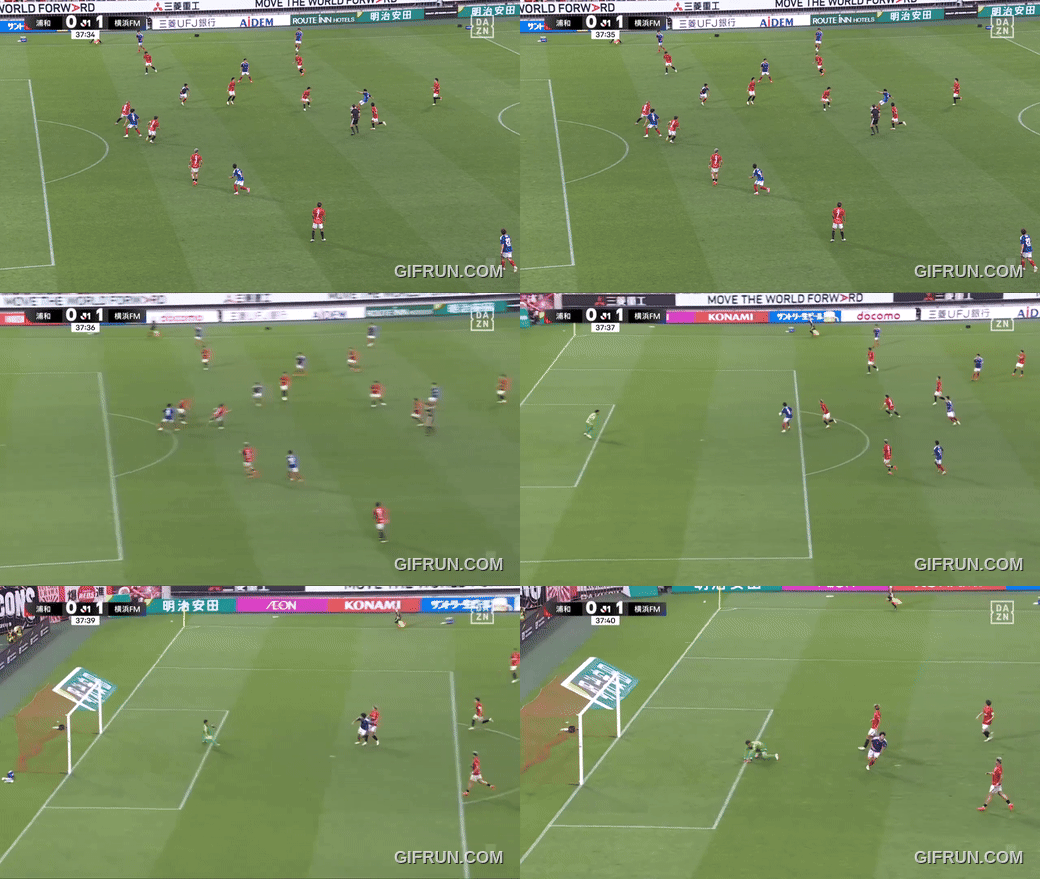
In fact, Tanimura kept his pace also at the start of this 2026-27 season. A brace in the opening match against Kashima Antlers, another one in Saitama against Urawa Reds, and one more goal to grant a point at home against Kyoto Sanga. He’s up already to 21 goals in 41 games with Marinos, a 0.51 goal-per-game ratio that puts him ninth all-time (we’re almost on pace with Anderson Lopes and Shoji Jo, to make a comparison).
All of this happened despite Marinos have been a trainwreck since Kevin Muscat left, and continuously changed both manager and personnel to find a way out from their mess. The first signs of Steve Corica’s reign are encouraging, including the trust put in the youngsters, but even they need a more expert player reigning in and helping them grow. At the age of 29, Tanimura can be exactly that, given how he went from being a reserve in the JFL to a starter in J1.
And who knows… could it be that Tanimura will take a spot in Japan’s squad for the 2027 AFC Asian Cup? I would argue that’s not impossible. First of all, since their growth as a football movement and with the AFC Asian Cup being played almost always six months after the FIFA World Cup, Japan always tended to bring some experimental players from the J.League in the last decade: Yohei Toyoda and Yu Kobayashi made it to the 2015 squad, Koya Kitagawa in 2019, Mao Hosoya in 2023.
Furthermore, the current strikers for the national team might be looking for a season to be focused around their new situations. I don’t think we’ll see Ayase Ueda in Saudi Arabia, given his new Lille adventure. And I’d argue that even Keisuke Goto might need all the time in the world at Freiburg. So… Koki Ogawa, sure. And? Kento Shiogai? It’s not working at Wolfsburg. What about if Tanimura could be actually a possible option? It wouldn’t be the first time for him as a dark horse.